
The world runs on rock · Current events
The Town Kiruna, the town that moves for its mine
In the far north of Sweden, a town of red wooden houses sits next to the world's largest underground iron ore mine. The ore runs under the town, so the town is moving: house by house, street by street, three kilometres east. In August 2025 it moved its church, whole, on wheels.
Scroll to cut the ground open
145 km north of the Arctic Circle
A town built for an ore hill
For centuries the Sámi knew there was iron in the hills of Kiirunavaara and Luossavaara. Mining began in 1898, the railway arrived in 1899, and on 27 April 1900 the town of Kiruna was laid out on the next hill along, for the miners of LKAB.6,5
Its church, finished in 1912 and paid for by the mining company, became one of Sweden's best-loved buildings.8
Cut open
A sheet of iron, tilted under the town
The ore body is a slab of magnetite about 4 km long and 80 to 120 m thick. It dips at about 60 degrees to the east, so the deeper it goes, the further it reaches under the town, and it continues down to at least 1,500 m.5
LKAB says the ore "continues to extend eastward under the old town, but also northward, where it remains open at depth – in other words, we don't see the end of it yet."3
Fe₃O₄ magnetiteapatite (P)rare earths
Going deeper
775 m, 1,045 m, 1,365 m
Until 1999 the deepest level of the mine was at 775 m. Then it went to 1,045 m, and in 2008 LKAB decided to go down to a new main haulage level at 1,365 m, which is where it mines today.5,1
That decision is what moved the town. In 2004 LKAB told Kiruna's leaders that mining toward the new level meant the town centre would have to move.1
Sublevel caving
Take the ore, let the roof fall
Since the 1960s the mine has used sublevel caving: the ore is blasted level by level from the top down, and the rock above it, the hanging wall, is left to break and fall into the space.5 It is efficient at this scale, and it means the ground over the ore sinks and cracks.
In 2018 the mine produced 26.9 million tonnes of ore. Over more than a century it has given up over 950 million tonnes.5
The line moves east
A forecast you can draw on a map
LKAB forecasts where the ground will deform from the shape of the ore, its mining plans and measurements, and drill cores from the rock around it. As mining has gone deeper, the line has been redrawn and the area inside it has grown.3
"Even if we stopped the mine today, the deformations would continue for many years," says LKAB's Stefan Hämäläinen.3
Pull down, or pick up
A new centre 3 km east
In 2010 the council chose to move the centre east, toward Tuolluvaara. Work started in 2014.6 The new town hall, Kristallen, was the first building, finished in 2018; the new centre's shopping streets and its Aurora culture house opened on 1 to 3 September 2022.7
Most old buildings are demolished. The most valued are moved whole, and LKAB says more, such as the parish hall, are still to go.2


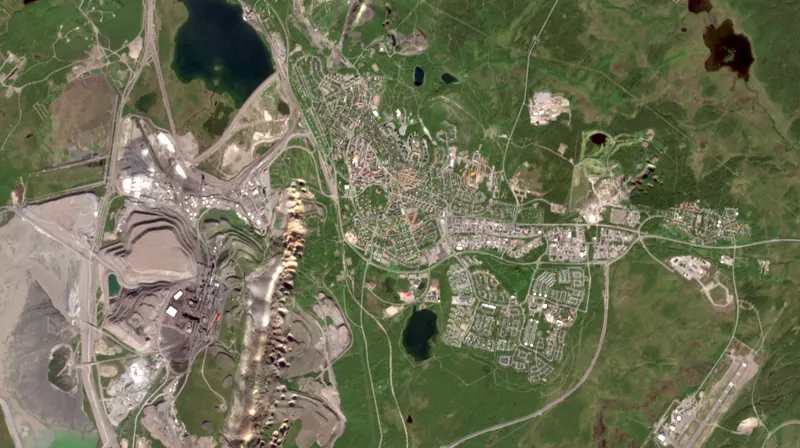


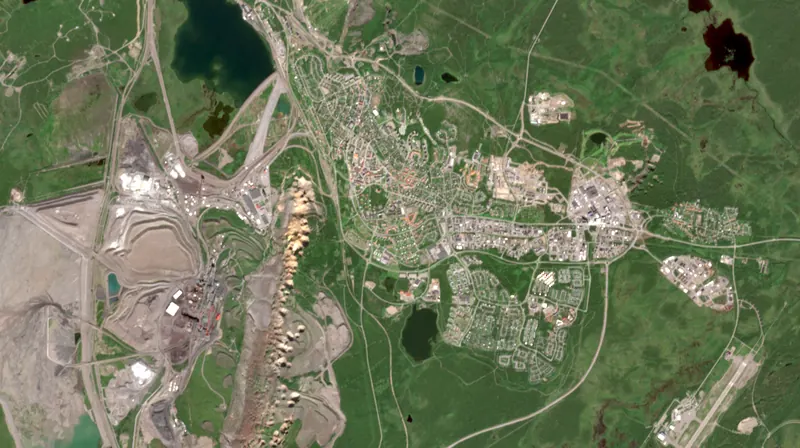
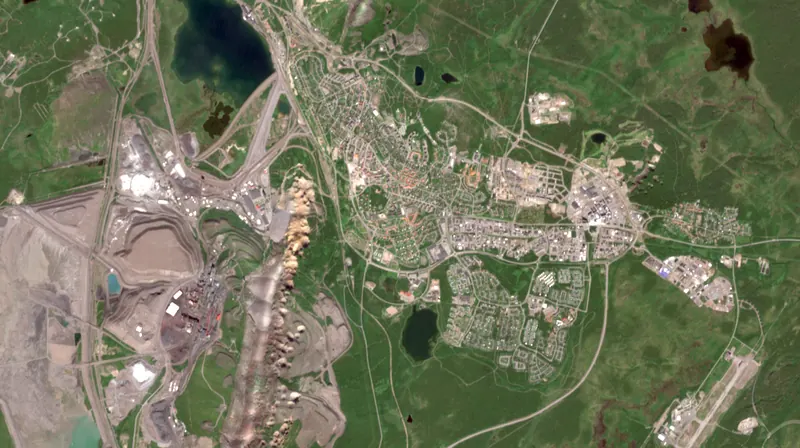
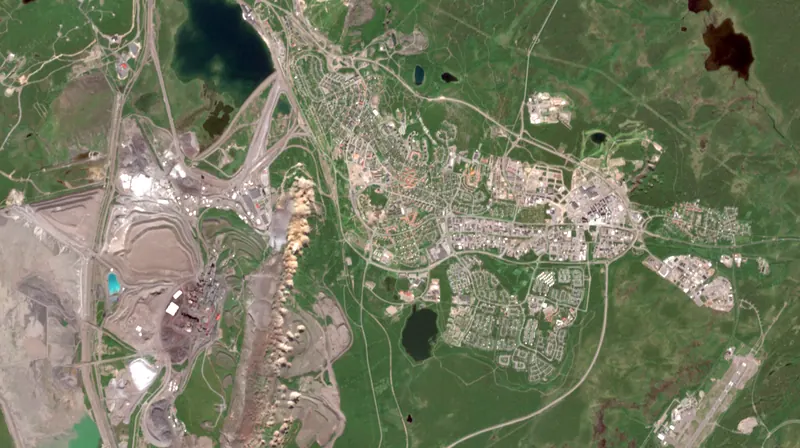

1990 to 2002
One town on one hill
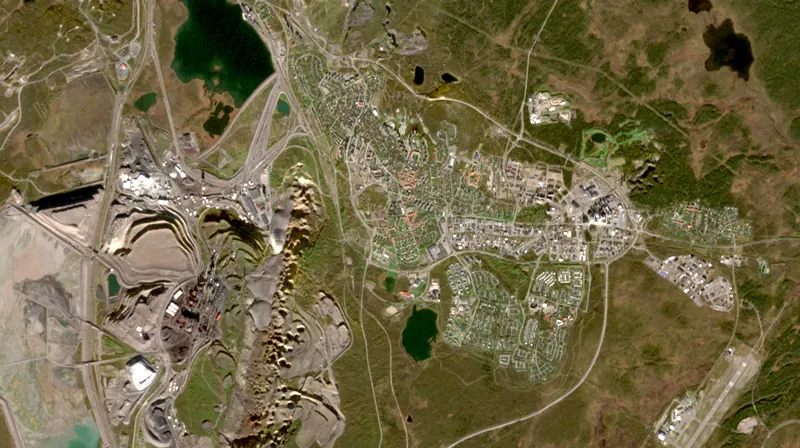
The mine on the left, the town on its hill in the middle. Until 1999 the deepest level was 775 m; then LKAB went to 1,045 m.5
2004 to 2015
The town is told
In 2004 LKAB told Kiruna its centre would have to move. In 2010 the council chose east; the move began in 2014.1,6 These are 30 m and then 10 m pixels, so streets blur and blocks show.
2018 to 2020
A centre on bare ground
Watch the patch east of the old town fill in. The new town hall, Kristallen, was the first building, finished in 2018.7
2022 to 2025
The new centre opens
Shops, a culture house and homes opened in the new centre on 1 to 3 September 2022.7 Meanwhile the old blocks nearest the mine are emptied and cleared.
August 2025
The church goes east
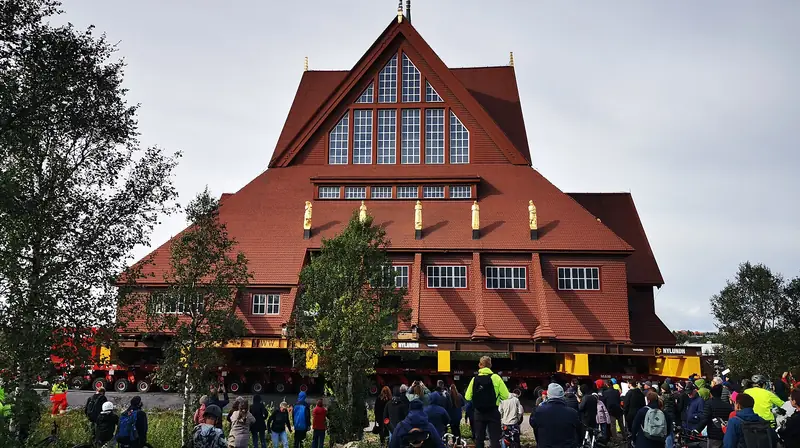
On 19 and 20 August 2025 the church was rolled 5 km to its new site between the cemetery and the new centre.2 Autumn: the birches have turned.
September 2026
And the line moves again
LKAB's August 2025 forecast puts about 2,700 more homes and 6,000 more people inside the zone.3 The town is still moving.
19 to 20 August 2025
The church on wheels
Kiruna Church weighs 672.4 tonnes and is 40 m wide. LKAB moved it in one piece over two days, along a 5 km route prepared for it, to a new site between the cemetery and the new centre. It was turned 180 degrees on the way, so its altar now faces west, toward the town.2
Thousands gathered along the route. The church is due to reopen at the end of 2026.2,8


Why move it whole
672 tonnes, at walking pace
Taking the church apart would have risked its cultural value and taken longer, LKAB says, so it went in one piece; the belfry went with it.1 Photos: TorbjørnS on Wikimedia Commons, CC BY 4.0, cropped.
Before and after
Drag across 24 years
 11 Aug 200222 Sep 2026
The red overlay marks ground where vegetation gave way to buildings, roads or bare earth between summer 2015 and summer 2025, from Sentinel-2 near-infrared. It is a rough 10 m guide, not a survey: it picks up the new centre to the east and the new roads, and some changes at the mine.
1 · Europe's iron
Sweden is a small iron ore producer by world standards, about 1.1% of mined iron ore, next to Australia's 38%. But in Europe it is almost everything: LKAB says it produced 86% of all the iron ore mined in the EU in 2025, and that Kiruna and Gällivare are the world's largest underground iron ore mines.4,9
2 · Out by rail
The ore is crushed, concentrated and made into pellets and fines, then carried on the Iron Ore Line to the ports of Luleå on the Baltic and Narvik in Norway, whose ice-free harbour ships all year.9 LKAB delivered about 26 million tonnes of iron ore products in 2025.4
3 · Rare earths next door
In January 2023 LKAB said the Per Geijer deposit, next to the Kiruna mine, held more than a million tonnes of rare-earth oxides, the largest known in Europe; by June it raised the figure to over 1.3 million.10 Its 2025 report puts its rare earths across Kiruna, Gällivare and Per Geijer at about 3.1 million tonnes in situ. China mines 69% of the world's rare earths.9
The EU named Per Geijer a Strategic Project in 2025. Mining it, and going below 1,365 m, still needs permits.9
4 · The neighbours
Listed explorers are drilling across the same orefield and further south: Talga's Vittangi graphite about 50 km east of Kiruna, Basin Energy's uranium projects, Kendrick, Beowulf and others. Their published drill results are on our globe.
And it goes on
Another 6,000 people
In August 2025 LKAB redrew the line again. Mining at the current main level will affect about 2,700 more homes and 6,000 more people, to be compensated over the next ten years at an estimated SEK 22.5 billion.3 The cost of the move was the main reason LKAB's operating profit fell from SEK 8.7 billion to 3.3 billion in 2025.4 In 2026 the town, short of about SEK 1.8 billion for the next stage, agreed a new deal in which LKAB puts in about SEK 1.1 billion.11
"Fundamentally it is positive that we have so much ore," says LKAB's chief executive, Jan Moström.3 We take no side here: these are the facts as published.
Go inside the mine: A day in the life of a mine follows 24 hours at Kiirunavaara, from the nightly blast to the ore train to Narvik.
More current events: The Ice, The Deep, SpaceX and The Drone War. Or go back to all the stories.
Sources
Shares of world output are from USGS Mineral Commodity Summaries 2026 via our minerals data; other figures are cited where they appear. The 3D scene is a schematic illustration, about 1 unit to 500 m, not to scale in detail and not LKAB's model. Satellite images: contains modified Copernicus Sentinel data 2015–2026, processed by Prospector Trails; Landsat 5, 7 and 8 images courtesy of the U.S. Geological Survey; both read from Microsoft Planetary Computer, true colour, 10 m (Sentinel-2) and 30 m (Landsat) pixels, cropped to one grid. Church photos: TorbjørnS, Wikimedia Commons, CC BY 4.0, cropped.
- LKAB: The moving of Kiruna Church (why it moved, the 1,365 m level, the 2004 notice)
- LKAB: Kiruna Church has found a new home (20 August 2025)
- LKAB: Continued mining affects more of Kiruna (29 August 2025)
- LKAB: Year-end report 2025 (10 February 2026)
- Kiruna mine (Wikipedia, with its sources): the ore body, levels, mining method, output
- Kiruna (Wikipedia, with its sources): founding, the 2010 decision, the start of the move
- Kiruna kommun: Om nya Kiruna (Kristallen, the new centre's opening)
- Smithsonian Magazine: To save this historic church, workers loaded it onto trailers (August 2025)
- LKAB In Brief: Annual and Sustainability Report 2025 (EU share, the mines, rail and ports, rare earths, permits)
- Engineering News: LKAB expands Europe's biggest rare earths deposit (June 2023)
- Mining & Metal News: LKAB takes bigger role in Kiruna relocation project (July 2026, citing SVT and Yle)
- Copernicus Sentinel-2 and USGS Landsat Collection 2 imagery, via Microsoft Planetary Computer
Keep exploring
Read next


All mining storiesThe world runs on rockAll mineralsMining by country
Cover photos from Wikimedia Commons: Conveyors, rail and ports by Kabelleger / David Gubler, CC BY-SA 4.0. Pictures: Kirunavaara gruva, Kiruna., Fotograf okänd, / Europeana (Public Domain Mark 1.0).