The Bessemer process: steel for everyone
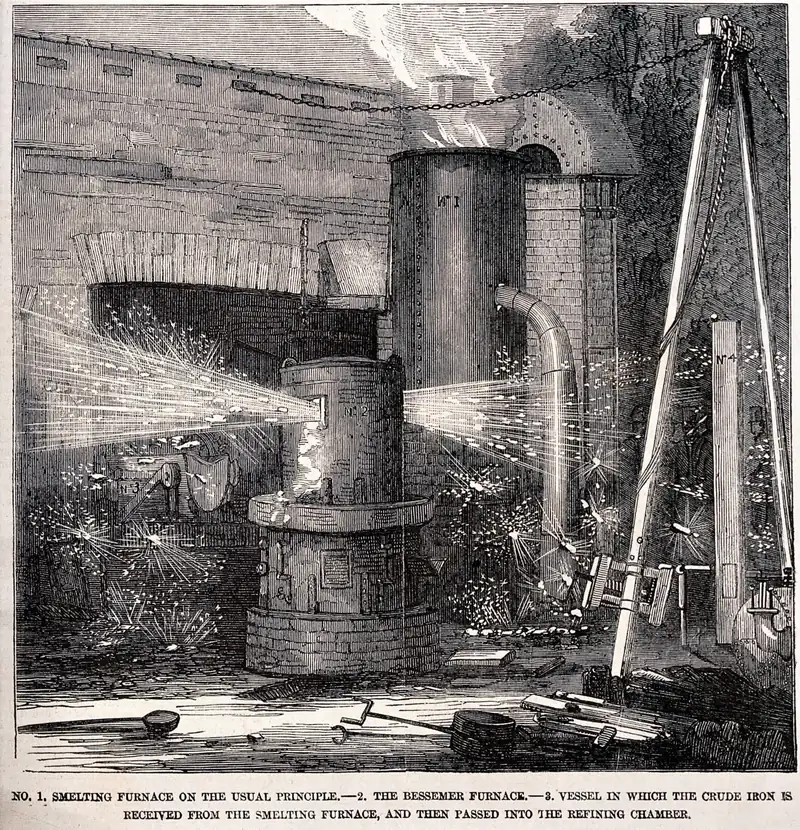
Engineering: the Bessemer smelting furnace installed at Baxter House, St Pancras Road, London. Wood engraving, 1856., Unknown (Wellcome Collection) (Public Domain Mark 1.0)
People have worked iron for a very long time. The first iron objects came from the sky: pieces found in Egypt from about 3500 BC hold about 7.5 per cent nickel, the mark of a meteorite. The Hittites of Asia Minor were the first to smelt iron from ore, around 1500 BC.6
For thousands of years after that, steel stayed scarce. Iron was easy to make in a rough form, but turning it into strong, springy steel was slow and costly. In 1856 an English inventor named Henry Bessemer read a paper at the Cheltenham meeting of the British Association. Its title promised steel "without fuel".1,5
On the Manufacture of Iron and Steel without Fuel
The idea was simple. Bessemer's converter blew air through molten iron. The oxygen burned out carbon and other impurities, and the burning itself kept the metal hot. His experiments drew wide attention.1
The first years went badly. Early licensees could not make good steel with the process, and it was nearly written off. Bessemer answered by building his own works at Sheffield in 1859, where he showed why the others had failed. The Sheffield works became profitable about ten years after it opened. He was knighted in 1879.1
Cheap steel changed what iron ore was worth. Rails, ships, bridges and later cars all needed it. By 1904, United States Geological Survey records show the world mining 95.5 Mt of iron ore a year. The 2025 estimate is 2,600 Mt of usable ore, more than 27 times as much.2,3
95.5 Mt
World iron ore mined in 1904 (USGS)2
Steel also needed coal, and lots of it. As we saw in chapter 7, British coal output peaked at 292 Mt in 1913. Much of the iron ore to go with it had to come from abroad.7

The panorama shows the Krupp works at Essen in Germany, one of the steel plants that grew up to use the new methods.
Iron had made fortunes before, of course. In Russia, Nikita Demidov began as a serf blacksmith, made his money making weapons and set up an iron foundry for the state. Peter the Great made him a noble in 1720. His son Akinfiy found and worked gold, silver and copper mines on top of the family iron business.4
The richest iron ore in Europe lay in the far north of Sweden, above the Arctic Circle. On 18 December 1890 Luossavaara-Kiirunavaara AB, known as LKAB, was founded on the initiative of Robert Schough, who had claimed deposits at Kiruna. Hjalmar Lundbohm became its first managing director.8
LKAB built the mines, and it built a model town for the miners to live in. That town was Kiruna, the town that moved for the iron underneath.8
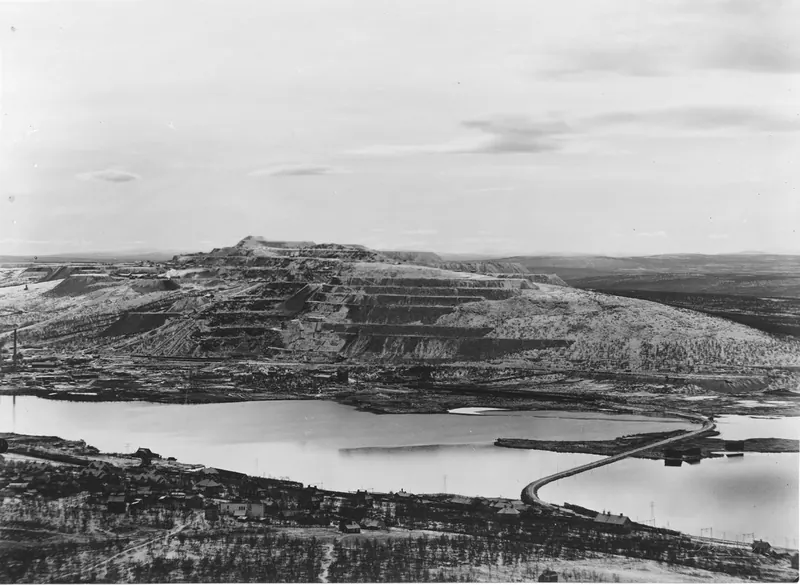
Ore is no use in the Arctic. It has to reach a steelworks. The Gulf of Bothnia, to the south, can freeze in winter. So a railway was built west over the mountains to Narvik in Norway, a port that stays free of ice. The Ofoten Line opened on 15 November 1902.10,13
Narvik still takes about two thirds of LKAB's exports, with a capacity of around 30 Mt a year. Ore also runs south by rail to Luleå on the Gulf of Bothnia when the sea allows.13
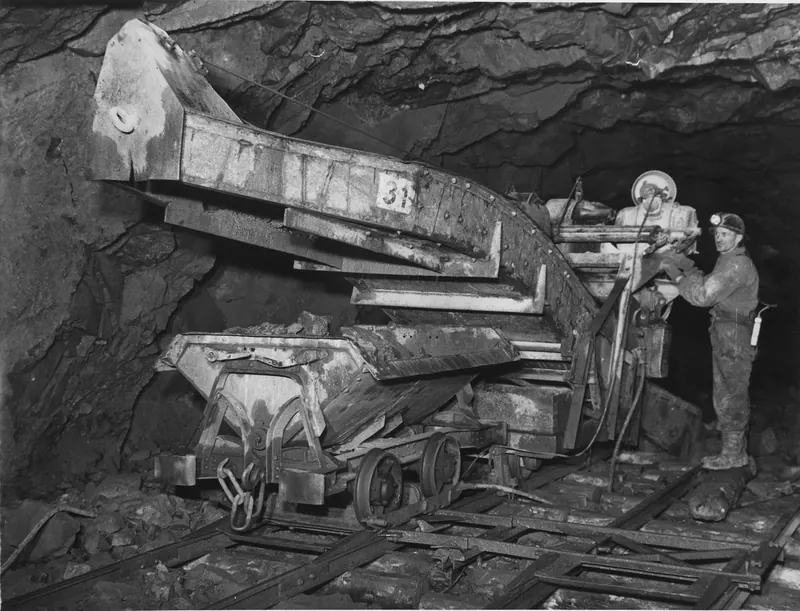
Kiruna began as an open mine on the hillside and went underground. Underground mining has run there since the 1950s. Today the main haulage level is 1,365 m below the surface.12
1,365 m
Depth of the main haulage level at Kiruna12
Following the ore down had a cost on the surface, because the town stood on top of the orebody. In 2004 LKAB and the town announced that much of Kiruna would move about 3 km east. The new city centre opened on 22 November 2018.8,11
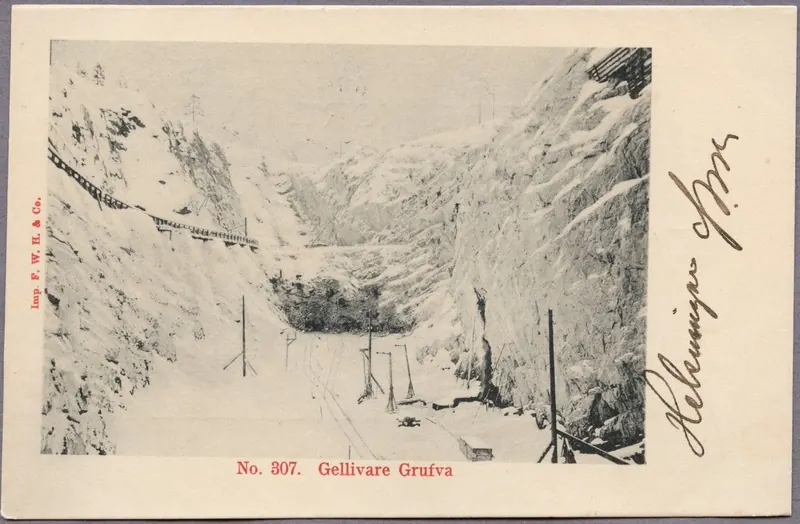
The picture above shows Malmberget, another LKAB iron mine in Swedish Lapland.9

Swedish ore and the Second World War
English War Work: The Iron Mine (1916), Joseph Pennell (American, 1857–1926) / Cleveland Museum of Art (CC0 1.0)
An iron mine in a neutral country can still be part of a war. Germany's steel industry depended on Swedish ore. Under a trade agreement of 1939, Sweden sent about 10 Mt of iron ore a year to Germany.14
The trade did not shrink as the war went on. In 1943 Sweden shipped 10,085,817 t of iron ore to Germany. Shipments through Narvik rose by about 70 per cent on 1942. A United States government report of 1944 set out the figures as the Allies pressed Sweden to cut the trade.14
10,085,817 t
Swedish iron ore sent to Germany in 194314
On the other side, Britain worked its own mines hard. The American artist Joseph Pennell drew British iron and coal mines for a series called English War Work during the First World War. His drawings show how much of the war effort began underground.7
World iron ore output reflected the wars. USGS records show 118 Mt in 1914 and 199 Mt in 1944. By 1964 the figure was 573 Mt, nearly three times the wartime level.2
Sweden remains a large producer. It produced 35,800 kt of usable iron ore in 2020, by USGS figures, and an estimated 26,000 kt in 2025. You can read more on mining in Sweden.3,15
Tata Steel and Jamshedpur: steel for India
Panaromavy över Fried Krupp Essen., Okänd / Europeana (Public Domain Mark 1.0)
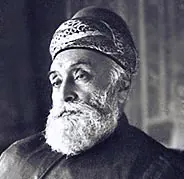
In India, the businessman Jamsetji Tata spent years studying how to make steel in his own country. He sent advisers to prospect across the country. The Dictionary of National Biography records a first outlay of about 36,000 pounds on the investigation alone.16,19
The site chosen was Sakchi, in Singhbhum. It was picked for three things: its iron ore, its coal, and its distance from Calcutta. Tata did not live to see it. He died at Nauheim in 1904.16
His son Dorabji Tata and his cousin RD Tata carried the project forward. The Tata Iron and Steel Company was registered on 26 August 1907, with capital equal to 1,545,000 pounds. Steel making began at the end of 1911, and the first ingot was rolled in 1912.16,17
26 Aug 1907 registered
Tata Iron and Steel Company is registered16
The works town was named Jamshedpur in his honour. Tata had also offered property worth 200,000 pounds for a research institute in 1898. It became the Indian Institute of Science at Bangalore.16
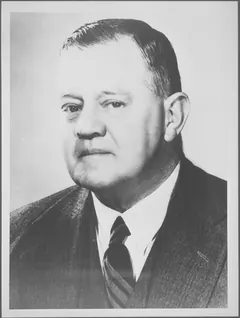
Australia built its own steel industry in the same years. BHP, the company formed at Broken Hill, moved into steel at Newcastle in 1913. Essington Lewis, who started underground at Broken Hill in 1904, rose to run the company. He expanded ore output at Iron Knob in South Australia, became Director-General of Munitions in May 1940, and after the war backed the Whyalla steelworks and shipyards. His motto was blunt.18
I AM WORK

Pilbara iron ore: the ban and the flight
Pilbara, NW Australia, NASA/METI/AIST/Japan Space Systems, and U.S./Japan ASTER Science Team (Public domain (NASA media, no copyright))
For decades Australia kept its iron ore at home. In 1936 the Yampi Sound Mining Company said it meant to supply Japan. In 1938 the Commonwealth government banned all iron ore exports, as an attempt to protect national interests against a militaristic Japan.20
The ban was still in place in 1952, when a prospector named Lang Hancock was flying over the Hamersley Range in the Pilbara of Western Australia. Above the Turner River and Boolgeeda Creek he saw a black outcrop below him. It was iron ore.23
The Pilbara ores sit in banded iron formations. These are thin layers of iron-rich rock and chert laid down in ancient shallow seas, mostly about 2.0 billion years ago. Later weathering can enrich the iron into high-grade ore.22
Hancock was not alone. In 1957 the prospector Stan Hilditch found a massive deposit further east. It became Mount Whaleback. Hilditch and his partner Charles Warman later sold their temporary reserves for 10 million dollars.25
In 1960 the Commonwealth lifted the export ban. Hancock worked to bring in investors from Australia and abroad. In 1963 he and his partner Peter Wright signed a deal with Hamersley Iron, controlled by Rio Tinto. They would receive royalties of 2.5 per cent of the value of all ore mined, in perpetuity.20,23
Here is a fact that surprises many people. The State Library of Western Australia says Lang Hancock never owned an iron ore mine in his lifetime. His wealth came from royalties on ore that other people mined.24

Mount Whaleback, Tom Price and the Port Hedland railway
Mount Whaleback Iron Ore Mine, Australia, NASA/METI/AIST/Japan Space Systems, and U.S./Japan ASTER Science Team (Public domain (NASA media, no copyright))
Once the ban was lifted, mines came quickly. The town of Tom Price was gazetted on 21 September 1964 to serve a mine of the same name. Mount Tom Price began operations in 1966, the first of Hamersley Iron's mines. Paraburdoo followed in 1974.21,31
At Mount Whaleback, BHP and its partners built a railway to the coast in 21 months from 1968. The Mt Newman project was officially opened on 26 June 1969. Ore runs to Nelson Point at Port Hedland, on trains that weigh 25,000 t or more.32,33
The numbers that followed are hard to picture. Australia mined 2,418,017 t of iron ore in 1950. In 2021 it mined 922,159,323 t, almost all of it in Western Australia. The chart shows the climb.27
Australia iron ore production, 1900 to 2021
Australia iron ore production rose from 26,122 tonnes in 1900 to 922,159,323 tonnes in 2021; the peak in this series is 922,159,323 tonnes in 2021. Basis: iron ore, gross weight.
Sources: A Comprehensive Dataset for Australian Mine Production, 1799 to 2021 (v1.4b, Tab04…; U.S. Geological Survey Mineral Commodity Summaries 2024 Data Release - world.zip…; U.S. Geological Survey Mineral Commodity Summaries 2025 Data Release (ver. 2.0, April…; Mineral Commodity Summaries 2026 Data Release - MCS2026_Commodities_Data.csv (world…
Most of that ore now goes to one customer. Port Hedland shipped 546 Mt of iron ore in 2024 to 2025, 61 per cent of Western Australia's export volume. Dampier shipped 138 Mt and Cape Lambert 159 Mt. China took 85 per cent of the value of the state's iron ore exports in the 12 months to September 2025.30
546 Mt
Iron ore shipped through Port Hedland in 2024 to 202530
A new name joined the old companies this century. Andrew Forrest took control of a small company in 2003 and renamed it Fortescue Metals Group. Fortescue shipped its first ore on 15 May 2008, from the Cloudbreak mine in the Chichester Ranges.34
Hancock's daughter, Gina Rinehart, chairs Hancock Prospecting. It runs the Hope Downs and Roy Hill mines. USGS lists Roy Hill, 340 km south-east of Port Hedland, with a capacity of 55 Mt a year in 2021.24,35
USGS estimates that Australia produced 980 Mt of usable iron ore in 2025, out of a world total of 2,600 Mt. That is well over a third of all the iron ore mined on earth. See more on mining in Australia and on the iron ore page.3

Carajás, Bayan Obo and Juukan Gorge
Carajas Mine, Brazil, NASA/METI/AIST/Japan Space Systems, and U.S./Japan ASTER Science Team (Public domain (NASA media, no copyright))
Brazil holds the other great iron province. Geological surveys of the Carajás region in Pará began in 1922. US Steel explored there from July 1967. The Serra Norte mines opened in 1984, and the S11D mine at Serra Sul followed in 2016. In 2025 Serra Norte produced 78.1 Mt and Serra Sul 86.0 Mt. Vale calls the Northern System the largest iron ore province in use in the world.36
In China, the Bayan Obo deposit in Inner Mongolia was first found as an iron deposit in 1927. Only later did geologists see that it also held rare earths and niobium. USGS calls it the largest known rare earth deposit in the world, with at least 1,500 Mt of iron reserves. We will come back to rare earths in chapter 12.37
Iron ore's story also has a harder side. In May 2020, Rio Tinto blasted the rock shelters at Juukan Gorge in the Pilbara to expand its Brockman 4 mine. The shelters showed 46,000 years of continuous human habitation. The blast was legal under section 18 of Western Australia's Aboriginal Heritage Act.38,39
46,000 years
Continuous human habitation shown at Juukan Gorge, destroyed in May 202039
Public anger followed. A board review by Rio Tinto in August 2020 cut executive bonuses, and the chief executive and two senior executives lost their 2020 bonuses. Juukan Gorge is now a reference point in debates on what miners owe to the people whose land they work. Our lesson on social licence looks at this in more depth.39
The Pilbara has an older scar too. At Wittenoom Gorge, asbestos was mined from 1933 to 1966. In 1962 asbestos was the fourth most valuable mined product in Western Australia. The Western Australian government says what remains has already caused thousands of deaths among miners, residents and visitors.55,56
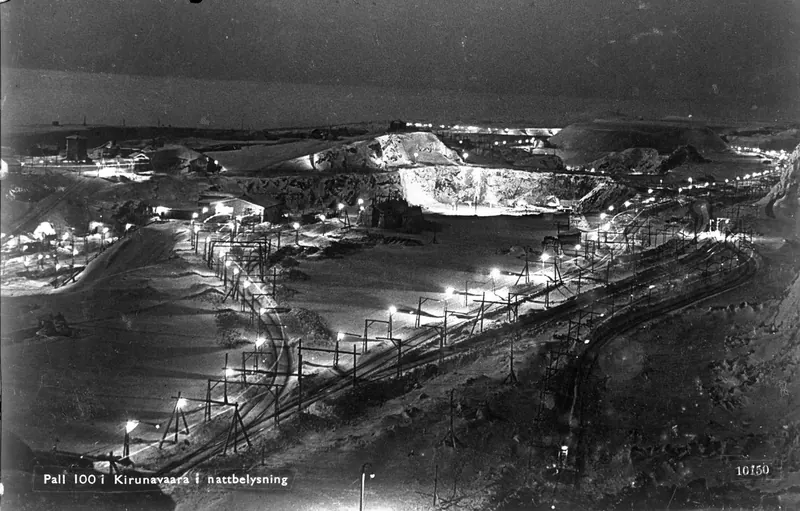
- Kiruna
- Mount Newman1969
- Hamersley Mines - Mount Tom Price1966
- Roy Hill
- Carajas S11D / Northern System1984
- Bayan Obo
- Kiruna iron ore to Narvik (Ofoten Line)1902
- Kiruna iron ore to Lulea (Iron Ore Line)
- Mount Whaleback iron ore to Port Hedland (Mount Newman railway)1969
- Pilbara iron ore from Port Hedland to China
- Swedish iron ore to Germany in the Second World War1939
- Lang Hancock spots iron ore in the Hamersley Range1952
- Juukan Gorge rock shelters destroyed2020
- Bayan Obo iron deposit found1927
- Bessemer process
Bessemer process.40
- LKAB founded
- Ofoten Line opens (Narvik)
Ofoten Line opens (Narvik).10
- Bayan Obo iron deposit found
Bayan Obo is the source of much of China's rare earth supply.37,42
- Vale founded
Vale founded.43
- Lang Hancock spots iron ore in the Hamersley Range
It led to the Pilbara iron ore industry once the embargo ended.20,23,44
- Iron ore export embargo lifted
It opened the way for Mount Tom Price, Mount Newman and later Pilbara mines.20,23,45
- Port Hedland development programme begins
A large expansion for iron ore export began in 1965.46
- Mount Newman railway is built in 21 months
- Mt Newman project is officially opened
Governor-General Sir Paul Hasluck opened the project that railed Mount Whaleback ore to Port Hedland.33,47
- Kiruna relocation announced
It is a case of a town moved because of the mine beneath it.8,11,48
- Fundao tailings dam collapse at Mariana
It is Brazil's worst environmental disaster and led to the largest mining liability cases in the UK and Brazil.49,50,51
- Juukan Gorge rock shelters destroyed
Rio Tinto's board review followed and its chief executive and two senior executives lost their 2020 bonuses.38,39,52,53
- Australia mines 980 Mt of iron ore
USGS estimates 980 million tonnes of crude iron ore from Australian mines in 2025.54
The scale keeps growing. BHP guides its Western Australia Iron Ore business at 253 to 264 Mt for its own share in the year to June 2027. You can compare these mines with others on our list of the largest mines in the world.57
Next: the atom
Steel built the twentieth century. But in its middle years, governments began to want a metal that nobody had needed before. Prospectors went out with Geiger counters instead of pans, and the hunt reached from the Congo to the Colorado Plateau and the Australian outback. Read on in chapter 9: uranium and the Cold War.24,58