
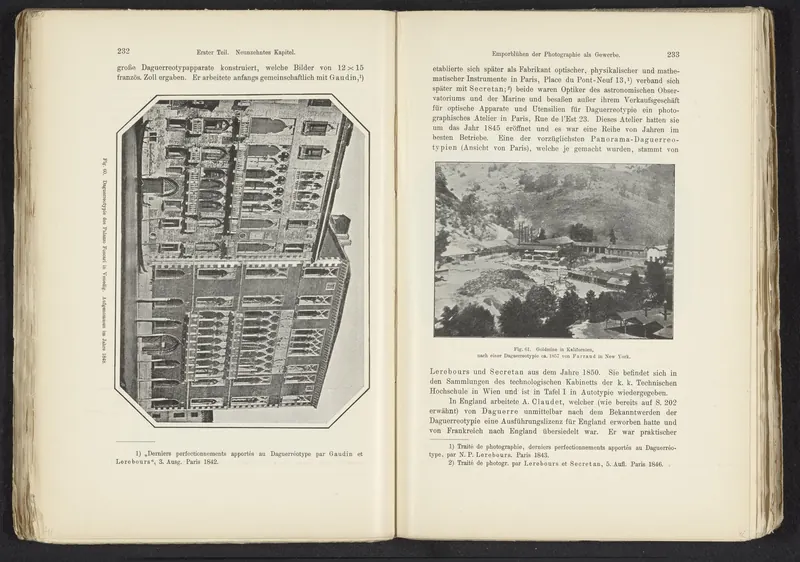
California, 1848: the flake in the tailrace
Gezicht op een goudmijn te Californië, Europeana (Public Domain Mark 1.0)
On 24 January 1848, James Marshall was building a sawmill for John Sutter on the South Fork of the American River, at Coloma in California. In the mill's tailrace he found gold. Word leaked out and reached San Francisco in March 1848.1,2
What followed was the fastest migration the world had seen. California had about 14,000 non-Indian people when gold was found. By the end of 1849 it had nearly 100,000, and by 1852 about 250,000. The 1850 census counted 92,597 people. California became a state in 1850. We compare the numbers in our story gold rushes then and now.4,5
14,000 to 250,000 people
California's non-Indian population, 1848 to 18524
The Census Bureau estimates that 750,000 pounds of gold were recovered from 1848 to 1855. That is about 340 t.5
The men who started it did badly. Adventurers seized Marshall's property, disputed his title to the land and left him in extreme poverty. John Sutter fared no better. His workers deserted, diggers overran his lands and the Supreme Court rejected his claim to 33 leagues of land.3,6
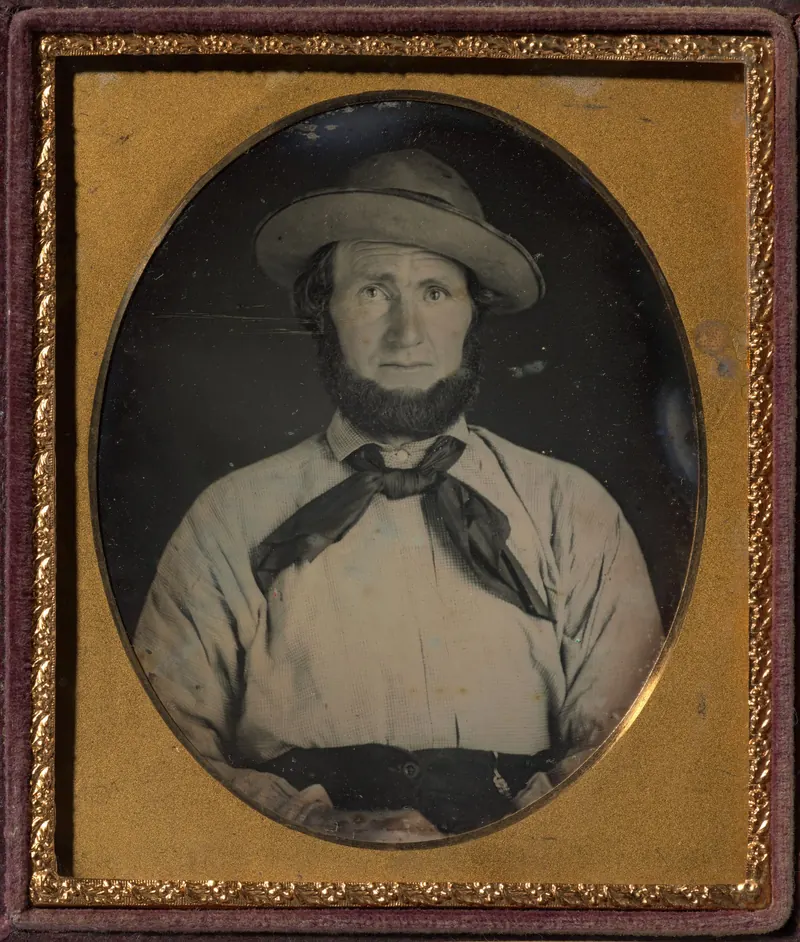
Gold also had to get out. From 1849 steamers carried mail and gold from San Francisco to Panama. The Winfield Scott left San Francisco on 1 December 1853 with 1 million dollars in gold and was wrecked the next night. Treasure sent to Panama from 1854 to 1869 totalled 9,053,526 dollars.7,8
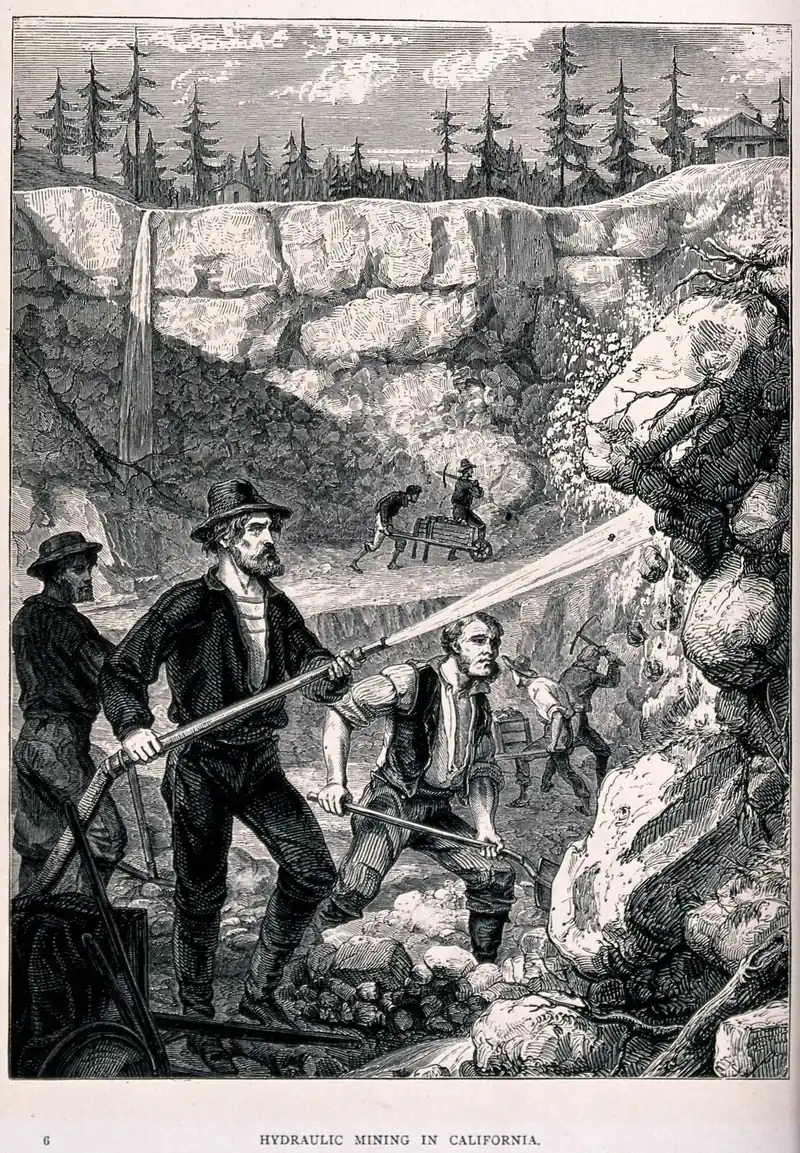
As surface gold ran out, miners went underground. The Empire Mine in Grass Valley ran from 1850 to 1956 and produced nearly 6 million troy ounces of gold. Cornish miners worked it from about the mid 1850s. Its deepest shaft went more than 5,000 vertical feet down.9

Gold mining in Australia: Bathurst, Ballarat and Bendigo
Goudzoekers in Australië, een Australisch meisje met haar broertje, een zendingspost op Nieuw-Zeeland en een bisschop op een slee, Europeana (Public Domain Mark 1.0)
One man who went to California was Edward Hargraves. He sailed to the diggings in 1849 and noticed that the rocks looked like those of the Blue Mountains back in New South Wales. On 12 February 1851 two men he had taught to wash gold in a cradle, Lister and Toms, found gold at Lewis Ponds Creek near Bathurst.10
Within a month a thousand men were looking for gold at the field named Ophir. It was the first publicised Australian gold rush. The colony's legislative council later granted Hargraves 10,000 pounds as a reward.13
He was not the first to find gold there. In 1840 the explorer Paul Strzelecki found gold-bearing quartz in the Wellington district. Governor Gipps asked him not to publicise it, for fear of unrest among convicts and labourers. The find stayed quiet until the 1851 rush.11
The rush moved south. Gold was notified in the Yarra Ranges and the Pyrenees of Victoria on 5 July 1851, and the Mount Alexander, Ballarat and Bendigo fields followed. Between 1851 and 1861 an average of more than 40,000 people a year reached Victoria. Victoria was Australia's largest gold producer for 47 years, until 1898.12,13
The fields were rich. Ballarat produced about 9.3 million ounces of gold from 1851 to 1870. Bendigo produced 447,212 ounces in 1858 alone, and its first reefs opened in 1854.18,19
In the peak years from 1852 to 1855, Victoria produced most of the world's gold. Escorts carried about a tonne a week to Melbourne. The ship Madagascar sailed from Port Phillip in July 1853 with more than 60,000 ounces of gold dust for the Bank of England. It was never seen again.20,21
Australia gold production, 1851 to 1910
Australia gold production rose from 9.94 tonnes in 1851 to 84.62 tonnes in 1910; the peak in this series is 119 tonnes in 1903. Basis: contained gold in dore, concentrate or bullion leaving the mine.
Sources: A Comprehensive Dataset for Australian Mine Production, 1799 to 2021 (v1.4b, Tab04…; U.S. Geological Survey Mineral Commodity Summaries 2024 Data Release - world.zip…; U.S. Geological Survey Mineral Commodity Summaries 2025 Data Release (ver. 2.0, April…; Mineral Commodity Summaries 2026 Data Release - MCS2026_Commodities_Data.csv (world…
The chart shows Australian gold output through the rush years. Australia mined 9.944 t of gold in 1851 and 76.069 t in 1860. For gold mining in Australia today, including its record of 327.952 t in 2020, see our guide to mining in Australia.14,15
The diggers had grievances. Miners at Ballarat opposed the gold licence system. On 30 November 1854 about 500 gathered under the Eureka flag and elected Peter Lalor as their leader. On 3 December police and troops attacked the Eureka Stockade. Six police and troopers and at least 22 diggers died, and 125 miners were taken prisoner.22
28 deaths
Eureka Stockade, Ballarat, 3 December 185422
Thousands of Chinese miners came too. Lowe Kong Meng, born in British Penang, reached Victoria in 1853. In 1854 he founded Kong Meng and Co. to supply Chinese miners with goods from China, India and elsewhere. On 30 May 1859 he led a delegation of Melbourne's Chinese merchants to the Chief Secretary to argue against the residence tax.23
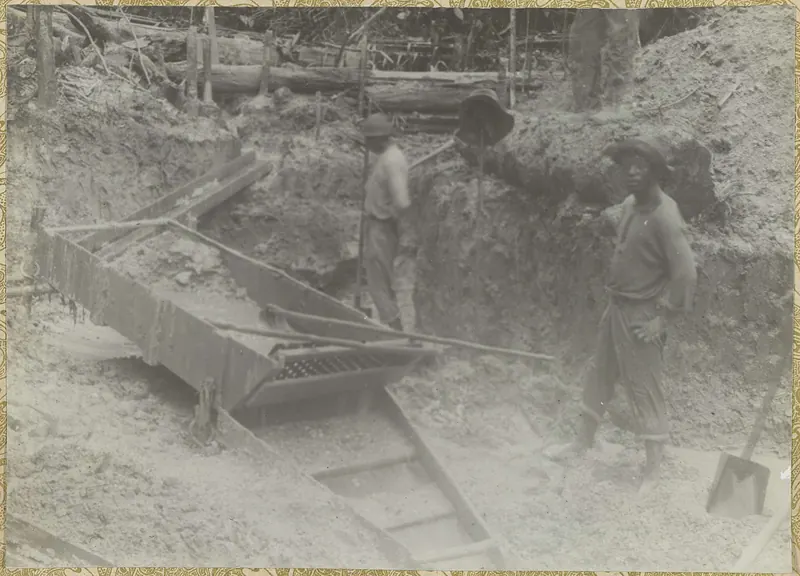
Victoria also gave the world its most famous nuggets. On 9 June 1858, twenty-two Cornish miners of the Red Hill Mining Company found the Welcome Nugget at Bakery Hill, Ballarat, about 55 m underground. It weighed 68.98 kg.13
Eleven years later came something bigger. In 1869 the Welcome Stranger was found just under the soil at the base of a tree. It weighed about 70 kg. Geoscience Australia calls it the largest gold nugget ever found.13
70 kg gold
The Welcome Stranger, the largest gold nugget ever found, 186913
In New South Wales, a mass of reef gold weighing 286 kg came out of Bernhardt Holtermann's Star of Hope mine at Hill End on 19 October 1872. It was the largest specimen of its kind. The photographers Merlin and Bayliss recorded it before it was crushed.24
Otago, the Fraser and the Cariboo
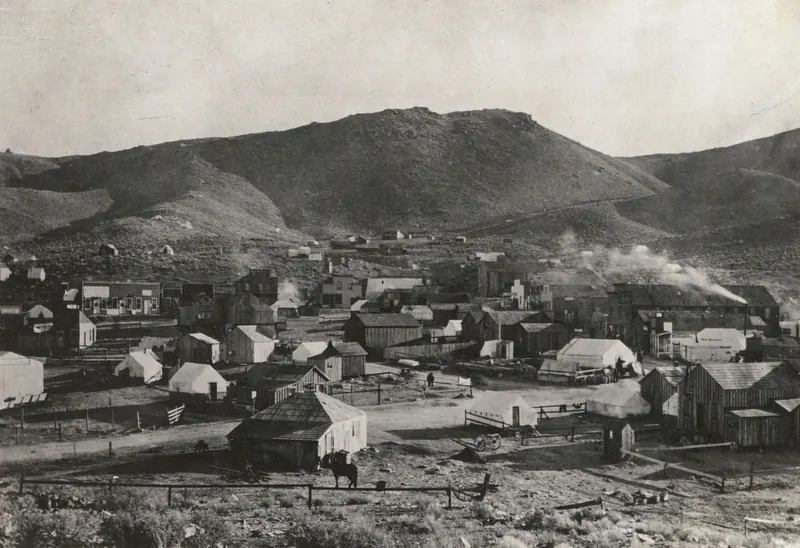
California. gold mining town, Koch, Franz Otto (Herstellung) (Fotograf) / Europeana (Public Domain Mark 1.0)
Gold seekers moved from field to field around the Pacific. On 25 May 1861 Gabriel Read found gold at Gabriels Gully in Otago. New Zealand's Department of Conservation calls it the country's first major gold rush. Dunedin's population jumped and Otago became the wealthiest province.25
In British North America, gold found in the Fraser River in 1857 became a full rush in 1858. Parks Canada puts the number of miners at about 30,000, and many were American. The rush led Britain to create the Colony of British Columbia in 1858, partly from fear that the United States would annex it.26,27
Further north in the Cariboo, Billy Barker and seven partners struck rich gold at 40 feet on Williams Creek in 1862. The boom town of Barkerville grew up around the strike. Barker is often called a Cornishman. He was in fact born in Cambridgeshire, and the Dictionary of Canadian Biography finds no evidence for the tale that his wife spent his fortune.28

Comstock, Pikes Peak and the Black Hills: myths of the American West
Goldstrike Mine, Nevada, NASA/METI/AIST/Japan Space Systems, and U.S./Japan ASTER Science Team (Public domain (NASA media, no copyright))
In 1859 placer miners near Virginia City, Nevada, made two strikes of silver and gold ore. The National Park Service calls it the first major silver strike in the United States. The towns of Virginia City and Gold Hill grew from about 4,000 people in 1862 to about 25,000 by 1874.33,34
The lode carries the name of Henry Comstock. He did not find it. Patrick McLaughlin and Peter O'Riley found the outcrop on 8 June 1859. Comstock claimed ownership and was given a share, but he never shared in the millions the mines produced. He shot himself in Montana in 1870.29
About 7 Mt of ore was milled from the Comstock Lode from 1860 to 1880, and it was exhausted by 1881. About 7,500 t of mercury was lost in processing it.35
Some people did get rich. John Mackay rose from common miner to partner in the Big Bonanza, and estimates put his assets as high as 100 million dollars. George Hearst paid 3,000 dollars in 1859 for a one-sixth share of a Comstock mine, and left the Comstock with nearly 100,000 dollars.36,37
The Colorado rush of 1858 to 1859 took the name Pikes Peak, but most of the early finds were far from the mountain. As many as 100,000 people may have set out in 1859. Only about 40,000 reached Denver, and about 10,000 were left in Colorado by early August 1859.30
In 1874 an army expedition under George Custer went into the Black Hills, and one of its members found gold at French Creek. The Treaty of 1868 had set the land aside as part of a Sioux reservation. Prospectors came anyway. The Homestake claim was located near Lead in April 1876 and sold in 1877 to George Hearst and partners.38
The Homestake became the largest and deepest gold mine in North America. It produced 41 million ounces of gold and 9 million ounces of silver before it closed in 2001.39
One prospector could have owned half of it. In 1874 Thomas Walsh turned down an offer of half of a Deadwood prospect that later became the Homestake. He made his fortune anyway, from the Camp Bird gold mine near Ouray, Colorado, which he found in 1881.31
Colorado has two more myths worth fixing. In 1891 Mollie Gortner found gold near Cripple Creek and became the first woman to stake a claim in her own name there. An official survey still credited the find to "Mr M. C. Gortner". And the Titanic survivor Margaret Brown, whose family wealth came from Leadville mine shares, was never called Molly in her lifetime.32,40

The Klondike gold rush, 1896 to 1900
Gold prospectors constructing a long box with a filter for panning gold. Process print after H.M. Paget, 1899., Henry Marriott Paget (Public Domain Mark 1.0)
In August 1896 a party camped near the Klondike River found gold on Rabbit Creek, soon renamed Bonanza Creek. Parks Canada dates the find to the afternoon of 16 August. The party was Skookum Jim, also called Keish, his nephew Dawson Charlie, George Carmack and Kate Carmack. Accounts differ on who deserves the credit. Skookum Jim is generally held to be the discoverer.41,42
George Carmack filed the first claim on 24 September 1896, probably in his name because he was the only Euro-American in the party. Kate Carmack, a Tagish woman, had sewn and baked for miners before the strike. The family claims produced close to a million dollars of gold in four years. George later left her almost penniless.47,48
The world found out a year later. The steamship Portland reached Seattle on 17 July 1897 with 68 miners and more than a ton of gold. Between 1897 and 1900 more than 100,000 people set out for the Klondike. No more than 40,000 reached Dawson City.44,49
100,000 set out
People who started for the Klondike, 1897 to 1900; no more than 40,000 arrived44
Parks Canada estimates that Dawson City had 20,000 to 30,000 people at the height of the rush in 1898 and 1899. By 1918 it had fewer than 1,000.50
The rush's best known writers mined little or no gold. Jack London sailed for the Klondike at 21 in July 1897 and crossed the Chilkoot Pass. He left with scurvy in the spring of 1898. His Yukon stories made him a fortune. Robert Service, the Bard of the Yukon, was a bank clerk, never a prospector.45
Women were few. In 1901 only one percent of Yukon miners were women. Nellie Cashman, who had joined about 200 prospectors heading to the Cassiar district in 1873, was one of them. She told reporters she spent every cent she made on more claims.46

Coolgardie and Kalgoorlie: the last great Australian rush
Kalgoorlie-Boulder, Australia, NASA/JPL-Caltech (Public domain (NASA media, no copyright))
The last of the great 19th century rushes was in the desert of Western Australia. In September 1892 Arthur Bayley and William Ford found gold at Fly Flat, later Coolgardie. Bayley took 554 ounces to the warden at Southern Cross. Bayley's Reward went on to produce more than 500,000 ounces over about 70 years.51,52
In June 1893 Paddy Hannan, Thomas Flanagan and Dan O'Shea found gold near Mount Charlotte, about 40 km north-east of Coolgardie. On 17 June Hannan rode to Coolgardie with about 100 ounces to file a reward claim. Within about a week more than 1,400 men were working the new field.53,55
Western Australia passed Victoria as Australia's top gold producer in 1898. Its output peaked at 2,064,803 fine ounces in 1903. The Golden Mile at Kalgoorlie has since produced about 58 million ounces.12,51
The goldfields had no water. The Goldfields Water Supply Scheme pumped water 566 km from Mundaring Weir to Kalgoorlie, lifting it 390 m over the Darling Scarp. Work began in 1898 and the scheme opened in January 1903.56,57
A future president learned his trade here. In 1897 the 22 year old Herbert Hoover was sent to inspect mines near Coolgardie for Bewick Moreing. He persuaded the firm to develop Sons of Gwalia and ran it until late 1898. He became President of the United States in 1929.54
The Super Pit at Kalgoorlie is now one of Australia's best-known open pit gold mines. See the largest gold mines and our gold page for where gold is mined now.58
Comparing the gold rushes
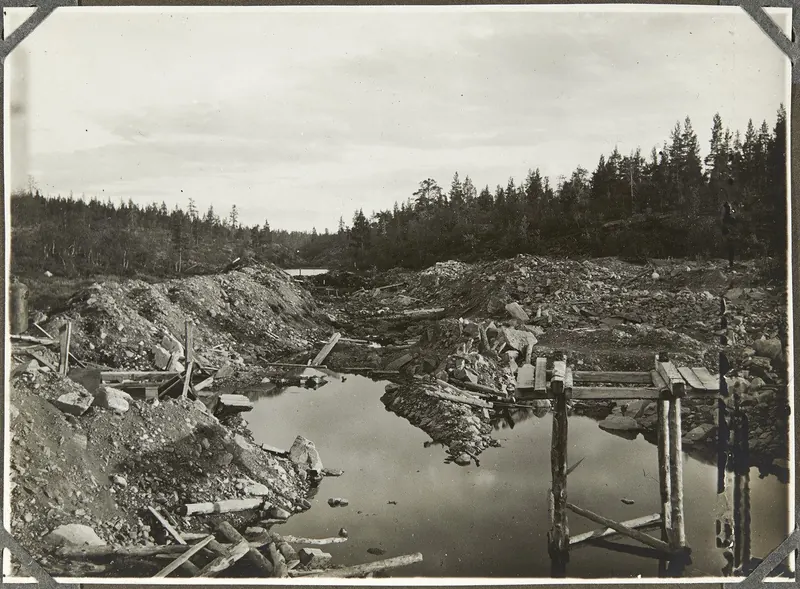
Kuivankurun kaivos kesällä 1927, Mikkola, Erkki / Museovirasto (CC BY 4.0)
How did the rushes compare? The table sets the main measures side by side for California, Victoria, the Klondike, the Witwatersrand and Western Australia. Each figure links to its source.4,12,44,61
- Sutter's Mill (Coloma)1848
- Empire Mine1850
- Ballarat goldfield1851
- Bendigo goldfield1851
- Gabriel's Gully1861
- Comstock Lode1859
- Homestake Mine1876
- Klondike (Bonanza Creek)1897
- Coolgardie goldfield1892
- Golden Mile, Kalgoorlie-Boulder1893
- San Francisco to Panama gold (Pacific Mail steamers)1849
- Victorian gold to London (gold ships)1852–1855
- Klondike gold from St. Michael to Seattle (SS Portland, 1897)1897
California gold rush
- Discovery1848-01-242Marshall at Sutter's mill
- Population before rush (1848)14,000 people (non-Indian)4State population estimate when gold was found
- Population end 1849 (1849)100,000 people4"nearly 100,000"
- Population 1852 (1852)250,000 people4"some 250,000"
- Census population (1850)92,597 people51850 US census count
- Gold recovered (1855)750,000 pounds5Estimated recovered 1848 to 1855. About 340 tonnes at 0.4536 kg per pound (computed).
- Value recovered then (1900)25,000,000,000 US dollars, modern equivalent4Mother Lode and Klamath fields together, "modern-day equivalent of more than $25 billion" by the turn of the century
- News reached san francisco1848-035Rumours reached San Francisco in March 1848
- Population after 50 years (1900)1,485,053 people5California census 1900
Victorian gold rush
- First discovery clunes1850-0312Hon. W. Campbell at Clunes, "probably" first
- Rush notification1851-07-0512Gold notified in the Yarra Ranges and the Pyrenees
- Commonwealth population 1851 (1851)437,665 people12Australia end of 1851
- Commonwealth population 1861 (1861)1,168,149 people12Australia end of 1861
- People who came (1861)40,000 people per year, average12"Over 40,000" a year reached Victoria 1851 to 1861
- Years as top australian producer (1898)47 years12Victoria led until Western Australia passed it in 1898
- Victoria gold 1901 (1901)730,450 fine ounces12ABS table
- Deaths at the Eureka Stockade (1854)28 people22Six police and troopers and at least 22 diggers, State Library Victoria
- Peak year185612Victoria's highest yearly gold output
Klondike gold rush
- Discovery1896-08-1641Parks Canada; staking on 17 August per its history text
- News to outside world1897-0744SS Portland reached Seattle with over a ton of gold
- People who set out (1900)100,000 people44Set out for the Klondike 1897 to 1900 ("more than")
- People who came (1900)40,000 people44"No more than 40,000" reached Dawson City
- Canada gold value before (1897)1,240,000 pounds sterling (assumed)12Canada national gold yield, ABS table; Klondike share not separated
- Canada gold value peak (1900)5,742,000 pounds sterling (assumed)12Canada national gold yield, ABS table
- World gold value (1900)52,086,000 pounds sterling (assumed)12World gold yield 1900, ABS table
- Canada share of world gold (1900)11 percent12Computed from the two ABS values (5.742 / 52.086)
Witwatersrand gold rush
- Discovery1886-0761Harrison, Langlaagte; his affidavit date is not on the opened page
- Camp population (1886)3,000 people61About 3,000 inhabitants by August 1886, mostly White
- Public diggings proclaimed (1886)9 farms61Proclaimed 8 September 1886
- Towns founded (1886)1 town61Johannesburg named 3 October and declared 4 October 1886
- Transvaal gold value (1897)11,654,000 pounds sterling (assumed)12ABS table, Transvaal
- Transvaal gold value war low (1900)1,481,000 pounds sterling (assumed)12Output collapsed during the South African War
- Transvaal gold value later (1909)30,988,000 pounds sterling (assumed)12ABS table, Transvaal
- Transvaal share of world gold (1909)33.7 percent12Computed: 30.988 / 91.91
Hannan finds gold at Kalgoorlie
- Coolgardie find (1892)554 ounces52Bayley, September 1892
- Bayleys reward output (1962)500,000 ounces over about 70 years52"over 500,000 ounces"
- Goongarrie alluvial1893-0512ABS Year Book
- Kalgoorlie discovery1893-0651Hannan and Flanagan
- Wa gold output (1901)1,703,417 fine ounces12ABS table
- Wa gold output peak (1903)2,064,803 fine ounces12Peak for WA and for Australia
- Wa share of australian gold53.15 percent, 1901 to 1909 annual average12ABS table
- Water pipeline length (1903)566 kilometres57Goldfields Water Supply Scheme, built 1898 to 1903
- Water pipeline cost then2,500,000 pounds (debate figure of 1898)56"two and a half million pounds" quoted in the Assembly debate, WA Museum
The rushes changed world gold supply. The US Mint estimated world output at an average of 186.47 thousand ounces a year from 1493. By 1899 it put world output at 14,837.775 thousand ounces.59
World gold production, 1493 to 1899
World gold production rose from 5.8 tonnes in 1493 to 462 tonnes in 1899; the peak in this series is 462 tonnes in 1899. Before 1867 the world series gives period averages per year. Basis: fine gold, world mine output.
Sources: Annual Report of the Director of the Mint for the fiscal year ended June 30, 1915…; Annual Report of the Director of the Mint for the fiscal year ended June 30, 1915…; Historical Statistics for Mineral and Material Commodities in the United States (Data…
- California Gold Rush begins
California Gold Rush begins.62
- Bathurst and Ophir gold rush
It was the first publicised Australian gold rush and prompted the Victorian discoveries.13,63
- Victorian gold rush begins
Victorian gold rush begins.64
- Pikes Peak (Colorado) gold rush
Most of the early finds were far from Pikes Peak, yet the rush took its name and led to the founding of Colorado Territory.30,65
- Otago gold rush
It financed the early growth of Dunedin and the colony.25,66
- Kimberley diamond rush
The hand-dug Big Hole is the best-known symbol of the diamond rush.67,68
- Schieffelin finds silver at Tombstone
The NPS file says Tombstone became the largest town in Arizona Territory.69,70
- Leadville silver boom
Leadville shows how fast a silver camp could outgrow a state capital.71,72
- Barberton gold rush
Barberton was the first major gold boom of the eastern Transvaal, two years before the Witwatersrand.73,74
- Cripple Creek gold rush
Cripple Creek was the last great Colorado gold camp and its mine is still the state's only large gold mine.75,76
- Bayley and Ford strike gold at Coolgardie
Arthur Bayley and William Ford made the first big Goldfields strike.77
- Paddy Hannan applies for a reward claim at Kalgoorlie
Hannan, Flanagan and O'Shea's find led to Australia's biggest gold rush to that date.78
- Steamship Portland docks at Seattle with a ton of Klondike gold
The ship carried 68 miners from St. Michael, and news of the gold set off the stampede.49,79,80
- Dawson City at the height of the Klondike rush
Parks Canada estimates 20,000 to 30,000 people at the height of the rush.50
Next: diamonds and deep gold
The chart has a sharp rise at the end. It was not caused by a prospector with a pan. In 1868 a German explorer named Carl Mauch found a gold field in the Transvaal that nobody took seriously for about 15 years. When they did, in 1886, it turned out to be the largest gold field on Earth, and the men who mined it had made their first fortunes in diamonds. Read on in chapter 6: diamonds and the Rand.61,81


