

Older than farming: the oldest mine in the world
Hand Axe (5000–3000 BCE), Egypt, Haraga, excavated in 1914, Predynastic (5000–2950 BCE) / Cleveland Museum of Art (CC0 1.0)
In the Weld Range of Western Australia there is a hill of red and yellow ochre called Wilgie Mia. The State Library of Western Australia says the mine is estimated to be 27,000 years old. It believes Wilgie Mia is the oldest continually worked mine site in human history.1
The miners were initiated Wajarri Yamatji men. They broke the ochre with stone mauls and split it with wooden wedges hardened in fire. They built pole scaffolding so that several levels could be worked at once. That is a real mine plan, with benches and access, thousands of years before anyone wrote the word.1
Ochre from Wilgie Mia did not stay in the Weld Range. It was traded as far as Ravensthorpe on the south coast, into Queensland and across the Nullarbor. The first mine we know of was already feeding a long trade network. The site remains sacred to Wajarri Yamatji people today.1
27,000 years
Estimated age of the Wilgie Mia ochre mine1
That pattern runs through this whole series. Someone finds a rock that people want. Someone else learns how to get it out of the ground. Then a route forms to carry it to the people who will pay for it. The rocks change. The pattern does not. You can see where the same minerals are mined now on our guide to mining in Australia.

Flint mines: Spiennes and Grimes Graves
Hand Axe (4400–2100 BCE), Egypt, Haraga, excavated in 1914, Predynastic (5000–2950 BCE)–Old Kingdom (2647–2124 BCE) / Cleveland Museum of Art (CC0 1.0)
In Europe the first deep mines were dug for flint, the stone that made the sharpest tools of the age. At Spiennes, 6 km south-east of Mons in Belgium, miners dug shafts into two chalk plateaux. ICOMOS dates underground flint mining there to between 4400 and 4200 BCE, which makes Spiennes one of the oldest mining sites in Europe.2
Spiennes was not a short episode. The dates show mining went on through the 4th millennium BCE and into the first half of the 3rd. That is well over a thousand years of digging on the same two hills.2
Across the North Sea, Neolithic miners at Grimes Graves in Norfolk sank 433 mines and pits, some up to 13 m deep. They worked the flint from about 2600 BC to about 2100 BC. After a gap of about 500 years, simple pit mining briefly started again. The site became a guardianship monument in 1931.3
433 mines and pits
Neolithic flint workings at Grimes Graves, Norfolk3
Flint has left a mark on modern industry too. The element silicon takes its name from the Latin silex, meaning flint. The stone that cut Neolithic meat now names the metal inside every computer chip.4

Bronze Age copper mining: Faynan, Timna and the Great Orme
Timna in de Negevwoestijn; rotspartij "de zuilen van Salomo", Poll, Willem van de / Europeana (Public Domain Mark 1.0)
Copper was the first metal people learned to win in quantity. The Royal Society of Chemistry notes that copper beads more than 10,000 years old have been found in northern Iraq, probably made from native copper. The English word comes, through Old English, from the Latin Cyprium aes: metal of Cyprus.4
In the Arabah valley, the desert between the Dead Sea and the Red Sea, two districts became the copper works of the ancient Near East. At Wadi Faynan in Jordan, people mined and smelted copper from the Chalcolithic, 4500 to 3100 BC. Work went on, with gaps, until the 4th century AD, and again under the Mamluks from 1250 to 1516. Up to 200,000 t of slag still lies there.6
Across the border in Israel, Timna has 6,000 years of copper activity. Its golden era ran from the end of the 14th century to the start of the 9th century BCE. Production peaked in the 10th century BCE and was centred on two sites, Slaves' Hill and Timna 30.5
Egypt controlled operations at Timna from the end of the 14th to the middle of the 12th century BCE. Some of the copper found at Pi-Ramesses, the capital of the 19th dynasty in the Nile delta, has lead isotopes in the range of Faynan and Timna ores. The scientists are careful here. The data cannot tell Faynan from Timna, and the route is inferred, not proven.7,8
When Egypt pulled out, output at Timna and Faynan grew under local control. Smelting in the Arabah reached its peak in the 11th to 9th centuries BC. It burned large amounts of wood, an early sign that mines change the land around them as well as the land beneath.7,9

At the other end of the Bronze Age world, miners in north Wales dug copper at the Great Orme from about 1600 to 1200 BC. Almost 6.5 km of tunnels are recorded, and there may be 10 km more. The workings were lost for three thousand years. They were recognised only in the mid 1970s, and the mine opened to visitors in 1991.10,11
Copper also travelled. Metal finds at Moriken-Wildegg on the Swiss plateau match the Solea ores of Cyprus, from around 1400 BC. The authors present this as new evidence for long-distance copper trade, not as proof of a route. You can follow what copper does today on our copper page.12

Not every early mine was for metal. Lapis lazuli, the deep blue stone, had spread through the ancient East and Egypt by the end of the 4th millennium BC. The Badakhshan mines in Afghanistan, of which Sar-e-Sang is the best known, are widely held to be the only ancient source. Gerzean graves at Naqada in Egypt held lapis, and one held a Mesopotamian cylinder seal.13,14
Tin mining in Cornwall and the first long-distance metal trade
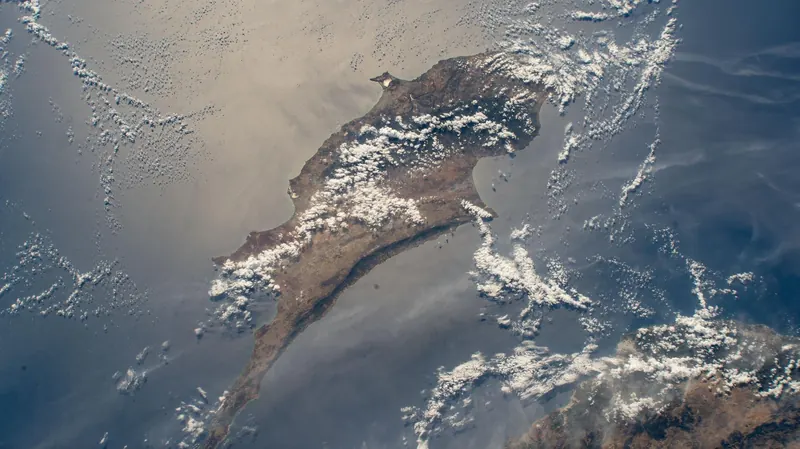
The island Republic of Cyprus in the Mediterranean Sea, NASA JSC (Public domain (NASA media, no copyright))
Copper alloyed with about 5% tin gives bronze, which is harder and easier to work than copper. Tin is scarce in the Earth's crust, so a few remote places rich in it suddenly became important. The Royal Society of Chemistry notes that people in China were mining tin in Yunnan around 700 BC. You can read how tin is used and mined today on our tin page.4
Cornwall and Devon were among them. An antler pick and a wooden shovel from the Carnon Valley tin workings, near Truro, date mining there to 1620 to 1497 BC and to 1266 to 1108 BC. People were streaming tin in Cornwall at the same time Egypt ran the copper mines of Timna.16
1620 BC earliest date
Antler pick from the Carnon Valley tin workings, Cornwall16
Cornish tin travelled a very long way. Tin ingots from wrecks off Hishuley Carmel, Kfar Samir South and near Haifa, on the coast of modern Israel, match the ores of Cornwall and Devon in lead isotopes, trace elements and ore age. One study dates the Israeli ingots to the 13th to 12th century BC. Another puts them at about 1400 to 1300 BC.16,17
At the British end of the route, forty tin ingots from a probable Bronze Age wreck off Salcombe in Devon are close in chemistry to ingots found in Mediterranean wrecks. Metal from the far west of Europe was reaching the eastern Mediterranean by sea more than 3,000 years ago.16
- Great Orme Mines-160
- Timna Valley
- Wadi Faynan (Khirbat Faynan)
- Hallstatt salt mine-150
- Laurion silver mines
- Sar-e-Sang lapis lazuli mines
- Cornish tin to the Levant (Bronze Age)-1300
- Arabah copper (Timna and Faynan) to Pi-Ramesses-1300–-1150
- Cypriot copper to the Swiss plateau (c. 1400 BC)-1400
- Badakhshan lapis lazuli to Egypt-3000
Tin mining in Cornwall went on, in one form or another, for most of the next 3,500 years. It comes back in chapter 3, when Cornish engineers take on the problem of water in deep mines. For the industry today, see mining in the United Kingdom.16
Salt was mined too. ICOMOS reports large-scale salt production at Hallstatt in Austria in the middle of the 2nd millennium BC. Underground mining began at the end of the Late Bronze Age with a shaft method borrowed from copper mining. A wooden staircase left in the mine has been dated to 1108 BC. The cemetery there gave its name to a whole period of European prehistory, the Hallstatt culture.15,18

Laurion silver mines: the metal that built a navy
Tetradrachm: Head of Athena (obverse); Owl (reverse) (480–449 BCE), Greek, minted at Athens (Attica) / Cleveland Museum of Art (CC0 1.0)
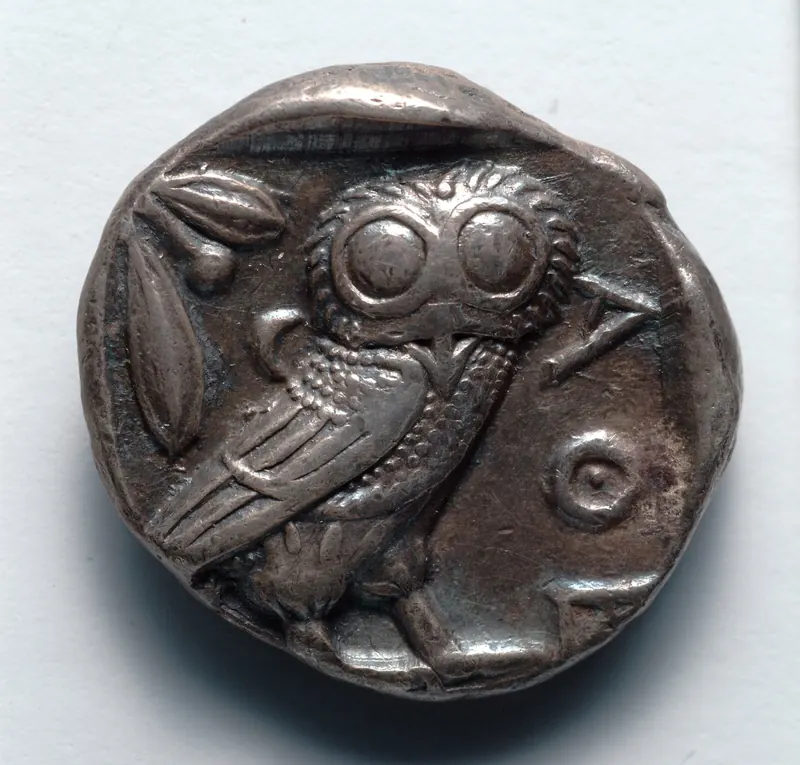
Silver turned mining into state power. In south-east Attica, the Laurion mines produced silver and lead for Classical Athens. Their silver funded the Athenian fleet and the famous owl coins.19
New lead isotope work has changed the dates. By measuring the lead in early owl coins, researchers found that Laurion silver became the bulk of Athenian supply only shortly before 483/2 BCE. That is when miners reached the rich "third contact", a deep ore layer. The study ties the discovery of one ore horizon to the money that paid for a fleet.19
How much silver came out of Laurion is not known with any confidence. Published figures differ by orders of magnitude, so we do not give one. What is clear is the direction of travel, set out on the Laurion to Athens route on our map.20

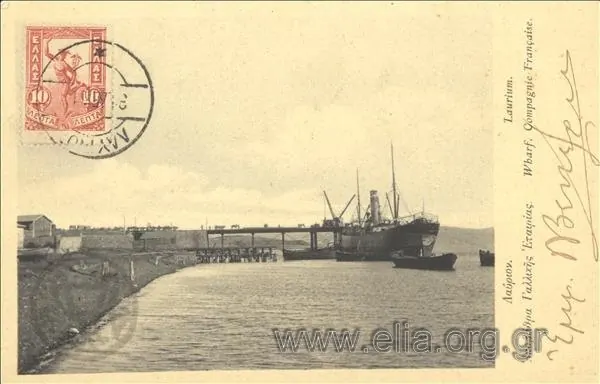
The mines were worked again in modern times. The photographs in this chapter show Laurion around 1903 and its loading pier in 1911. The district had become an industrial mining town, more than two thousand years after its silver paid for Athens.20

Roman mining: Las Médulas, Riotinto and Dolaucothi
Rio Tinto, Spain, NASA/GSFC/METI/ERSDAC/JAROS, and U.S./Japan ASTER Science Team (Public domain (NASA media, no copyright))
Rome mined on a scale no earlier state had tried. At Riotinto in south-west Spain, silver output peaked in Roman times and carried on until the crisis of the early 3rd century AD. After that, miners turned to the copper lodes. More than 20 Mt of ancient slag remains.21
The most striking evidence comes from Greenland. Isotopes in Greenland ice indicate that about 70 percent of the metal worked between 150 BC and AD 50 came from Riotinto. Roman smelting was large enough to leave a trace in Arctic ice, thousands of kilometres away.21
70% of metal
Share of metal worked 150 BC to AD 50 traced to Riotinto in Greenland ice21
In the north-west of Spain, Las Médulas became Rome's gold field. Roman interest began about 27 BC. For the next 150 years or so it was the most important gold source for Rome. Up to 10,000 miners worked there, and nuggets of up to 3 kg are recorded.22
The method was called ruina montium, the wrecking of mountains. Water was brought in canals up to 100 km long and released to bring down whole hillsides of gold-bearing conglomerate. More than 80 million cubic metres of waste were moved. The red pinnacles left behind are now a landscape people travel to see. It was a Roman form of hydraulic mining, which came back with a vengeance in California 1,800 years later.22
Rome reached Wales too. Romans began the first extensive gold mining at Dolaucothi in AD 70 to 80. Mining there stopped only in October 1938, when Mitchell's shaft had been deepened to 146 m.24
The Romans also worked Almadén in central Spain for mercury. It was mined for about two thousand years and is said to have supplied about one third of all the mercury ever used by humans. Mining closed only in 2003.25
Much of what we know about Roman mining was written down by Pliny the Elder. As procurator of Hispania Tarraconensis from AD 73, he came to know the mines of Spain. Books 33 to 37 of his Natural History deal with minerals and their uses. He died on 24 August AD 79 at Stabiae, after sailing his galleys towards the eruption of Vesuvius to watch it and to rescue friends on the shore.23
Beyond the Mediterranean: Andean copper, Khotan jade and African gold
Ingot Torque (c. 1500 BCE), Hungary, Bronze Age / Cleveland Museum of Art (CC0 1.0)
The Mediterranean was not the only centre. In the Andes, the Illimani ice core in Bolivia records copper pollution from the Early Horizon, around 700 BC, linked to smelting by the Chiripa and Chavín cultures. Andean metalworking was already old when the Spanish arrived.39
In China, Zhou era jade from Guanzhong, from around 1046 BC, includes pieces of nephrite from the Khotan area of the Tarim Basin. Around AD 90, the historian Ban Gu recorded five Tarim kingdoms producing jade, with Khotan the richest.32
In southern Africa, gold built cities. Chibuene, on the Indian Ocean coast of Mozambique, was using purpose-made crucibles by 800 CE. New digs at Great Zimbabwe found fragments of more than a hundred gold-processing vessels from the period 1000 to 1600 CE. Burials at Mapungubwe held 2.3 kg of gold goods.34
2.3 kg gold goods
Gold in burials at Mapungubwe, southern Africa34
- Badakhshan lapis lazuli is known across the Ancient East and Egypt
Lapis lazuli had spread from the Badakhshan mines to Mesopotamia and Egypt by about 3000 BC.13,27
- Copper from Cyprus may reach the Swiss plateau
Metal finds at Moriken-Wildegg match the Solea ores of Cyprus, which suggests long-distance copper trade around 1400 BC.12,28
- Uluburun shipwreck
Uluburun shipwreck.29
- 40 tin ingots lost in a wreck off Salcombe, Devon
Forty tin ingots from a probable Bronze Age wreck off Devon are close in chemistry to ingots found in Mediterranean wrecks.16,30
- Egypt runs the Timna copper industry
Timna formed part of a wider copper industry under Egyptian control from the end of the 14th to the mid-12th century BC.7,31
- Egypt withdraws from Arabah copper production
After the Egyptian withdrawal, copper output at Timna and Faynan grew under local control.7,31
- Khotan jade appears in Western Zhou assemblages
Zhou-era jade from Guanzhong includes pieces of nephrite from the Khotan area of the Tarim Basin.32,33
- The Hanshu names Khotan as rich in jade
Ban Gu records five Tarim kingdoms producing jade, with Khotan the richest and Yarkand known for blue-green jade.32,33
- Gold is worked and refined at Great Zimbabwe
New digs at Great Zimbabwe found fragments of over a hundred gold-processing vessels from the period CE 1000-1600.34,35
- Banska Stiavnica: inception recorded
Banska Stiavnica has an inception date of 1156 in Wikidata.36
- Swansea: inception recorded
Swansea has an inception date of 1158 in Wikidata.37
- Wieliczka Salt Mine: inception recorded as c. 1300
Wieliczka Salt Mine: inception recorded as c. 1300.38
The scale has changed beyond recognition. The Great Orme yielded copper by the basket. The chart below shows world copper production in the 20th century alone, from USGS data. The story of how mining grew from one to the other runs through the rest of this series.26
World copper production, 1900 to 2020
World copper production rose from 495,000 tonnes in 1900 to 20,600,000 tonnes in 2020; the peak in this series is 20,600,000 tonnes in 2018. Basis: copper content.
Sources: Historical Statistics for Mineral and Material Commodities in the United States (Data…

What the first miners left us
Tetradrachm: Owl, Crescent Moon, Olive Branch (reverse) (480–449 BCE), Greek, minted at Athens (Attica) / Cleveland Museum of Art (CC0 1.0)
The first miners set patterns that still hold. They worked out where the good rock lay and how to follow it underground. Wilgie Mia's scaffolds, the shafts at Spiennes and the smelters at Timna all solved the same problems modern mines solve: access, ventilation, haulage and what to do with the waste.1,2,5
They also tied far places together. Cornish tin reached the coast of Israel. Laurion silver became Athenian coins that travelled the Mediterranean. Mining was global long before anyone used the word.16,19
Some names have lasted. Spain decided in 1869 to sell the Rio Tinto mines. A London group led by Hugh Matheson made the best offer, and the Rio Tinto Company was registered on 29 March 1873. Today's Rio Tinto group traces its origin to that company and takes its name from the river the Romans mined. We pick up that story in chapter 4.40
Next: the silver mountain
One thread from Roman Spain runs straight into the next chapter. Mercury, worked at Almadén since Roman times, became the key to the greatest silver boom in history. In the early 1570s, miners in the Andes began mixing mercury with crushed silver ore. The mountain they used it on was called Cerro Rico, the rich hill of Potosí. It would pay for an empire and send silver around the world to China. Read on in chapter 2: how silver made the first global economy.25,41


