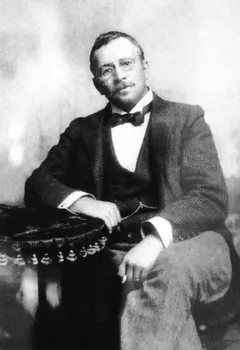
Kimberley: a hill cut into claims
Kimberley, South Africa: the Kimberley mine and town. Woodburytype, 1888, after a photograph by Robert Harris., Harris, Robert, active 1881-1888. (Public Domain Mark 1.0)
In 1871 diggers began work on a low hill in the dry country north of the Cape Colony. It held diamonds, carried up from deep in the Earth by an ancient volcanic pipe. The hill became the Kimberley mine. Digging went on until August 1914. By then the mine had yielded 2,722 kg of diamonds from 22.5 million tons of ground and left a hole 214 m deep.1,5
About 50,000 miners dug the Big Hole, largely by hand. It covers 17 ha and is 463 m across. Underground workings later reached 1,097 m before the mine closed in 2005. We tell the story of the hole itself in our feature the Big Hole, Kimberley. This chapter follows the money it made.3,6
2,722 kg diamonds
Yield of the Kimberley mine, 1871 to 1914, from 22.5 million tons of ground5
The rock that held the diamonds is now called kimberlite, after the town. Kimberlite pipes are carrot-shaped bodies of volcanic breccia that carry diamonds up from the mantle. Mined kimberlites yield only 0.1 to 0.6 parts per million of diamond. Most of the rock that comes out of a diamond mine is waste.4

At first the hill was worked by thousands of diggers on small claims. Within 17 years it was controlled by one company. The rest of this chapter is about how that happened, and what the money did next.3,7


Barnato, Rhodes and Beit: the making of De Beers
Griqualand West, South Africa: Kimberley diamond mine. Woodburytype, 1888, after a photograph by Robert Harris., Harris, Robert, active 1881-1888. (Public Domain Mark 1.0)
One of those men was Barney Barnato. He followed his brother Harry from London to the diamond fields in 1873 and was a millionaire within ten years. Barnato liked to say he had arrived in South Africa penniless. The Dictionary of National Biography says he had over fifty pounds on reaching Cape Town, and that the penniless story was one of his own fictions.8,10
His rival was Cecil Rhodes. Rhodes went to the diamond fields to supervise his brother's claim. In 1871 he bought a claim at De Beer's, and with Charles Rudd he went on to buy the old De Beers claims, which gave the company its name.7,11
Behind Rhodes stood Alfred Beit. At 17 Beit joined a Hamburg firm of South African merchants and was sent to Kimberley, where he became Rhodes's close friend. In 1888 he lent Rhodes 250,000 pounds without security to complete the amalgamation of the mines.9
The deciding fight was over Barnato's Kimberley Central Diamond Mining Company, the main rival to De Beers. In 1888 Rhodes paid 5,338,650 pounds for it, with four million going to the Barnato brothers.10
5,338,650 pounds paid in 1888
Price Rhodes paid for Barnato's Kimberley Central company10
On 13 March 1888 De Beers Consolidated Mines was founded to control diamond production in South Africa. It was one of the first great mining monopolies. Controlling supply, rather than just digging, became the business model of the diamond trade for most of the next century.7

Another partner in the amalgamation was Julius Wernher, who reached Kimberley in January 1871 for the diamond merchant Jules Porges. His firm became Wernher, Beit and Co. in 1890, and it would soon be the leading house on a new gold field.12


The Witwatersrand gold rush, 1886
Witwatersrand, South Africa: part of the city of Johannesburg. Woodburytype, 1888, after a photograph by Robert Harris., Harris, Robert, active 1881-1888. (Public Domain Mark 1.0)
The Witwatersrand had been found once already. In 1868 the German explorer Carl Mauch, on a British-backed search for diamonds in the Transvaal, found the Witwatersrand gold field. His find was only recognised about 15 years later. He died in Stuttgart in 1875, aged 37.13
Smaller gold rushes came first, in the eastern Transvaal. A rush began at Pilgrim's Rest in 1873 after Alec "Wheelbarrow" Patterson found alluvial gold nearby. Barberton was named after Henry Barber on 24 July 1884, after he and his cousin Fred found gold there.17,18

Then, in July 1886, George Harrison found the main reef on the farm Langlaagte. By August the unnamed camp had about 3,000 people. Nine farms were proclaimed public diggings on 8 September. The town was named Johannesburg on 3 October 1886.14
Growth was fast. By the end of 1887, 14 mines with 93 stamps were making about 19,080 ounces of gold a year. By 1895 Johannesburg had about 102,000 people.16
3,000 to 102,000 people
Johannesburg, August 1886 to 189516
The Rand was not like California or Victoria. Its gold lies in ancient river gravels, now hard conglomerate, 3,100 to 2,200 million years old. A digger with a pan could do little with it. Working it took capital, machines and chemistry. Read more about this Witwatersrand conglomerate in our glossary.4
The diamond men had all three. Joseph Benjamin Robinson, who had made a fortune in Kimberley diamonds, bought the Langlaagte and Randfontein estates, judging correctly that the main reef ran westwards. In 1888 Alfred Beit arranged for Hermann Eckstein to set up a Witwatersrand branch of his firm.19
Other Kimberley men moved north too. Sammy Marks went from Cape Town to Kimberley and then to the Transvaal, where he formed the African and European Investment Company, a major Rand finance house. He founded the town of Vereeniging through a mining company, developed the Witbank coalfield and later sat in the Senate from 1910 to 1920.15
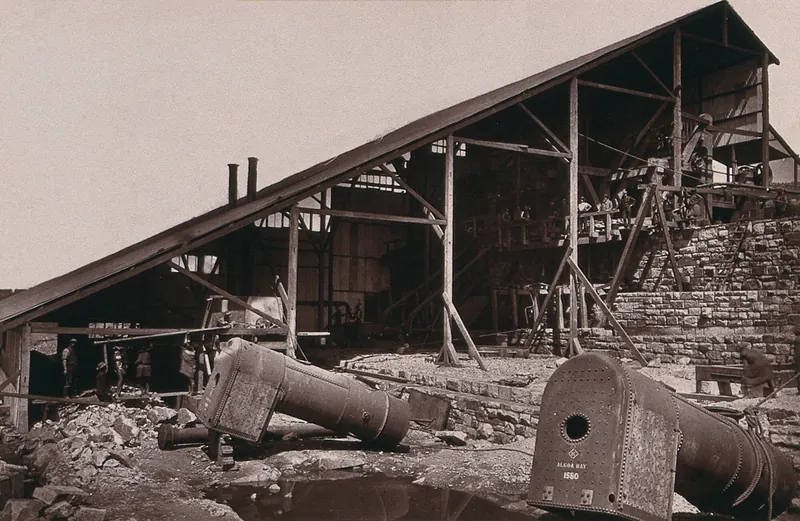

The cyanide process: chemistry saves the Rand
Neerslagvaten bij de Robinson Mine bij Johannesburg, Europeana (Public Domain Mark 1.0)
By 1890 the surface diggings were running out, and the deeper ores were harder to treat. The answer came from Glasgow.21,22
In 1885 the Glasgow doctors Robert and William Forrest and the chemist John Stewart MacArthur got hold of some refractory gold ore and began experiments. In November 1886 they tested potassium cyanide as a solvent for gold. British patents followed in October 1887 and July 1888.20
The MacArthur-Forrest process reached the Witwatersrand in May 1890. Recovery from complex ores rose from about 45 to 98 percent. Monthly gold output roughly doubled within two years.20,21
45% to 98% gold recovery
Rise in recovery from complex Rand ores after cyanide arrived in 189020
MacArthur gained little from it. In 1896 the Great Cyanide Case in the Pretoria High Court challenged the novelty of his patents. They were annulled in South Africa and then elsewhere.20
Cyanide is still at the heart of gold mining. USGS notes that heap leaching with cyanide was proposed in 1969 as a way to treat low-grade ores. You can read how it works in our glossary entries on cyanidation and the heap leach.22


Deep levels, the Randlords and the Jameson Raid
Wemmer Gold Mine Johannesburg, Europeana (Public Domain Mark 1.0)
Because the reef dipped, the richest future lay far below the outcrop. Wernher, Beit and Co. was a forerunner in the Rand deep-level system, sinking shafts to reach the reef far underground. The Dictionary of National Biography credits it as the main source of later Rand prosperity.9
The scale became enormous. In 1912 the mines of the Wernher group produced 3,500,000 ounces of fine gold and paid 4,250,000 pounds in dividends. That was 51 percent of the profits of the whole Witwatersrand.12
The Transvaal's gold was worth 11.65 million pounds in 1897. It fell to 1.48 million in 1900 during the South African War, then rose to 30.99 million in 1909. That was about a third of all the gold mined in the world that year.23
Mining wealth turned into politics. In December 1895 Leander Starr Jameson, a Kimberley doctor and friend of Rhodes, led an armed raid from the border towards Johannesburg. He surrendered on 2 January 1896. Beit had helped place the force on the border. The failure forced Rhodes to resign as Prime Minister of the Cape in January 1896.9,11,24
Rhodes had already pushed north. On 30 October 1888 Charles Rudd and two others, acting for Rhodes, got the Ndebele king Lobengula to sign the Rudd Concession, a charge over all the metals and minerals in his kingdom. A royal charter for the British South Africa Company followed in 1889.25,26
Rhodes died in 1902 and left 6 million pounds. His will funded the Rhodes scholarships. His colonial legacy remains contested.11
Barnato died in 1897. His nephew Woolf Joel took over his business affairs and was assassinated in Johannesburg in March 1898.8

Oppenheimer, the Cullinan and the miners
1000 feet level Kimberley mine, Europeana (Public Domain Mark 1.0)
On 26 January 1905 Captain Frederick Wells, manager of the Premier mine, found a 3,106 carat diamond near the rim of the pit. It was named after the company chairman, Sir Thomas Cullinan. The two largest stones cut from it weigh 530 and 317 carats. It is the largest gem diamond ever found.27
3,106 carats
The Cullinan diamond, found at the Premier mine on 26 January 190527
A new generation took over. Ernest Oppenheimer went to Kimberley as a diamond buyer in 1902, aged 22. In September 1917 he founded Anglo American with American and British finance. In 1926 it became the largest single shareholder in De Beers, and he became De Beers chairman in 1929.28,31
The mines ran on the labour of Black miners, who had little say over their pay. In August 1946 the African Mine Workers' Union, led by J. B. Marks, called a strike from 12 August. The government counted 75,000 strikers, and South African History Online says the number was probably nearer 100,000. Police and soldiers drove them back to work. Officially 9 were killed and 1,248 wounded.29,30
Ernest's son Harry Oppenheimer, born at Kimberley in 1908, ran the family businesses from 1957. The Guardian's obituary called him the last of the Randlords. It says his interests in gold, platinum, diamonds and coal helped sustain the apartheid economy despite his image as a reformer.32

The deepest mines and the new diamond fields
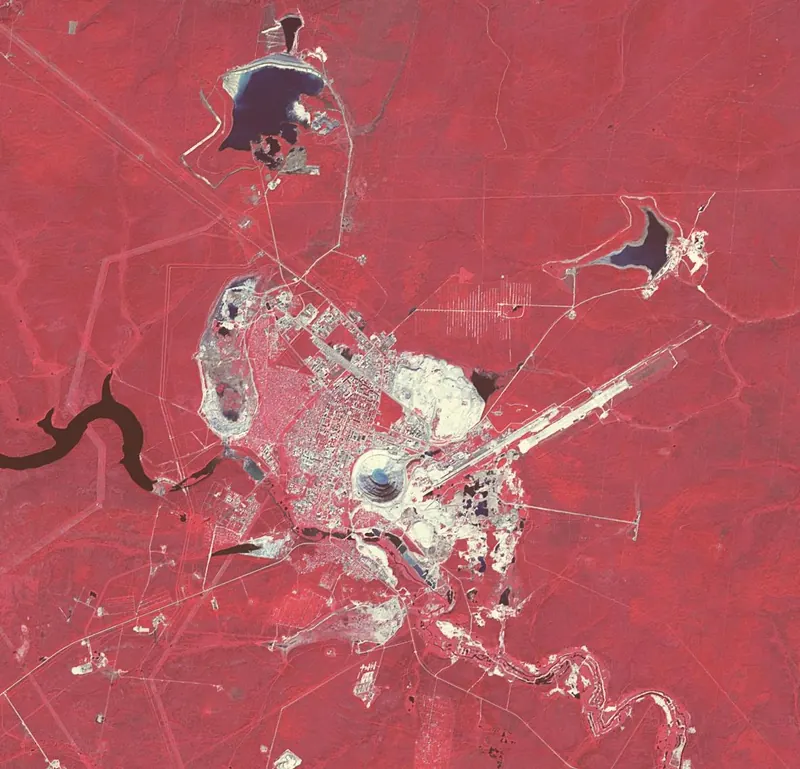
Orapa Diamond Mine, Botswana, NASA/GSFC/METI/ERSDAC/JAROS, and U.S./Japan ASTER Science Team (Public domain (NASA media, no copyright))
The Rand's deep-level idea never stopped. Mponeng, near Carletonville, works the Ventersdorp Contact Reef at 3,160 m to 3,740 m below datum, with development at 3,841 m. It is one of the deepest mines in the world. It produced 333,402 ounces of gold in the year to June 2025.33,34
3,841 m deep
Development depth at Mponeng, one of the world's deepest mines33
Diamonds moved on too. On 25 April 1967 De Beers geologists found the Orapa pipe in Botswana. President Seretse Khama opened the mine on 1 July 1971. Debswana, a 50:50 partnership of the government and De Beers from 1975, went on to open Jwaneng in 1982, which De Beers calls the richest diamond mine in the world by value.35
In Siberia, the Mir pipe in Yakutia was found on 13 June 1955. ALROSA says open pit mining there ended in 2001. In Canada, Chuck Fipke and Stewart Blusson found 81 small diamonds at Lac de Gras in November 1991, setting off the greatest diamond staking rush in North American history.65,66
In Western Australia, Argyle closed on 3 November 2020 after more than 865 million carats of rough diamonds in 37 years. It was the main source of rare pink diamonds.67
- Kimberley Big Hole1871
- Jagersfontein diamond mine1852
- Witwatersrand main reef mines, 1886 to 18871886
- Pilgrim's Rest goldfield1873
- Mponeng1986
- TauTona
- Orapa1971
- Jwaneng1982
- Venetia
- Mir diamond mine1957
- Diavik2003
- Argyle diamond mine
- Kimberley diamond rush1871
- Gold found on the Witwatersrand1886
- Cullinan diamond found1905
- African mine workers' strike on the Witwatersrand1946
- San Francisco ships US$724 million of treasure in 16 years
Eastern ports took US$462 million, England US$168 million and China US$68 million.43,44
- General Mining Law of 1872
The law remains the basis for claims to locatable minerals on US federal land.45,46
- Black Hills gold rush
The expedition went ahead although the 1868 treaty had made the Black Hills part of a Sioux reservation. Homestake became a long-lived mine that closed in 2001.47,48
- Homestake Mine: inception
Homestake Mine: inception.49
- Barberton gold rush
Barberton was the first major gold boom of the eastern Transvaal, two years before the Witwatersrand.17,50
- Gold found on the Witwatersrand
It created the largest gold field known and Johannesburg.14,51
- Gold find at Southern Cross
A find at Southern Cross caused excitement in 1888, before the Coolgardie and Kalgoorlie rushes.52
- Paddy Hannan applies for a reward claim at Kalgoorlie
Hannan, Flanagan and O'Shea's find led to Australia's biggest gold rush to that date.53
- Gold found on Rabbit (Bonanza) Creek
- Steamship Portland docks at Seattle with a ton of Klondike gold
The ship carried 68 miners from St. Michael, and news of the gold set off the stampede.56,57,58
- Nome gold rush
The NPS describes the Nome strikes as the end of the American gold rush trail.59,60
- Harry Oppenheimer born
Harry Oppenheimer born (date from Wikidata).61
- Rand Rebellion begins
An uprising on the Witwatersrand began on 28 December 1921 and ran into 1922 (dates from Wikidata).62,63
- Bretton Woods conference
Bretton Woods conference.64
How did the Rand compare with the earlier rushes? Our comparison sets it beside California and the Klondike.23,39
Witwatersrand gold rush
- Discovery1886-0714Harrison, Langlaagte; his affidavit date is not on the opened page
- Camp population (1886)3,000 people14About 3,000 inhabitants by August 1886, mostly White
- Public diggings proclaimed (1886)9 farms14Proclaimed 8 September 1886
- Towns founded (1886)1 town14Johannesburg named 3 October and declared 4 October 1886
- Transvaal gold value (1897)11,654,000 pounds sterling (assumed)23ABS table, Transvaal
- Transvaal gold value war low (1900)1,481,000 pounds sterling (assumed)23Output collapsed during the South African War
- Transvaal gold value later (1909)30,988,000 pounds sterling (assumed)23ABS table, Transvaal
- Transvaal share of world gold (1909)33.7 percent23Computed: 30.988 / 91.91
California gold rush
- Discovery1848-01-2438Marshall at Sutter's mill
- Population before rush (1848)14,000 people (non-Indian)39State population estimate when gold was found
- Population end 1849 (1849)100,000 people39"nearly 100,000"
- Population 1852 (1852)250,000 people39"some 250,000"
- Census population (1850)92,597 people401850 US census count
- Gold recovered (1855)750,000 pounds40Estimated recovered 1848 to 1855. About 340 tonnes at 0.4536 kg per pound (computed).
- Value recovered then (1900)25,000,000,000 US dollars, modern equivalent39Mother Lode and Klamath fields together, "modern-day equivalent of more than $25 billion" by the turn of the century
- News reached san francisco1848-0340Rumours reached San Francisco in March 1848
- Population after 50 years (1900)1,485,053 people40California census 1900
Klondike gold rush
- Discovery1896-08-1641Parks Canada; staking on 17 August per its history text
- News to outside world1897-0742SS Portland reached Seattle with over a ton of gold
- People who set out (1900)100,000 people42Set out for the Klondike 1897 to 1900 ("more than")
- People who came (1900)40,000 people42"No more than 40,000" reached Dawson City
- Canada gold value before (1897)1,240,000 pounds sterling (assumed)23Canada national gold yield, ABS table; Klondike share not separated
- Canada gold value peak (1900)5,742,000 pounds sterling (assumed)23Canada national gold yield, ABS table
- World gold value (1900)52,086,000 pounds sterling (assumed)23World gold yield 1900, ABS table
- Canada share of world gold (1900)11 percent23Computed from the two ABS values (5.742 / 52.086)
Today conflict diamonds are kept out of the legal trade by the Kimberley Process Certification Scheme, signed by 37 participants at Interlaken and in force since 2003. For mining in the region now, see mining in South Africa and mining in Botswana.68
Next: the cost underground
Deep mines were dangerous mines. In 1960 about 900 pillars collapsed at the Clydesdale colliery at Coalbrook in South Africa, and 437 miners were buried alive. Half a century earlier, in northern France, a single explosion had killed more than a thousand. The next chapter is about the disasters that made mining what it is, and the laws written after them. Read on in chapter 7: mining disasters and the laws they forced.69,70