De re metallica: the first great mining manual
De re metallica libri XII. Georg Agricola, 1556., Unknown (Wellcome Collection) (CC BY 4.0)
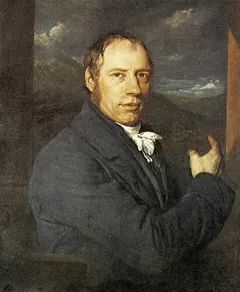
A young doctor named Georg Bauer settled as town physician at Joachimsthal, a rich silver mining centre in the mountains of Bohemia. He wrote under the Latin name Georgius Agricola. At Joachimsthal he learned mineralogy and mining from the local officials, and his first book on the subject, Bermannus, made him famous.1
His great work, De re metallica, was published at Basel in 1556, the year after he died. It became a standard work on mining and smelting. Agricola was also mayor of Chemnitz four times. Staying Catholic while the town turned Protestant brought him into sharp conflict with it, and he was buried at Zeitz.1
The woodcuts in De re metallica are the best picture we have of a 16th century mine. They show shafts and tunnels, water wheels driving pumps, bellows forcing air underground and teams of men and horses lifting ore. Much of what they show, from prospecting to smelting, is still part of a modern mine plan.1

Joachimsthal was a lively place for ideas. Johann Mathesius was called there in 1532 to run the Latin school. He became the town's Lutheran pastor and married the daughter of a mining official. Agricola knew him and thought well of him.1,2

Joachimsthal, today's Jáchymov in the Czech Republic, was founded in 1516. Its silver made it famous in Agricola's day. Four centuries later the waste rock from its mines would make it famous again, for a very different element. That story is in chapter 9.3
Scandinavia had some of the largest mines of the early modern world. The Falun mine in Sweden, the Great Copper Mountain, was the world's largest copper producer in the 17th and 18th centuries. Up to 1,200 people worked underground. Legend dates mining there to about AD 700. Production stopped only in 1992.4
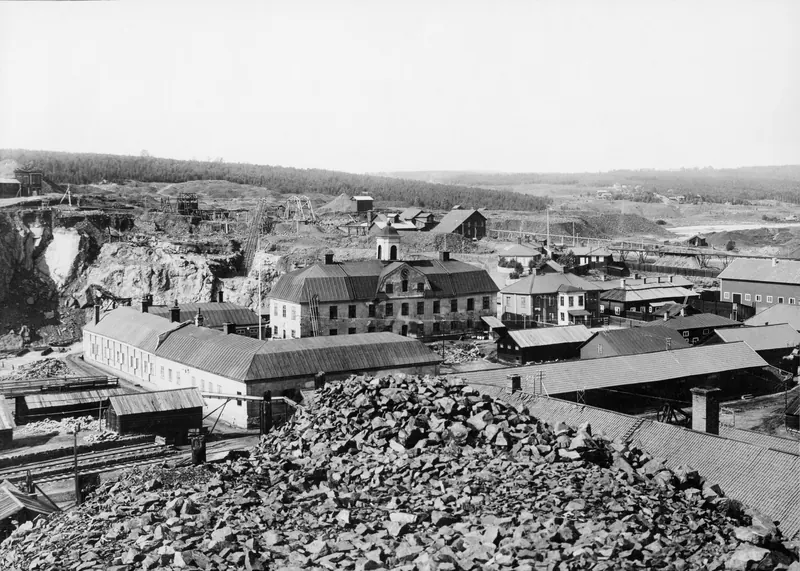
Falun is also famous for engineering. Christopher Polhem built a water-wheel system to lift ore and water from the mine. Moving power from a river to the shaft was the central problem of every deep mine before steam.4
1,200 underground workers
Falun copper mine at its height in the 17th and 18th centuries4
The mining area of the Great Copper Mountain became a World Heritage Site in 2001. For mining in Sweden today, from Falun to Kiruna, see mining in Sweden.6
In Norway, silver was found by children. In the summer of 1623 two young herders found silver at Kongsberg, and state mining began that autumn. The workforce peaked at 4,075 people in 1770. The deepest level, in the King's Mine, reached 1,068 m below the surface. Over its life Kongsberg produced about 1,350 t of silver. Parliament voted in 1955 to close the works, and the last smelting took place in 1958.5
1,068 m deep
Deepest level of the King's Mine at Kongsberg, Norway5
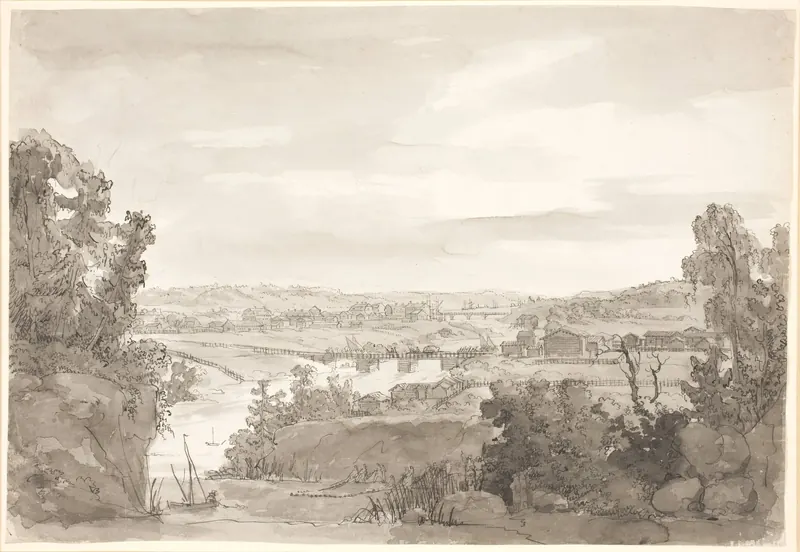
Further north, Røros was founded in 1644 and produced copper for 333 years, about 110,000 t up to 1977. It had more than 40 copper mines. The mining town is a World Heritage Site.7,8
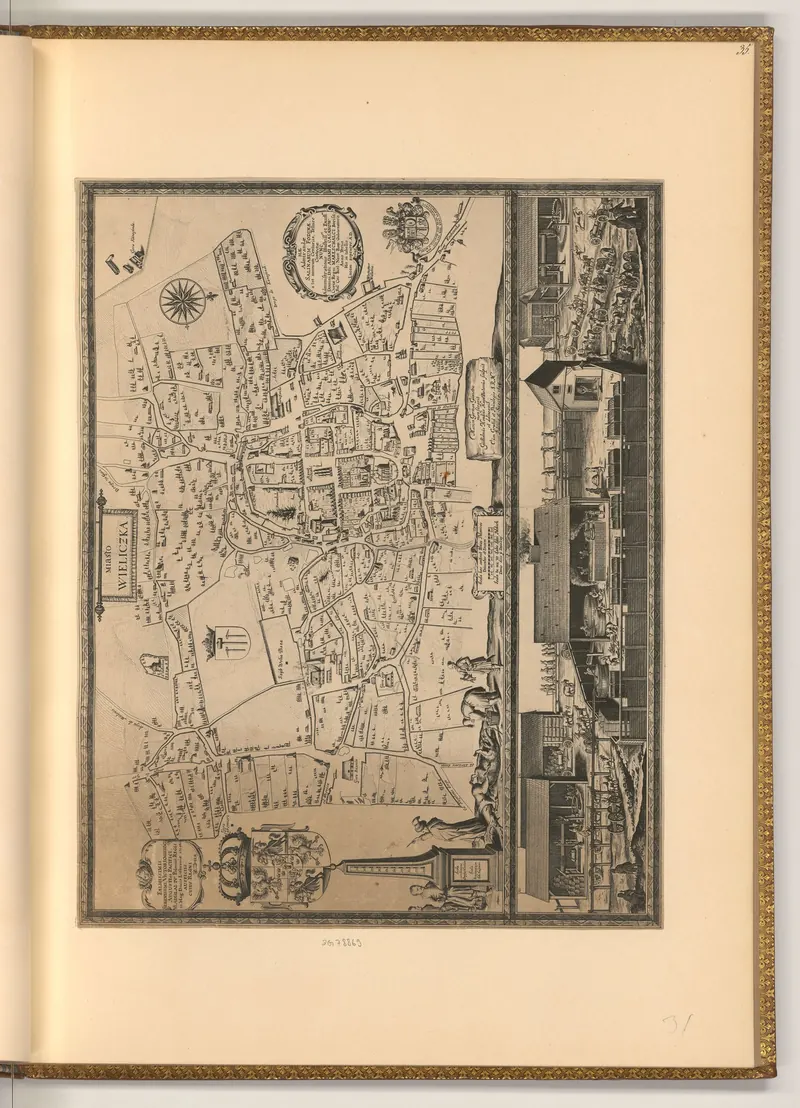
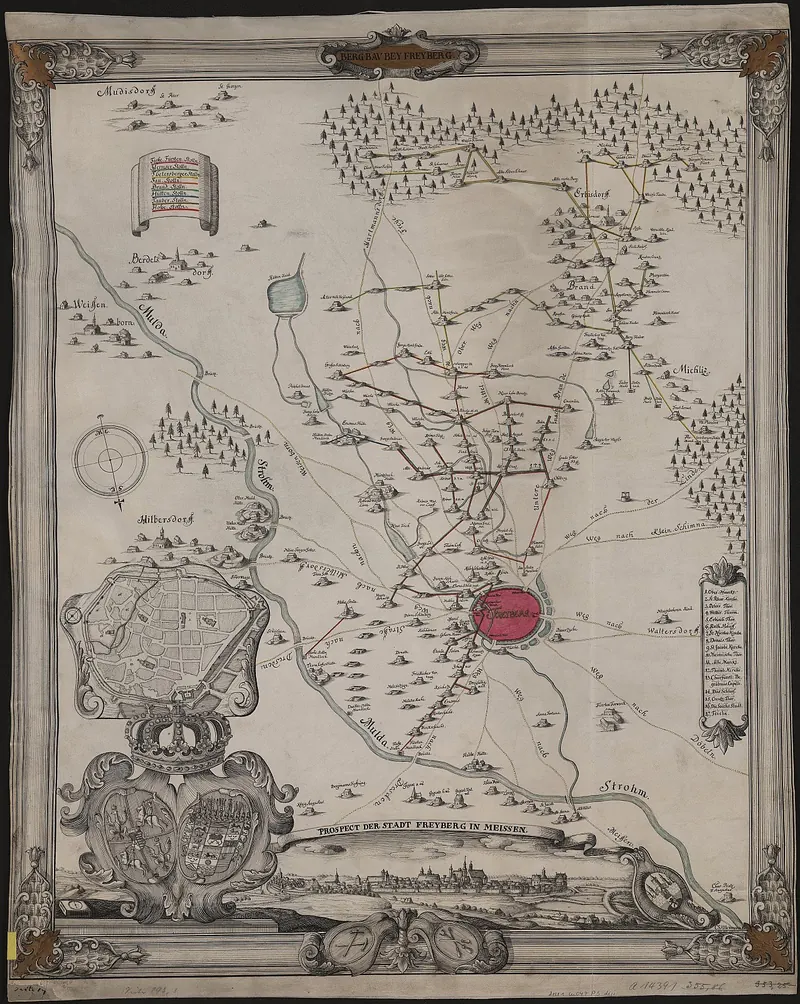
In Poland, the salt mine at Wieliczka went down nine levels, to 315 or 327 m depending on the source. Salt mining there ended in 1996. The 1645 map below shows how complex a mine plan had become by the 17th century.9
Freiberg, forests and the first mining schools
Bergbav bey Freyberg. - [Approx. 1: 25,000]. - Dresdae, 1745. - 1 Kt. : color. Feather drawing , Gr. 159 x 64 cm with co, Europeana (CC BY-SA 4.0)
Deep mines needed timber for props, charcoal for smelting and fuel for fire-setting. In Saxony the forests of the Ore Mountains were being stripped. Hans Carl von Carlowitz, who became mining chief at Freiberg in 1711, worried about it. In 1713 he published Sylvicultura oeconomica, the first purely forestry book in the world.10
It is an early sign of a worry that runs through this series. Mines use up more than ore, and here a mining official feared the mines would run out of wood before they ran out of silver.10
Freiberg also trained the people who would run mines across the world. Abraham Gottlob Werner studied at the Freiberg Mining Academy from 1769 and began teaching mineralogy and mining there in 1775. One of his students was Alexander von Humboldt.11,12
Before his famous travels, Humboldt was a mining official. He became a Prussian mining assessor in March 1792. He raised mine yields in Ansbach-Bayreuth, worked on a safety lamp and a breathing apparatus, and in 1793 paid out of his own pocket for a mining school at Steben, the first of its kind.11
Freiberg graduates later shaped mining in America. Waldemar Lindgren trained there before designing smelter furnaces for Marcus Daly at Anaconda and becoming chief geologist of the US Geological Survey. Rossiter Raymond studied there before advising Congress on the Mining Law of 1872.13,14
Newcomen's engine: steam to pump the mines
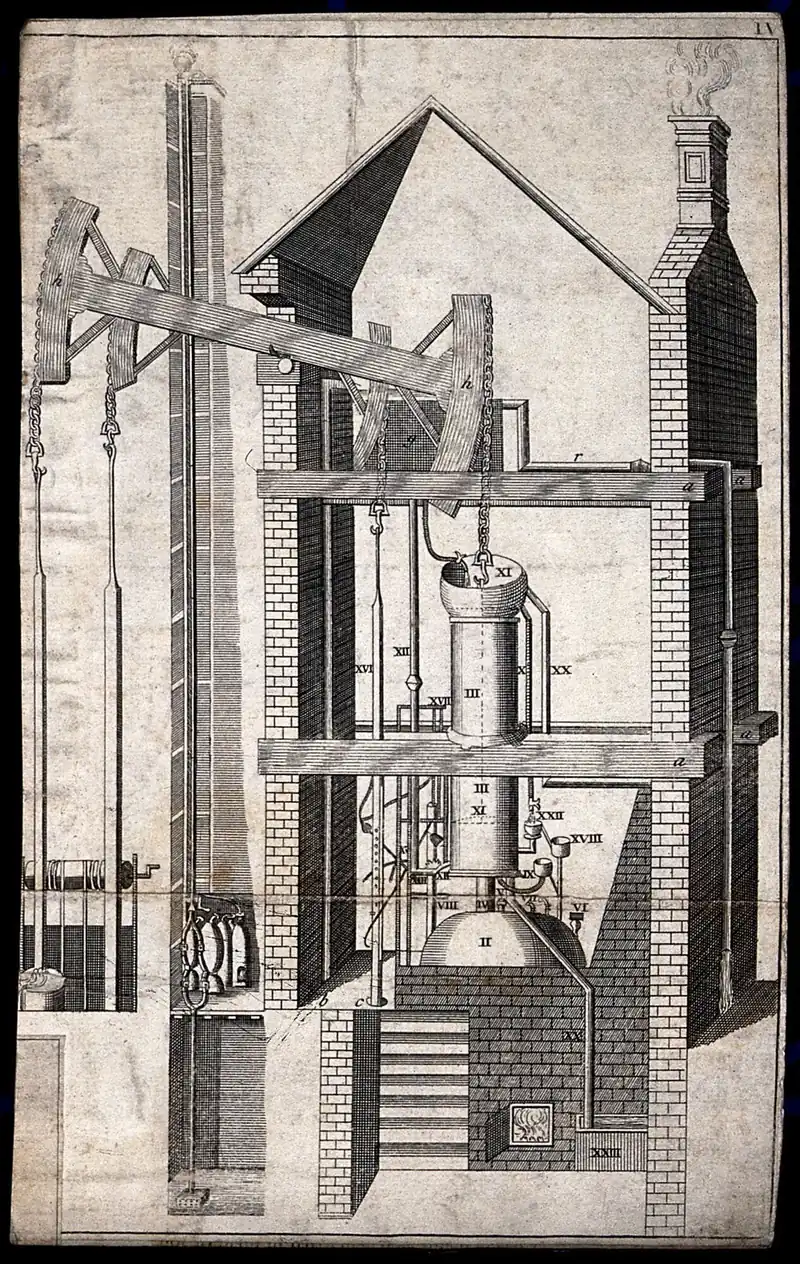
Engineering: a Newcomen steam-engine. Engraving, 174-., Unknown (Wellcome Collection) (Public Domain Mark 1.0)
Water was the enemy of every deep mine. The answer came from Devon. Thomas Newcomen, baptised at Dartmouth in 1663, built an atmospheric engine in 1712. The Dictionary of National Biography calls it the first authentic beam engine.15
The engine spread fast. By August 1716 an advertisement said engines for draining mines were at work in Stafford, Warwick, Cornwall and Flint. One was contracted for Edmonstone Colliery in Midlothian in 1725. Newcomen's engine stayed the model for pumping engines for nearly three quarters of a century.15
The next leap came from inside the mines. Richard Trevithick was a mine engineer in Cornwall from 1790. He built his first engine at Ding Dong in 1795 and patented high-pressure steam engines in 1802. In 1803 he built the first steam railway locomotive. The railway age started as a mining tool.16
Trevithick's life shows how risky the business was. He went bankrupt in 1811. In 1816 he went to Peru to install engines in the silver mines, and his mining ventures in South America lasted until 1827, at a loss. He died working for a foundry in Kent.16
Cornish beam engines still stand. The engine at Levant, built in 1840, is the oldest surviving Cornish beam engine and is still steamed. You can read how engines like it worked in our glossary entry for the beam engine and the engine house.17

Tin mining in Cornwall at its peak
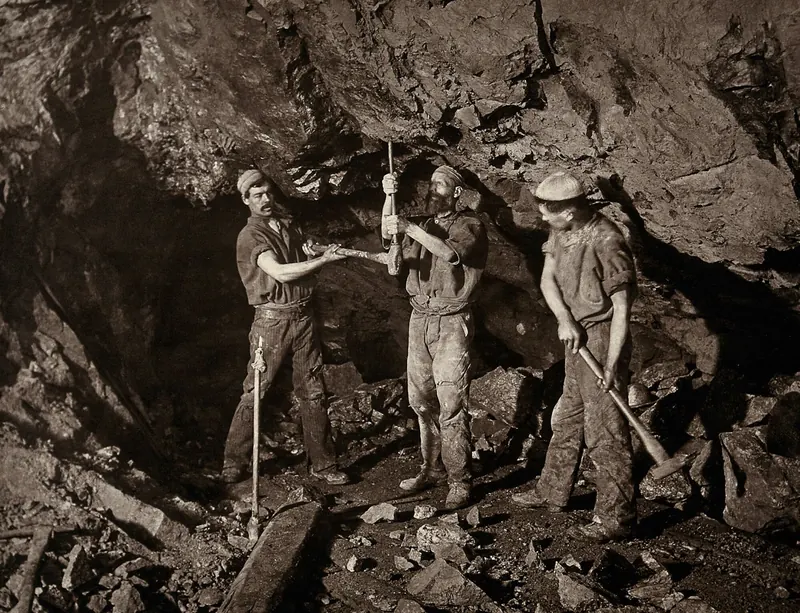
Dolcoath tin mine, Camborne, Cornwall: miners in a mine shaft, standing on wooden platforms connected by ladders. Photograph by J. C. Burrow, 1890/1910., Burrow, J. C., 1852-1914 (Public Domain Mark 1.0)
Steam let Cornish mines go deeper than ever. Dolcoath, near Camborne, was worked from the early 1700s. Its Williams Shaft reached the 412 fathom level, about 754 m down. Between 1853 and 1920 it produced 350,000 t of copper and more than 100,000 t of black tin. It closed in 1921.18
754 m deep
Williams Shaft at Dolcoath, the Queen of Cornish Mines18
On the cliffs at St Just, Cornish miners followed the lodes out under the sea. Undersea mining there was more concentrated than anywhere else in the 18th and 19th centuries. The Crowns engine houses at Botallack still stand on the rocks, with an arsenic labyrinth and calciner nearby.17
Cornwall and West Devon mined more than tin. Devon Great Consols worked copper from 1844 to 1903. Later it refined arsenic, from 1922 until 1930.21
Cornish ground even gave chemistry a new element. In 1791 a black sand from the Manaccan valley was sent to the clergyman William Gregor. He showed it held an unknown metal, later named titanium by the German chemist Klaproth. In 1797 Klaproth said the discovery belonged solely to Gregor.19
Then the copper ran out. ICOMOS says only tin mines kept working after the copper crash of 1866. Geevor closed in 1990. South Crofty was the last Cornish tin mine to close, in 1998. The Cornwall and West Devon Mining Landscape joined the World Heritage List in 2006.17,20
Tin is mined elsewhere now. USGS estimates the world mined 290,000 t of tin in 2025, led by China, Indonesia, Peru, Brazil and the DR Congo. For tin mining in Cornwall today, and the hunt for lithium there, see mining in the United Kingdom and our tin page.22

Coal, gas and the Davy lamp
A coal mine: miners at work above and below ground. Coloured lithograph., Unknown (Wellcome Collection) (Public Domain Mark 1.0)
Steam engines burned coal, and coal had to be mined. British coal output grew through the 19th century and peaked at 292 Mt in 1913. In 2025 the United Kingdom produced 0.12 Mt. The chart shows the whole arc.23
United Kingdom coal production, 1853 to 2025
United Kingdom coal production rose from 71.51 million tonnes in 1853 to 0.12 million tonnes in 2025; the peak in this series is 292 million tonnes in 1913. Basis: total UK saleable coal output, deep-mined plus opencast.
Sources: Historical coal data: coal production, availability and consumption 1853 to 2025; Historical coal data: coal production, availability and consumption 1853 to 2025
Coal mines held a danger metal mines rarely did: firedamp, the methane gas that explodes when it meets a naked flame. Humphry Davy, born at Penzance, designed a safety lamp for coal mines. By January 1817 a subscription from the coal trade had reached nearly 1,500 pounds. On 26 September 1817 the coalowners gave him a service of plate. He published On the Safety Lamp for Coal Mines in 1818.24

1,500 pounds testimonial
Raised by the coal trade for Davy's safety lamp by January 181724
The lamp was only as safe as the people using it. At Bulli Colliery in New South Wales, a gas explosion on 23 March 1887 killed 81 men and boys. The Royal Commission found miners had removed the mesh from their lamps. It named an exposed Davy lamp, or more probably an overcharged shot, as the cause.25

Children underground and the Mines Act of 1842
The physical and moral condition of the children and young persons employed in mines and manufactures / Illustrated by extracts from the Reports of the Commissioners. For inquiring into the employment of children and young persons in mines and collieries, and in the trades and manufactures., Great Britain. Commissioners for Inquiring into the Employment and Condition of Children in Mines and Manufactories; Great Britain. Royal Commission on the Employment and Condition of Children in Mines and Manufactures. (Public Domain Mark 1.0)
Mining at this scale used children. The pictures in this section come from the 1842 report on children's work in British mines. The same year the Mines and Collieries Act banned women and girls from working in mines and collieries, and regulated the work of boys.27
The act passed under the care of Lord Ashley, later the 7th Earl of Shaftesbury. It ended the apprenticeship system and barred women and boys under thirteen from underground work.26

- Mercury amalgamation adopted for Potosi silver
Amalgamation let miners treat poorer ore and drove the output of Potosi, at a high cost in health to the workers.28,29
- Newcomen atmospheric engine
Newcomen atmospheric engine.30
- Harvey's Foundry opens at Hayle
Harvey and Co became the foremost mine-engine foundry in the world, serving a global market.31,32
- Lambert brings the reverberatory furnace to Chile
The furnace let smelters use copper sulphides that had been thrown away before.33,34
- First US contract mail steamers run by way of Panama
Mail and gold-seekers crossed the isthmus by mule, later by rail.35,36
- Caldera-Copiapo railway opens its first section
Chile first railway, built with Atacama capital, ran 41 km from Caldera port to Monte Amargo.37,38
- Bessemer process
Bessemer process.39
- First railway is built to Antofagasta from the El Carmen nitrate flat
The Antofagasta Nitrate Company laid the line between the salar El Carmen and the port.40,41
- Hall-Heroult process
Hall-Heroult process.42
- Cyanide process for gold developed in Scotland
USGS says heap leaching with cyanide was proposed in 1969 as a way to treat low-grade ores.43,44,45
- Antofagasta railway reaches Oruro
The line to the Pacific cut costs of sending Bolivian ore to Europe.40,46,47
- Matadi-Kinshasa Railway opens
Matadi-Kinshasa Railway opens.48
It was one of the first laws to say who could and could not work underground. Many more would follow, nearly all of them written after a disaster. We look at those in chapter 7.27
Cornish miners go global
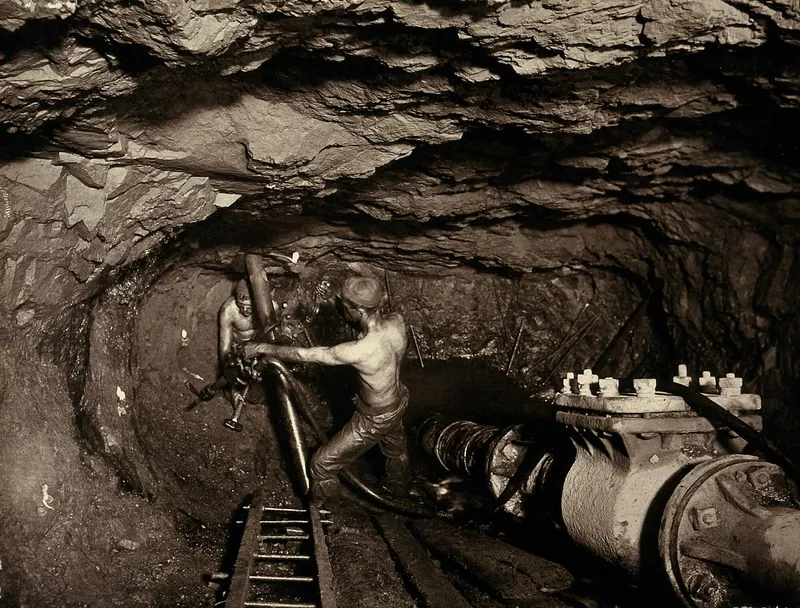
Tincroft tin mine, near Camborne, Cornwall: two miners at work in a mine shaft. Photograph by J. C. Burrow, 1890/1910., Burrow, J. C., 1852-1914 (Public Domain Mark 1.0)
When the Cornish mines declined, their miners did not stop mining. They took their skills with them. More than 1,000 workers, most of them Cornish, dug copper at Burra in South Australia from 1845. Cornish miners worked the Empire Mine in California from about the mid 1850s. In 1858 it was twenty-two Cornish miners of the Red Hill Mining Company who found the 68.98 kg Welcome Nugget at Ballarat.49,50,51
The skills they carried were the ones this chapter describes: sinking shafts, timbering, pumping and following a lode underground. The engine houses they left at home are now part of a World Heritage landscape. Geevor, near St Just, is described as the largest metalliferous mine site open to the public in the United Kingdom.17,20
Germany kept its old mines too. The Mines of Rammelsberg, the historic town of Goslar and the Upper Harz Water Management System form a World Heritage Site inscribed in 1992 and extended in 2010. The ponds, ditches and tunnels of the Upper Harz were built to drive the wheels that drained and worked the mines, the same problem Newcomen solved with steam.52,53

By the middle of the 19th century, Cornish miners and their engines were going all over the world. Trevithick had taken his to Peru. In 1845 copper was found at Burra in South Australia, and more than 1,000 workers, mostly Cornish, came to dig it. Their ore, and ore from Chile, sailed to one small town in Wales that smelted much of the world's copper. Read on in chapter 4: Copperopolis, from Swansea to Butte.16,49