

Joachimsthal: a silver town and its black waste
De re metallica libri XII. Georg Agricola, 1556., Unknown (Wellcome Collection) (CC BY 4.0)
Uranium was found in a mine long before anyone knew what it was. Miners in the medieval silver mines of central Europe kept turning up a heavy black mineral. It was pitchblende. They had no use for it.3
The best known of those mines were at Joachimsthal in the mountains of Bohemia, now Jáchymov in the Czech Republic. The town dates from 1516. A young doctor named Georgius Agricola settled there as town physician and learned about mining from the local officials. His great book, De re metallica, came out at Basel in 1556. We met it in chapter 1.1,4
Joachimsthal was a lively place for learning. In 1532 Johann Mathesius was called to be rector of its Latin school, where he built up the library. He became the town's Lutheran pastor and married the daughter of a mining official. Agricola knew him and thought well of him.1,2
None of these men knew that the black mineral on the spoil heaps would one day matter more than the silver. That would take nearly four centuries.1,3
In 1789 the chemist Martin Heinrich Klaproth identified a new element in pitchblende. It was named after the planet Uranus. Peligot first isolated the metal in 1841.3
Uranium is a silvery metal and very dense: 19.1 grams in every cubic centimetre. The earth's crust holds about 2.7 parts per million of it. It is radioactive and toxic, and it has no role in living things. The ores that matter are uraninite, which is pitchblende, brannerite and carnotite.3,5
1789 year
Klaproth identifies uranium in Joachimsthal-type pitchblende3
For another hundred years after Klaproth, uranium was a chemist's curiosity, and the pitchblende of the silver mines was still waste.3

Marie Curie and radium
The laboratories of Marie and Pierre Curie, Paris: room where experiments on uranium ore took place. Photograph, ca. 1900., Unknown (Wellcome Collection) (Public Domain Mark 1.0)
That changed in a shed in Paris. Marie Curie noticed that pitchblende was more radioactive than its uranium content could explain. Something else in it was giving off rays. With her husband Pierre she set out to find it.6
The work led to two new elements, polonium and radium. Her raw material came from a mine. It was the residue left over after uranium salts had been taken out of pitchblende from St Joachimsthal. The silver town's waste had become the starting point for a new science.6,7

Pierre Curie died in 1906. Marie carried on, and in 1911 she won the Nobel Prize in Chemistry.6
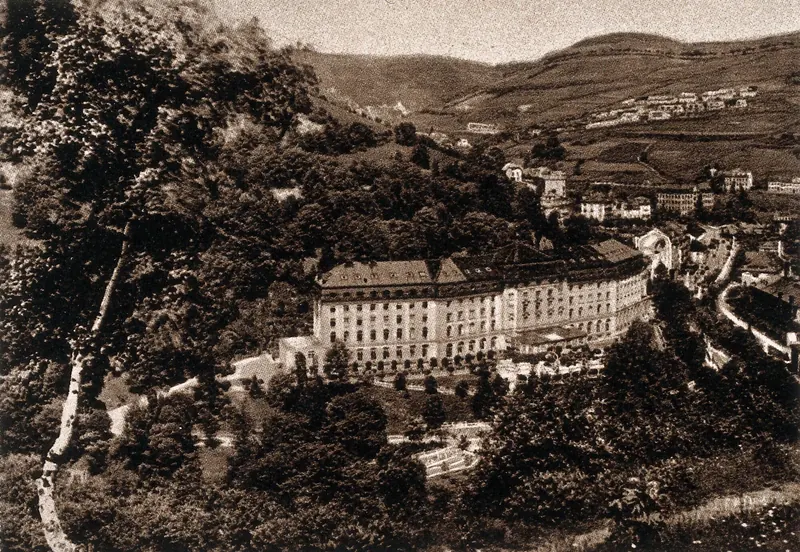
The old silver town took the new element as part of its name. The picture shows the Radium Palace Hotel at Joachimsthal.4
The new trade drew in old mining men. John Stewart MacArthur, whose cyanide process had transformed gold recovery on the Witwatersrand in chapter 6, later refined radium at Runcorn and Balloch.8


Shinkolobwe: the richest uranium mine in the world
Kopermijn te Kolwezi in de provincie Shaba (Katanka), Mieremet, Rob / Anefo / Europeana (Public Domain Mark 1.0)
The next great source of radium was in central Africa. Union Minière du Haut Katanga was created by a royal decree of King Leopold II of Belgium on 28 October 1906, to mine the copper of Katanga in the Belgian Congo.10
Among its properties was Shinkolobwe, about 15 km from Likasi. The uranium ore there was unusually rich. One history of the Manhattan Project says it was up to 60 times richer than average.9
60x richer
Shinkolobwe ore compared with average uranium ore9
Union Minière refined radium from it. The first grams of its radium came out of its plant at Olen, in Belgium, in late 1922. The man who would decide the mine's later fate was Edgar Sengier. In 1911, while working in Shanghai, he received a cable asking him to join a mission to Katanga. He went on to lead Union Minière.11
Katanga was mined on a scale Joachimsthal had never known. In the Union Minière open pits, steam shovels cut the share of ore dug by hand from 90 per cent to 16 per cent in six years, up to 1923.12
Radium was so concentrated in the Katanga ore that the market filled up. In 1937 Union Minière stopped work at Shinkolobwe. Its stocks of radium and uranium were enough to cover the next 30 years of demand.13
In 1938 the United States used 168 tons of uranium oxides. Of those, 106 tons came from the Belgian Congo and 26 tons from Colorado. Few people yet saw uranium as anything more than a source of radium and colour.14
The Belgian Congo is now the Democratic Republic of the Congo. Its copper and cobalt story is told in our Congo copper and cobalt story.9
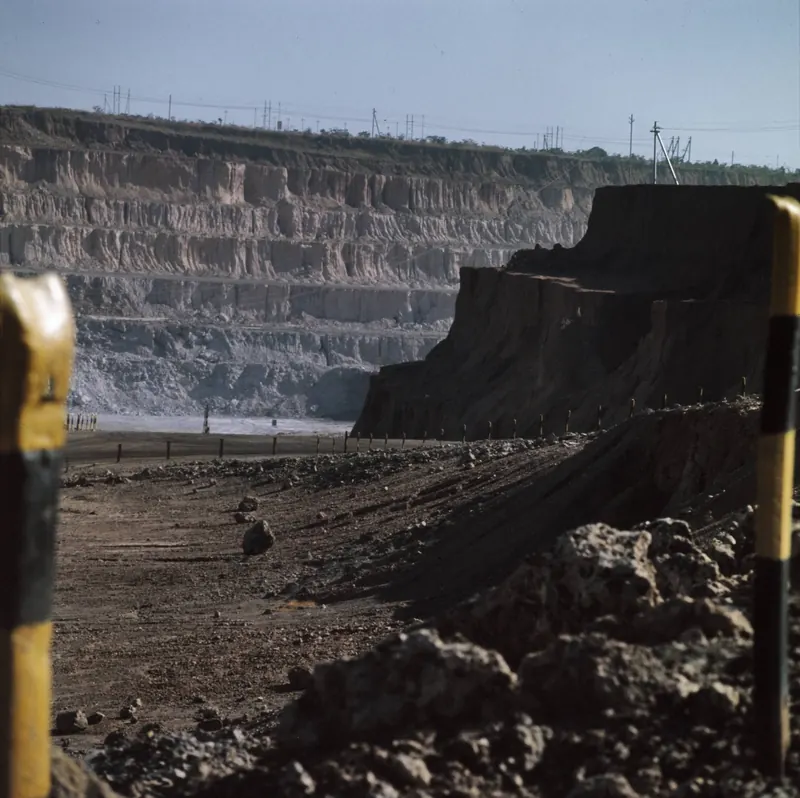
Manhattan Project uranium: ore on Staten Island
Zaire (voorheen Belgisch Congo ); kopermijn de Kolwezi, Mieremet, Rob / Anefo / Europeana (Public Domain Mark 1.0)
Then came the war. The Manhattan Project, the American programme to build an atomic bomb, traces its start to 1939.16
Sengier had seen trouble coming. At the end of 1940, fearing that Germany might take over the Congo, he had about 1,200 tons of very rich Shinkolobwe ore shipped to New York. It sat in drums in a warehouse on Staten Island.11,14
In March 1942 Sengier offered the ore to the United States. In early September Colonel Kenneth Nichols of the Army met him and moved to acquire the 1,200 tons on Staten Island. By the end of the year the Army had also acquired about 3,000 tons of ore still in the Congo.15
1,200 tons
Shinkolobwe uranium ore stored on Staten Island in 194014
Shinkolobwe was one of three main sources of uranium for the project. The others were the Eldorado mine in Canada and mines in the American West. The Office of Scientific and Technical Information says the Congo ore gave about two thirds of the uranium the project used.13,17
Uranium had become a matter for heads of government. In 1944 Roosevelt and Churchill signed an agreement to set up a Combined Development Trust. Its aim was to win exclusive rights to Belgian Congo uranium.14
The United States purchased 3.4 million pounds of Shinkolobwe ore in 1944 alone. The mine was officially closed in 2004.9

The Cold War uranium boom
Interior of the Plum Brook Reactor Facility, NASA GRC (Public domain (NASA media, no copyright))
After the war, the hunt for uranium went worldwide. Australia shows how fast things moved. In 1954 it produced 13.9 t of uranium oxide. By 1961 it produced 1,338 t, almost a hundred times as much.18
The boom did not last. Australian output fell to 267 t in 1965 and 230 t in 1970. Then it rose again. It reached 1,852 t in 1980 and 3,835 t in 1985. The chart shows the two booms and the gap between them.18
Australia uranium production, 1954 to 2021
Australia uranium production rose from 13.9 tonnes U3O8 in 1954 to 4,076 tonnes U3O8 in 2021; the peak in this series is 11,220 tonnes U3O8 in 2005. Basis: uranium oxide (U3O8) produced.
Sources: A Comprehensive Dataset for Australian Mine Production, 1799 to 2021 (v1.4b, Tab04…
Uranium towns came and went with the mines. Mary Kathleen, in Queensland, is today listed simply as a former mining settlement.22
The second boom built more lasting mines. Ranger, in the Northern Territory, opened in 1980. In about 40 years it produced about 112,000 t of uranium. Pit mining ended in 2012, and stockpiled ore fed the mill until production stopped in January 2021.19

The picture shows the Northern Territory savanna, Ranger's home, from space. Closing the mine meant more than switching off the mill. The site had to be rehabilitated, a task that was due to be finished by January 2026.19
In South Australia, the largest find of the period had no surface outcrop at all. A magnetic anomaly led explorers to drill at Olympic Dam. In 1975 drill hole RD1 cut 38 m averaging 1.0 per cent copper between 353 and 391 m deep. It proved a vast body of copper, gold, silver and uranium.20,23
Olympic Dam gave its name to a whole family of deposits. Geologists call them iron oxide copper-gold deposits. They are large bodies of broken, hematite-rich rock holding copper, uranium, gold and rare earths. Olympic Dam itself is about 1,500 million years old. Explorers look for them by searching for a gravity high, since the iron-rich rock is heavier than its surroundings.21
The Roxby Downs Indenture Act of 1982 set the terms, and production began in 1988. BHP bought the mine with Western Mining Corporation in 2005. It lies 560 km north-west of Adelaide, and its milling capacity was raised to 11 Mt a year in 2023. In the year to June 2026 its Copper South Australia business produced 3.6 kt of uranium alongside 321 kt of copper. You can read more about the uranium Australia mines on our uranium page.24,25
11,220 t U3O8
Australian uranium output in 2005, the peak year18
Cigar Lake, Namibia and Kazakhstan: uranium today
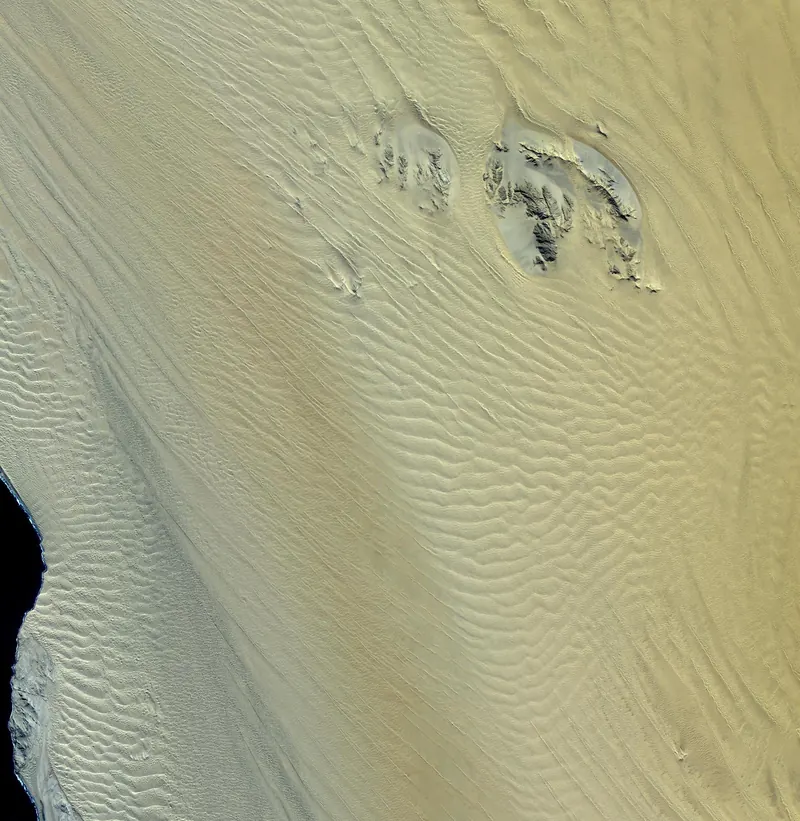
Namib Desert, Namibia, NASA/GSFC/METI/ERSDAC/JAROS, and U.S./Japan ASTER Science Team (Public domain (NASA media, no copyright))
The richest uranium ore today comes from the Athabasca Basin of Saskatchewan in Canada. Its deposits are of a type called unconformity-related uranium. The pitchblende sits in broken rock close to an ancient erosion surface, buried under younger sandstone. These deposits are 1,800 to 1,200 million years old.21,34
McArthur River has been mined since 1999, with its ore milled at Key Lake, which opened in 1983. Ore is mined 530 to 640 m below the surface. Together the two have produced 583 million pounds of uranium oxide.35
Cigar Lake is richer still. It was commissioned in 2014 and began commercial operation in May 2015. The ore is mined about 480 m down, using a jet-boring method. At the end of 2025 its average grade was 16.33 per cent uranium oxide. Since it was commissioned, Cigar Lake has produced 174.5 million pounds of uranium oxide.26
16.33% U3O8
Average grade at Cigar Lake, Saskatchewan, end of 202526
In Namibia, the Rössing open pit in the Namib Desert dates from 1976. It produced 2,111 t of uranium in 2020, about 4 per cent of world output. Its neighbour Husab, owned 90 per cent by China General Nuclear Power Group, produced 3,302 t, about 7 per cent. USGS says two of the world's ten largest uranium mines are in Namibia. See mining in Namibia.27,36
Uranium mining still runs in cycles. Langer Heinrich, in the Namib Desert 80 km east of Walvis Bay, was put on care and maintenance in 2018. Its owner, Paladin, released a plan to restart it in November 2021.27
Uranium matters to Namibia's economy. In 2019 mining and quarrying made up 9.3 per cent of the country's output by the national measure, and uranium accounted for 1.4 percentage points of that. The state company Epangelo Mining holds 10 per cent of Husab.37
Kazakhstan was the world's leading producer of uranium in 2023. Its mines look nothing like Shinkolobwe. At Inkai, found between 1976 and 1978, there is no pit and no shaft. Instead a solution is pumped through wells into the ore body and brought back to the surface carrying the uranium. This is called in-situ recovery. In 2025 Inkai produced 8.4 million pounds of uranium.28,38
Inkai took a long time to reach that point. JV Inkai was registered in 1996 and received its licence for Block 1 in 1999. The first half of the main processing plant was commissioned in the last quarter of 2008, about thirty years after the deposit was found. Our lesson on discovery to production looks at why gaps like this are normal.28
- Shinkolobwe mine is shut
Union Minière stopped work because radium and uranium stocks covered the next 30 years of demand.13,29
- US imports 106 tons of uranium oxides from the Belgian Congo
Of 168 tons used in the US that year, 106 tons came from the Congo and 26 tons from Colorado.14,29
- Manhattan Project begins
Manhattan Project begins.16
- About 1,200 tons of Shinkolobwe ore reach Staten Island
Sengier shipped the ore to keep it out of German hands and stored it in a warehouse.14,30,31
- Colonel Nichols buys the Staten Island uranium and 3,000 tons more
Contracts with Sengier secured the ore needed for wartime work.14,31
- Combined Development Trust is set up for Congo uranium
Roosevelt and Churchill signed an agreement to seek exclusive rights to Belgian Congo uranium.14,29
- Olympic Dam drill hole RD1
- Rossing uranium mine: Wikidata inception date
The Namibian open pit uranium mine is dated to 1976 in Wikidata.33
Next: whose ore is it?
Shinkolobwe's story raises a question that runs through the second half of the twentieth century. The ore lay in Africa, but a Belgian company sold it to the United States. Who should decide, and who should profit? In 1967 the Congolese state nationalised Union Minière. It was far from alone. Read on in chapter 10: resource nationalism.10


