

A find is not a mine
Elektrisk malmletning. Undersökningar på Billiton, 1920., Okänd / Europeana (Public Domain Mark 1.0)
When a prospector or a drill hole finds ore, the work has only begun. Someone has to prove how much ore there is, work out how to mine and process it, raise the money, win the permits, and build the roads, railways, power and towns. This lesson looks at how long that took for some of the most famous mines in history.
Start with the fastest kind. Escondida in Chile, now the largest copper mine in the world, was found in 1981 after geochemical exploration from 1978. Production began in 1990. That is about nine years from discovery to first copper, for one of the biggest mines ever built.1,3
Kambalda was even quicker. Western Mining Corporation found nickel sulphides there in 1966, and production began the following year. A rich, shallow orebody close to an existing goldfield could move very fast.2,4
1 year gap
Kambalda nickel: found in 1966, in production in 19672
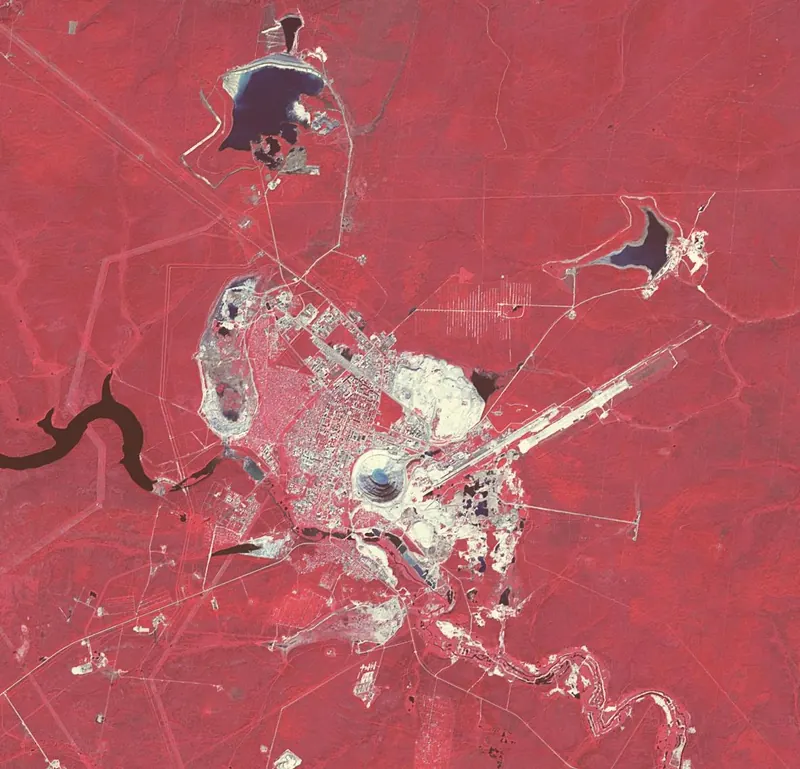
In Yakutia, the Mir diamond pipe was found on 13 June 1955, and Wikidata gives 1957 as its start. The Soviet state set the pace, not the market.5,6

Decades in waiting: Carajás and the Ertsberg
Carajas Mine, Brazil, NASA/METI/AIST/Japan Space Systems, and U.S./Japan ASTER Science Team (Public domain (NASA media, no copyright))
At the other extreme is Carajás in Brazil, the largest iron ore province in use. Geological surveys of the region began in 1922. US Steel explored there from July 1967. The Serra Norte mines began in 1984, and S11D at Serra Sul only in 2016.7
1922 to 2016 years
From the first Carajás surveys to the opening of S11D7
The Ertsberg in Indonesia waited because nobody read the report. Jean Jacques Dozy described the copper outcrop on a 1936 expedition. His report appeared just as war reached the Netherlands and lay unnoticed until 1959. Freeport's Forbes Wilson read it and trekked to the outcrop in 1960. Mining began in 1972, thirty-six years after the first description.8,9
Once a mining district is open, the next find moves faster. The Grasberg deposit nearby was found in 1988, and open-pit mining began there in 1990.9,10

Waiting on the law: the Pilbara
Mount Whaleback Iron Ore Mine, Australia, NASA/METI/AIST/Japan Space Systems, and U.S./Japan ASTER Science Team (Public domain (NASA media, no copyright))
Sometimes the barrier is a government decision. Lang Hancock spotted iron ore in the Hamersley Range in 1952, but Australia had banned iron ore exports since 1938. Nothing could be sold abroad until the ban was lifted in 1960.14,15
Stan Hilditch found the deposit that became Mount Whaleback in 1957. The railway to Port Hedland took 21 months to build from 1968, and the Mount Newman project opened on 26 June 1969. That is twelve years from find to first shipment, most of it spent waiting for the law to change and the money and railway to follow.11,16
Hamersley Iron's first mine, Mount Tom Price, began in 1966, fourteen years after Hancock's flight. Chapter 8, iron, steel and the Pilbara, tells the full story.17
Olympic Dam in South Australia shows the same pattern. Drill hole RD1 hit copper in 1975. The Roxby Downs Indenture Act, which set the terms for mining, came in 1982. Copper production began in 1988, thirteen years after the discovery hole.3,12
A table of gaps
Mir Diamond Mine, Siberia, NASA/METI/AIST/Japan Space Systems, and U.S./Japan ASTER Science Team (Public domain (NASA media, no copyright))
The table brings together the dates in our data. The gap is measured from the first recorded discovery to the first recorded production.18,20,21,22,23,24,25
| Deposit | Found | First production | Gap |
|---|---|---|---|
| Kambalda nickel, Australia | 1966 | 1967 | 1 year |
| Mir diamonds, Russia | 1955 | 1957 | 2 years |
| Orapa diamonds, Botswana | 1967 | 1971 | 4 years |
| Argyle diamonds, Australia | 1979 | 1983 (alluvial) | 4 years |
| Escondida copper, Chile | 1981 | 1990 | 9 years |
| Diavik diamonds, Canada | 1994 | 2003 | 9 years |
| Jwaneng diamonds, Botswana | 1971 | 1982 | 11 years |
| Oyu Tolgoi copper, Mongolia | exploration from 2000 | 2011 (open pit) | 11 years |
| Mount Whaleback iron, Australia | 1957 | 1969 | 12 years |
| Olympic Dam copper, Australia | 1975 | 1988 | 13 years |
| Inkai uranium, Kazakhstan | 1976 to 1978 | 2008 (main plant) | about 30 years |
| Ertsberg copper, Indonesia | 1936 | 1972 | 36 years |
| Carajás iron, Brazil | surveys from 1922 | 1984 (Serra Norte) | 62 years |
The diamond mines stand out as quick. Argyle's AK1 pipe was found in October 1979 after prospectors followed diamonds up Smoke Creek. Alluvial mining began in 1983 and the open pit in 1985.18,19
In Botswana, De Beers found the Orapa pipe on 25 April 1967, and the mine opened on 1 July 1971. Jwaneng's pipes were found in March 1971, and the mine opened on 14 August 1982.20
- Kambalda nickel1967
- Mir diamond mine1957
- Orapa1971
- Argyle diamond mine
- Escondida1990
- Diavik2003
- Jwaneng1982
- Oyu Tolgoi2011
- Mount Newman1969
- Olympic Dam1988
- Inkai1976
- Grasberg minerals district1972
- Carajas S11D / Northern System1984
Gold rushes look like the opposite case. When Paddy Hannan, Thomas Flanagan and Dan Shea found gold at Kalgoorlie in June 1893, more than 1,400 men were working the new field within about a week. Alluvial gold lies near the surface and can be won with a pan, so there was almost no gap at all.40

But the gap reappears as soon as the gold goes underground. Great Boulder and Ivanhoe were pegged on the Golden Mile in 1893. The leases were only combined into a single open pit, the Super Pit, in 1989, nearly a century later.41,42
In Nevada, Newmont explored the Carlin Trend from 1961 and began open-pit mining at Carlin in 1965. Nearby at Goldstrike, gold was first found in 1962 and first mined in 1976. The large deposits there, Deep Post, Betze and Screamer, were only found in 1986 to 1988, by drilling around a mine that was already working.26,43
- Bayan Obo iron deposit found
Bayan Obo is the source of much of China's rare earth supply.27,28
- Lang Hancock spots iron ore in the Hamersley Range
It led to the Pilbara iron ore industry once the embargo ended.14,15,29
- Mir kimberlite pipe found in Yakutia
The journal calls Mir one of the largest and best known diamond deposits in Russia and the world.5,30
- WMC discovers nickel at Kambalda
WMC drilling found the first large nickel deposit under gossans sampled in 1954.31
- De Beers finds the Orapa kimberlite
Orapa was the first mine opened by the company, ahead of Letlhakane (1977) and Jwaneng (1982).20,32
- Windarra and Mount Keith nickel found
- Kimberlite pipes found at Jwaneng
- Olympic Dam drill hole RD1
- Argyle diamond pipe AK1 found
It became the world's largest diamond producer by volume.18,19,36
- Escondida porphyry copper found
- Diamonds found at Lac de Gras
Why some mines take so long
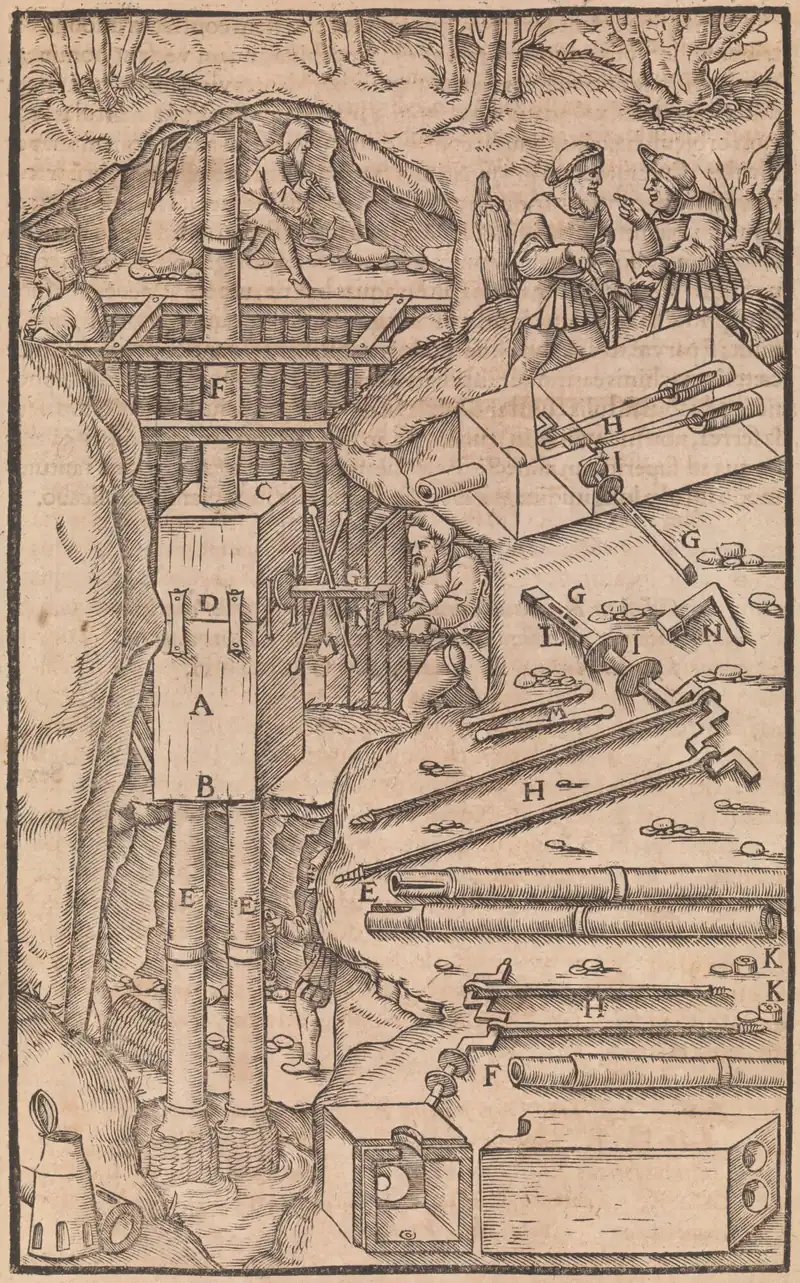
De re metallica libri XII. Georg Agricola, 1556., Unknown (Wellcome Collection) (CC BY 4.0)
Several causes run through the cases. The first is depth and cover. Olympic Dam had no outcrop at all, and Escondida's ore lay under 300 m of barren rock. Proving a hidden orebody takes many drill holes. Our guide to reading drill results explains what those holes report.1,12
The second is the mining method. Oyu Tolgoi began as an open pit in 2011. Its underground mine, reached through shafts about 1.3 km deep, only reached sustainable production in March 2023.23
Diavik in Canada's Northwest Territories shows the steps laid end to end. Exploration around Lac de Gras began in 1991 and 1992. The kimberlite pipes were found in 1994 and 1995. Construction was approved in 2000, and diamond production started in 2003. A fourth pipe began production in 2018, and Rio Tinto became sole owner in November 2021.17,44
The third is the licence. Inkai's deposit was found between 1976 and 1978. JV Inkai was registered in 1996, received its licence for Block 1 in 1999, and commissioned the first half of its main plant in late 2008.21
The fourth is the market. Greenbushes was mined for tin from 1888 and for tantalum from 1942. The spodumene was there all along, but lithium production only began in 1983, when there was a market for it.25,45
Projects in our own time face the same steps. Thacker Pass in Nevada, a large lithium clay project, targets completion of its first phase in late 2027, backed by a 2.26 billion US dollar government loan.46
Even a sale does not mean a mine. Inco bought the Voisey's Bay nickel find in Canada in 1996 for 4.3 billion Canadian dollars. Vale's records give 2005 as its start year, nine years later.24,47
Taken together, the history suggests that a decade from discovery to production is common for a large mine, that some of the most famous deposits waited far longer, and that the reasons were as often legal, political or commercial as geological. To understand how deposits are measured before they are mined, see our guide to resources and reserves.
Next in this series: what history shows about resource nationalism.48


