The shape of a boom
South Africa: a crowd of people gathered outside The Goldfields offices in Johannesburg. 1896., Unknown (Wellcome Collection) (Public Domain Mark 1.0)
Every mining boom in this history follows a rough shape. First comes a find. Then come people, then money, then towns. At some point the ore gets harder to win, or the price of the metal falls, and the boom turns. Not every boom ends badly, and not every bust is final. But the shape repeats often enough to be worth knowing.
The Comstock Lode in Nevada is a classic case. The National Park Service calls the 1859 strike there the first major silver strike in the United States. Virginia City and Gold Hill grew from about 4,000 people in 1862 to about 25,000 by 1874. By 1881 the lode was exhausted.1,3
Even inside a boom there are slumps, and someone usually profits from them. In 1864 the Bank of California sent William Sharon to the Comstock during a slump. He lent at two per cent a month, when rivals charged three to five. When mines and mills could not pay, he foreclosed. He ended up with a monopoly of mines, mills and the railway that served them.2
Booms leave more than ghost towns. About 7 Mt of Comstock ore was milled from 1860 to 1880, and about 7,500 t of mercury was lost in processing. Some of the costs of a boom arrive long after it ends.3

When the price moves: Leadville and the Tabors
A boom can end even when the ore is still there. Horace Tabor held a share in a Leadville claim in Colorado that proved to be a massive silver lode. It became the Little Pittsburg mine, and he became one of the wealthiest mining men in Colorado.4
Then the rules changed. The move to the gold standard cut the value of silver, and Tabor's fortune fell with it. The fortune was lost after 1893. He died nearly penniless in 1899.4,6
His second wife, Baby Doe, spent about thirty years trying to keep the Matchless mine, living in a shack beside it. The mine was mostly flooded and spent. She became a symbol of the boom and bust of Colorado silver.6
His first wife, Augusta, had run a grocery that kept the family going before Leadville paid. After their divorce in 1883 she received only a small part of the fortune. She invested it carefully, and when she died in 1895 her estate was worth at least 1 million dollars. The partner who left the boom early came out ahead.5
The same thing happened in platinum. In 1924 Hans Merensky found the Merensky Reef in South Africa, a platinum layer about one metre thick. His find set off a platinum rush. But falling prices closed all but two of his platinum mines by 1930.7

Towns that rise and fall: Coolgardie and Wiluna
Kalgoorlie-Boulder, Australia, NASA/JPL-Caltech (Public domain (NASA media, no copyright))
Western Australia shows how fast a boom town can grow and shrink. Gold was found at Coolgardie in September 1892. By 1897 the town had about 25,000 people and more than 700 companies. In 2021 it had 773 people.8,9
25,000 to 773 people
Coolgardie's population in 1897 and in 20218
Its neighbour had a different fate. Kalgoorlie, found in June 1893, sat on the Golden Mile, which has produced about 58 Moz of gold and is still mined today. Hannan wrote that by 1893 only one claim, Bayley's, was still working at Coolgardie. The two towns were part of the same rush. What set them apart was what lay underground.13,14
Booms can also come from the price. Claude de Bernales raised 1 million pounds in London in 1926 to work the Wiluna gold mines. In the mid-1930s, as the Depression raised gold prices, Wiluna grew to over 9,000 people. In 1939 he was accused of mismanagement. Seven of his companies were suspended from the London Stock Exchange and wound up.10
Sometimes a dead town comes back. Kambalda began as a gold townsite in 1897 and was abandoned by 1907. Then Western Mining Corporation found nickel there on 28 January 1966, and a second townsite followed in 1969.15

The Poseidon bubble of 1969
Pilbara, NW Australia, NASA/METI/AIST/Japan Space Systems, and U.S./Japan ASTER Science Team (Public domain (NASA media, no copyright))
Kambalda started a nickel boom. Production began in 1967, and explorers spread out between Norseman and Wiluna looking for more.11
In September 1969 a prospector named Ken Shirley saw nickel sulphide caps in banded iron formation at Mount Windarra. He pegged 10,800 acres for a small company called Poseidon.22
What followed was one of the most famous episodes in Australian market history. Poseidon shares were about 0.80 dollars in early September 1969. After drilling at Windarra, they closed at a peak of 278 dollars on 13 February 1970. A Reserve Bank of Australia paper calls it an asset-price bubble.16
0.80 to 278 AUD
Poseidon share price, September 1969 to 13 February 197016
Mining shares fell through 1970 and 1971. Poseidon was delisted in 1976. A Senate Select Committee report in 1974 documented abuses during the boom and recommended changes to how financial markets were regulated.16
The find itself was real. Windarra and Mount Keith were both discovered in 1969. The problem was not the nickel but the price people paid for it in advance.11
Australian nickel went on to its own long cycle. The country mined 36.6 t in 1913 and reached a peak of 230,767 t in 2012. USGS estimates 45,000 t for 2025. BHP's Nickel West, which includes Mount Keith, moved to temporary suspension in 2024.17,18,19
Australia nickel production, 1967 to 2021
Australia nickel production rose from 2,093 tonnes in 1967 to 150,299 tonnes in 2021; the peak in this series is 230,767 tonnes in 2012. Basis: contained nickel in concentrate or ore (t Ni).
Sources: A Comprehensive Dataset for Australian Mine Production, 1799 to 2021 (v1.4b, Tab04…; U.S. Geological Survey Mineral Commodity Summaries 2024 Data Release - world.zip…; U.S. Geological Survey Mineral Commodity Summaries 2025 Data Release (ver. 2.0, April…; Mineral Commodity Summaries 2026 Data Release - MCS2026_Commodities_Data.csv (world…

The lithium cycle, 2016 to 2025
Lithium Mining, Nevada, NASA/GSFC/METI/ERSDAC/JAROS, and U.S./Japan ASTER Science Team (Public domain (NASA media, no copyright))
The most recent boom followed the same shape at a faster pace. USGS put the US average lithium carbonate price at 8,650 dollars a tonne in 2016. It fell to 8,600 dollars in 2020, rose to 68,100 dollars in 2022 and dropped to 46,000 dollars in 2023.23,25
Western Australia's lithium sales rose from 8.0 billion Australian dollars in 2021-22 to 20.9 billion in 2022-23. Two years later, the state's lithium royalty receipts were down 64.89 per cent.24,26
Mines opened and closed with the price. Wodgina was idled in 2019 and restarted in 2022. Mt Cattlin was placed on care and maintenance by the end of March 2025. Chapter 12, the new rush, tells the full story.27,28
What the pattern shows
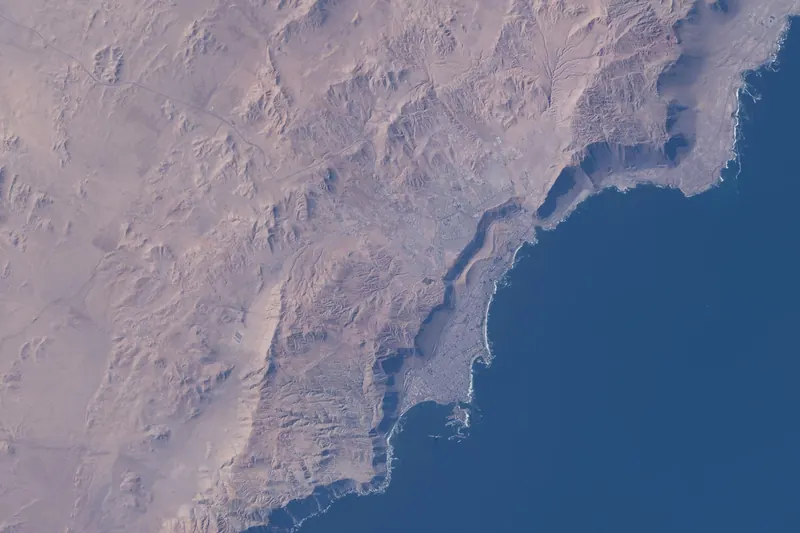
Iquique, Chile, at the base of a steep coastal slope just west of the Atacama Desert, NASA JSC (Public domain (NASA media, no copyright))
Some booms leave only ruins. The American West is dotted with ghost towns such as Bodie in California, founded in 1876, and Rhyolite in Nevada, founded in 1904. Humberstone, a nitrate works in the Atacama Desert of Chile, was built in 1862. It reached 3,700 people by 1940, closed in 1959 and was auctioned for scrap in 1961. It is now a World Heritage Site.29,55,56
Others end slowly. In Cornwall, only tin mines kept working after the copper crash of 1866. The last of them, South Crofty, closed in 1998.30
Even the biggest booms have breaks. In 1900, during the South African War, the value of Transvaal gold output fell to 1,481,000 pounds. The Rand story is told in chapter 6.57
- Victoria produces most of the worlds gold
Gold escorts carried about a tonne a week from Mount Alexander to Melbourne at the peak.31,32
- Rio Tinto Group founded
Rio Tinto Group founded.33
- Broken Hill Proprietary Company formed
BHP grew from this mine into one of the largest mining companies in the world.34,35
- Mount Lyell Mining and Railway Company founded
Mount Lyell Mining and Railway Company founded.36
- Bolivian tin output reaches 9,279.5 t
Annual output had nearly tripled in twelve years, ahead of the tin boom of the 1900s.37,38
- Katanga copper production begins
Oxide ore near the surface was mined by hand and at first shipped to Belgium for processing.39,40
- Mount Isa: inception recorded
Mount Isa has an inception date of 1923 in Wikidata.41
- About 1,200 tons of Shinkolobwe ore reach Staten Island
Sengier shipped the ore to keep it out of German hands and stored it in a warehouse.42,43,44
- Tom Price gazetted
Town gazetted for the Mount Tom Price iron ore mine.45
- Mt Newman project is officially opened
Governor-General Sir Paul Hasluck opened the project that railed Mount Whaleback ore to Port Hedland.46,47
- Rossing uranium mine: Wikidata inception date
The Namibian open pit uranium mine is dated to 1976 in Wikidata.48
- Privatisation of ZCCM weakens TAZARA's copper traffic
More copper then went by road along southern routes and the Tanzam highway.49,50
- Molycorp commissions new Mountain Pass operations
From 2012 to 2015 the US was a leading producer of rare earths outside China.51,52
- Lithium prices peak
The two USGS figures show how price series differ between sources.25,53,54
Across these cases, a few points recur. The size of the orebody decides whether a town lasts, not the size of the rush. Price changes, from the gold standard to the lithium market, can end a boom even when the ore is still there. The people who supply the boom, like Sharon's bank or Augusta Tabor's grocery, often do better than the people who chase it. And a share price can run far ahead of what is in the ground, as Poseidon showed. None of this tells anyone what will happen next. It only shows what has happened before.
Next in this series: how long it takes to turn a discovery into a mine. For how small exploration companies work, see our guide to the junior mining company.16