The finders: small rewards, big stories
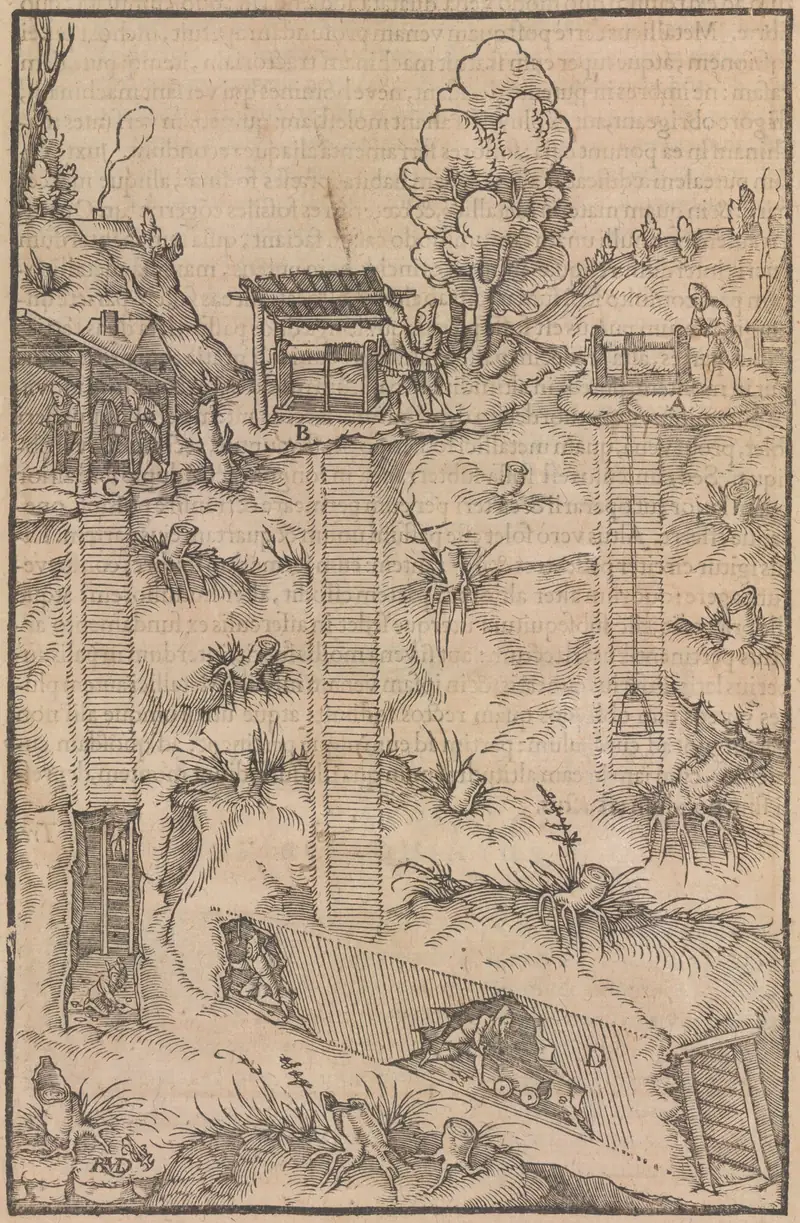
De re metallica libri XII. Georg Agricola, 1556., Unknown (Wellcome Collection) (CC BY 4.0)
Start with the people who found the gold. In 1851 Edward Hargraves was hailed as the man who started Australia's gold rush. The New South Wales legislative council granted him 10,000 pounds in 1853 as a reward. It was a reward, not a fortune, and he was later voted a pension of 250 pounds a year.1
In the Klondike, the three men named on the discovery claims of 1896, Keish, Dawson Charlie and George Carmack, shared close to one million dollars in gold over the next four years. It was a large sum, but it was split three ways.5,6
In Ontario, Benjamin Hollinger staked the Porcupine ground that became the Hollinger mine. It went on to produce about 19 million ounces of gold, worth nearly 600 million dollars, over 57 years. Hollinger sold his claims and died at 34 in 1919. The Dictionary of Canadian Biography calls his fortune modest.3
19 million oz gold
From the Hollinger mine over 57 years; its finder's fortune was modest3
The buyers did better. Noah Timmins's group bought the Hollinger and MacMahon claims. The Hollinger claims gave nearly 600 million dollars of gold before underground work ended in 1968.7
Some finders missed their chance entirely. In 1874 Thomas Walsh turned down half of a Deadwood prospect that later became the Homestake mine. He did better at Camp Bird, near Ouray, in 1881.4
The partners: getting in early
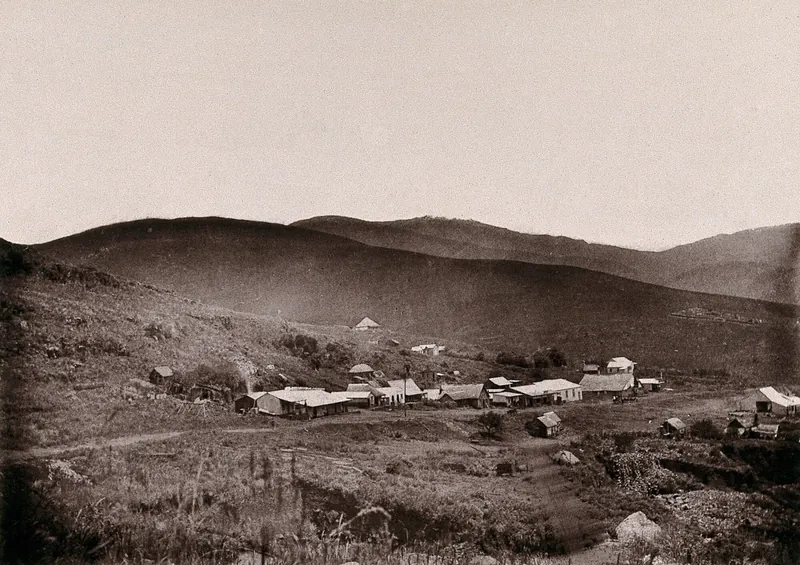
Pilgrim's Rest, South Africa: a settlement near the Lydenberg Gold Fields. Woodburytype, 1888, after a photograph by Robert Harris., Harris, Robert, active 1881-1888. (Public Domain Mark 1.0)
Buying a share early in a big deposit made more fortunes than finding one. In 1859 George Hearst agreed to pay 3,000 dollars for a one-sixth share of a Comstock mine. He left the Comstock with nearly 100,000 dollars, added to it in Utah, and went on to become a US Senator.8
The biggest Comstock fortune went to a man who started as a common miner. John Mackay became a partner in the Big Bonanza. The Kentuck mine alone yielded 3,641,062 dollars in three years. Estimates put his assets as high as 100 million dollars.11
100m USD
Upper estimate of John Mackay's assets, from the Comstock's Big Bonanza11
At Cripple Creek, Winfield Scott Stratton staked the Independence Mine on 4 July 1891 and became the district's first millionaire.12
The Browns of Leadville are better known for a myth. J. J. Brown, a mine engineer, was awarded 12,000 shares in a mine in 1893 for exploring a substantial seam, and the family became very wealthy. His wife Margaret survived the Titanic in 1912. She was never called Molly in her lifetime.9
Selling well was another route. Spencer Penrose sold the C.O.D. mine at Cripple Creek for 250,000 dollars, the largest sum paid for a Cripple Creek mine up to then. He put money into Daniel Jackling's bulk mining of low-grade copper at Bingham Canyon and later held the largest share in Utah Copper. Joseph De Lamar took 1,500,000 dollars from an Idaho mine and sold a half share to English buyers for 2,000,000 dollars.13,14
Women appear in these records too, though they were not always credited. Clara Kinney sold 25 mining claims in Arizona to a copper company in 1930 for 250,000 dollars. At Cripple Creek in 1891, Mollie Gortner became the first woman to stake a claim in her own name, yet an official survey credited the find to "Mr M. C. Gortner".10,15

The combiners: Kimberley and the Rand
Kimberley, South Africa: miners and washing gear at the Bultfontein diamond mine. Woodburytype, 1888, after a photograph by Robert Harris., Harris, Robert, active 1881-1888. (Public Domain Mark 1.0)
At Kimberley, the largest fortunes came from joining many small claims into one company. Cecil Rhodes went there to supervise his brother's claim. With Charles Rudd he bought the old De Beers claims and formed De Beers Consolidated in 1888.19
His great rival was Barney Barnato, whose Kimberley Central was the main competitor to De Beers. In 1888 Rhodes paid 5,338,650 pounds for Kimberley Central, and four million of it went to the Barnato brothers.16
Barnato liked to say he had arrived in South Africa penniless. The Dictionary of National Biography says he had over fifty pounds on reaching Cape Town, and that the story was one of his own inventions. He was a millionaire within ten years.17
Rhodes left 6 million pounds when he died in 1902. His colonial legacy remains contested.19
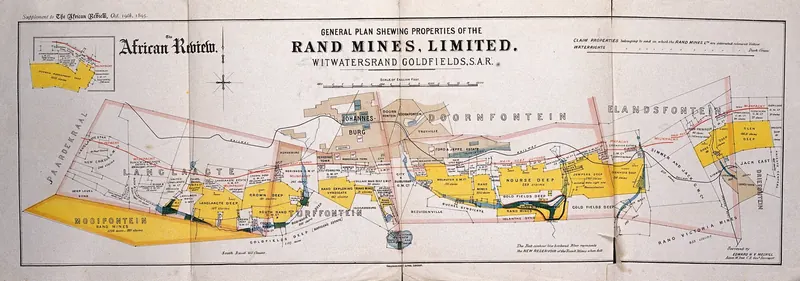
On the Witwatersrand, the same approach worked for gold. The mines of Julius Wernher's group produced 3,500,000 ounces of fine gold in 1912. They paid 4,250,000 pounds in dividends that year, 51 per cent of the profits of the whole Witwatersrand. Chapter 6, the Randlords, tells the story, and our Kimberley Big Hole story shows the mine itself.18
Some of the greatest mining fortunes were made by people who never dug at all. From 1485 Jakob Fugger of Augsburg lent money to Archduke Sigismund of Tyrol in return for cheap supplies of metal. His firm came to dominate the silver mines of Schwaz and the mint at Hall, and from 1494 it moved into Hungarian mining around Neusohl.20
On the Comstock, the banker William Sharon lent to mines and mills during a slump and foreclosed on those that could not pay. He ended up owning a monopoly of mines, mills and the railway.22
Lawyers did well too. William Stewart, the Comstock's best known lawyer, was estimated to have received some 500,000 dollars for his work on its lawsuits up to 1865. By his own account the total cost of the litigation was about 10 million dollars.23
In Victoria, Lowe Kong Meng came in 1853 and founded a firm in 1854 to supply Chinese miners. In 1859 a single cargo of his goods was said to be worth 10,000 pounds. An 1863 report said there were reputedly few wealthier men in the colony.21
In Leadville, Augusta Tabor ran a grocery that supported her family before her husband's silver paid. She left an estate worth at least 1 million dollars in 1895, while her former husband died nearly penniless four years later.24

The royalty holders
Mount Whaleback Iron Ore Mine, Australia, NASA/METI/AIST/Japan Space Systems, and U.S./Japan ASTER Science Team (Public domain (NASA media, no copyright))
In the twentieth century a new route to wealth appeared. Lang Hancock found iron ore in the Pilbara in 1952 but never owned a mine. In 1963 he and Peter Wright signed a deal with Hamersley Iron for royalties of 2.5 per cent of the value of all ore mined from the deposits, in perpetuity. That royalty was the source of his wealth.25
His fellow prospector Stan Hilditch, who found Mount Whaleback in 1957, took a different route. He and Charles Warman sold their temporary reserves for 10 million dollars.26
The next generation did build mines. Hancock's daughter, Gina Rinehart, chairs Hancock Prospecting, which runs the Hope Downs and Roy Hill mines. Andrew Forrest's Fortescue shipped its first ore on 15 May 2008.25,27
What the fortunes show
A map of Witwatersrand goldfield, South Africa, showing properties of the Rand Mines Limited. Chromolithograph after Edward H. V. Melvill., Melvill, Edward H.V (Edward Harker Vintcent), 1859-1914. (Public Domain Mark 1.0)
Across five centuries, the pattern is consistent. Finders were often paid a reward or a share and moved on. The largest fortunes went to those who bought in early, combined many claims into one, supplied and financed the miners, or held a royalty on someone else's production. Several famous rags-to-riches stories, such as Barnato's penniless arrival, turn out to be partly invented.
- Thomas Savery born
Thomas Savery born (date from Wikidata).29
- James Watt born
James Watt born (date from Wikidata).30
- Henry Bessemer born
Henry Bessemer born (date from Wikidata).31
- Marcus Daly born
Marcus Daly born (date from Wikidata).32
- Alfred Beit born
Alfred Beit born (date from Wikidata).33
- George Carmack born
George Carmack born (date from Wikidata).34
- Paul Heroult born
Paul Heroult born (date from Wikidata).35
- Ernest Oppenheimer born
Ernest Oppenheimer born (date from Wikidata).36
- Harry Oppenheimer born
Harry Oppenheimer born (date from Wikidata).37
- Ludlow Massacre
The National Park Service links the massacre to the debate on the eight-hour working day.38,39
- Bisbee Deportation
Bisbee Deportation.40
- Mother Jones dies
Mother Jones dies (date from Wikidata).41
- African mine workers' strike on the Witwatersrand
The strike was crushed, but SAHO says it had lasting effects on African trade unionism and politics.42,43,44
- Gina Rinehart born
Gina Rinehart born (date from Wikidata).45
Even the stories of fortunes lost can be wrong. Billy Barker struck rich gold at 40 feet on Williams Creek in 1862, and the town of Barkerville is named after him. He is often called a Cornishman and said to have lost his money to a spendthrift wife. The Dictionary of Canadian Biography says he was born in Cambridgeshire and finds no evidence that his wife spent his fortune.28
Next in this series: lucky breaks, and the finds that almost did not happen.10