A Caterpillar 797 haul truck with a worker standing beside a front tyre that is more than twice his height
A Caterpillar 797, with a worker for scale. Lechhabmed, Wikimedia Commons (CC BY-SA 4.0)
An electric shovel loading copper ore into railway wagons on a bench of the Bingham Canyon pit in 1942
Bingham Canyon, Utah, 1942: a power shovel loads ore into railway cars. Photograph by Andreas Feininger. Library of Congress, no known restrictions (Public domain)
A worker looking up at the raised body of a Cat 797 haul truck at the Escondida copper mine in Chile
A Cat 797 at Escondida, Chile, with its body raised. Duratray, Wikimedia Commons (CC BY-SA 4.0)
A yellow BelAZ 75710 dump truck on display, its cab platform level with the first floor of the building behind
A BelAZ 75710 on display at a museum complex in Verkhnyaya Pyshma, Russia. Лапоть, Wikimedia Commons (CC0)
A haul truck being loaded with coal by an electric shovel, with a dragline working behind
Loading coal at North Antelope Rochelle, Wyoming: shovel, truck and, behind, a dragline. Peabody Energy, Inc., Wikimedia Commons (CC BY 3.0)
A single giant mining tyre filling the back of a flatbed lorry on a highway, marked oversize load
One haul truck tyre, travelling alone as an oversize load. ajmexico, Wikimedia Commons (CC BY 2.0)
Oyu Tolgoi in the Gobi from space: bare desert in 1996, and in 2025 an open pit, plant, waste dumps and a tailings dam19962025
Oyu Tolgoi, Mongolia, August 1996 and August 2025. Scroll to move the line. USGS/NASA Landsat (Aug 1996) and Copernicus Sentinel-2 (Aug 2025), true colour, processed by Prospector Trails (Public domain)
A pickup crushed under the rear tyres of a haul truck that reversed over it
Why autonomy and collision avoidance matter: a haul truck reversed over a parked pickup it could not see. NIOSH, via Wikimedia Commons (Public domain)

Equipment/Hauling · Open-pit mines

The haul truck

In almost every big open pit, everything that is blasted leaves in a truck: ore to the crusher, waste to the dumps. The trucks that do it are the largest on Earth, with tyres taller than a two-storey ceiling and payloads heavier than a jumbo jet. Here is how they work and why mines run hundreds of them.

450 tBelAZ 75710 payload, the largest
363 tCat 797F payload
~4 mtall, each of its six tyres
1,000autonomous Komatsu trucks by April 2026

01 · Before trucks

When pits ran on rails

The first big open pits moved their rock by train. At Bingham Canyon in 1942 electric shovels loaded ore straight into railway wagons, and the tracks had to be moved bench by bench as the pit grew.

The truck changed that. In 1934 Euclid of Ohio built what is credited as the first dump truck designed for off-road work. Trucks could go wherever the shovel was, and over the next decades they took over the pits.

1934first off-highway truck

Sources: Library of Congress; Euclid Trucks.

02 · Ultra class

A jumbo jet's weight in rock, every trip

Today's largest trucks are called ultra class. Caterpillar's 797F carries a nominal 363 tonnes, 400 US tons. Loaded, it weighs about 624 tonnes and still climbs out of the pit on a 4,000 horsepower engine.

The driver sits on a platform about two storeys up, reached by a staircase across the front of the truck.

363 tpayload
624 tloaded

Sources: Caterpillar; 797F specification.

03 · The largest

BelAZ 75710: 450 tonnes

The largest of all is the BelAZ 75710, built in Zhodzina, Belarus, and unveiled in 2013. It is rated for a nominal 450 tonnes, weighs about 360 tonnes empty and is about 20.6 m long.

Two 2,300 horsepower MTU diesels drive generators, and electric motors turn all of its wheels: eight giant tyres, in pairs on two axles, where other ultra-class trucks run on six.

450 tpayload
20.6 mlong

Sources: BelAZ 75710; MINING.COM.

04 · Load, haul, dump

Matched to the shovel

A truck is only as quick as the machine that fills it. Mines pair each truck size with a shovel or excavator that can load it in a few passes, so neither waits for the other. Here a coal truck at North Antelope Rochelle in Wyoming is loaded by an electric shovel, with a dragline behind.

There are two ways to drive the wheels. Caterpillar's biggest trucks use a mechanical gearbox. Komatsu, Liebherr, Hitachi and BelAZ use diesel-electric drive: the engine turns a generator, and electric motors in the wheels do the work, as in a locomotive.

Sources: Caterpillar; BelAZ 75710.

05 · Tyres

Four metres of rubber

An ultra-class truck rolls on six tyres of size 59/80R63: just over 4 m tall and 5.3 to 5.8 tonnes each, depending on the maker. They travel to site one at a time, on their own trailer.

Tyres are one of a mine's biggest running costs, and heat is what kills them. Mines keep roads smooth, limit speeds on long hauls and watch tyre temperatures to make each set last. Prices are not published; trade reports put a new one at tens of thousands of US dollars.

~4 mtall
~5.5 teach

Sources: European Rubber Journal; SlashGear.

06 · From nothing

A pit dug by trucks

Oyu Tolgoi, in Mongolia's South Gobi, was bare desert in 1996. Its copper and gold deposit was found in 2001, and the open pit started producing in 2013. Every tonne of rock in that pit has been blasted, loaded and driven up a ramp.

Haul roads are built like small motorways, wide enough for two giants to pass, with ramps kept to a steady grade so loaded trucks can climb at speed.

Source: Rio Tinto, Oyu Tolgoi.

07 · Where they work

Every big hard-rock pit

Ultra-class trucks work wherever a lot of rock is blasted and dug: copper pits in Chile, Peru, the United States and Mongolia, iron ore in Australia's Pilbara and Brazil, gold at Kalgoorlie, coal in Wyoming, Queensland and Indonesia, and Canada's oil sands.

The makers are few: Caterpillar, Komatsu, Liebherr, Hitachi and BelAZ, with Chinese makers such as XCMG, Sany and Tonly growing fast.

Sources: Komatsu; Liebherr.

08 · No driver

Trucks that drive themselves

Many of these trucks now have no one in the cab. On 21 April 2026 Komatsu commissioned its 1,000th autonomous ultra-class truck, at Nevada Gold Mines. Others are moving off diesel: Liebherr's largest ever order, from Fortescue in Western Australia, is for 475 machines including battery-electric trucks by 2030.

1,000autonomous Komatsu trucks
475Liebherr units for Fortescue

Sources: Komatsu (2026); Liebherr annual report 2024.

The full story

What is a mining haul truck?

A haul truck is a rigid-frame, off-highway dump truck built to carry blasted rock from the loading face of an open pit to a crusher, stockpile or waste dump. The largest, called ultra class, carry roughly 290 to 450 tonnes a load. They are too wide and heavy for public roads, so they arrive at a mine in pieces and are assembled on site.

The biggest trucks

The BelAZ 75710, unveiled in 2013 in Belarus, is the largest by payload, rated at a nominal 450 tonnes. It is about 20.6 m long, weighs about 360 tonnes empty, and runs on eight tyres, driven by two 2,300 hp MTU diesel engines feeding electric wheel motors. Caterpillar's 797F, first launched as the 797 in 1998, carries 363 tonnes (400 US tons) and weighs about 624 tonnes loaded; its 4,000 hp C175-20 engine drives the rear wheels through a mechanical transmission. Komatsu's 930E carries about 290 tonnes, and Liebherr, Hitachi and a growing group of Chinese makers build trucks in the same class.

How a truck fleet works

A pit runs as a loop: drill, blast, load, haul, dump, return. Each truck is matched to a loading machine, a rope shovel or hydraulic excavator, that fills it in a few passes. Dispatch software tracks every truck by GPS and sends it to whichever shovel or dump will keep the fleet moving, because a truck queuing at a shovel, or a shovel waiting for a truck, wastes money. Graders and water carts keep the roads smooth and the dust down, which saves tyres and fuel.

Tyres

The largest haul truck tyre, size 59/80R63, is just over 4 m tall and weighs about 5.3 to 5.8 tonnes depending on the maker (Michelin, Bridgestone, Goodyear and others). An ultra-class truck runs six. Heat build-up, measured by a rating called TKPH (tonne-kilometres per hour), limits how hard a tyre can be worked, so mines plan speeds and haul distances around it. Prices are not published; trade reports suggest tens of thousands of US dollars for each new tyre.

Autonomy and electrification

Driverless trucks run from a control room, following mapped roads with GPS, radar and lidar and stopping for obstacles. Komatsu commissioned its 1,000th autonomous ultra-class truck on 21 April 2026; Caterpillar and Chinese makers run large autonomous fleets too. Mines are also cutting diesel: trolley-assist lines power trucks up ramps from the grid, and Fortescue's order with Liebherr, the largest in Liebherr's history, covers 475 machines including battery-electric trucks by 2030.

Why trucks still rule the pit

  • Flexibility: a pit changes shape every week, and trucks go wherever the shovel is.
  • Cost per tonne rises with depth, because every tonne climbs out. That is why deep pits add in-pit crushers and conveyors.
  • The next change is the powertrain: autonomy is already common, and electric drive from batteries or overhead lines is on the way.

More machines: all mining equipment. The pits these trucks work in: the biggest copper pits, the largest mines in the world and copper.

Questions people ask

What is the largest dump truck in the world?

The BelAZ 75710, built in Belarus and unveiled in 2013. It is rated for a nominal 450 tonnes of payload, weighs about 360 tonnes empty, is about 20.6 m long, and is driven by two 2,300 hp MTU diesel engines powering electric motors.

How much can a Cat 797 carry?

The Caterpillar 797F carries a nominal 363 tonnes (400 US tons). Fully loaded it weighs about 624 tonnes. Its 4,000 hp Cat C175-20 engine drives the wheels through a mechanical transmission.

How big are haul truck tyres?

The largest, size 59/80R63, are just over 4 m tall and weigh about 5.3 to 5.8 tonnes each, depending on the maker. An ultra-class truck runs on six. Prices are not published; trade reports put a new one at tens of thousands of US dollars.

Why do mines use trucks instead of conveyors?

Trucks are flexible. A pit changes shape every week as benches are blasted and dug, and trucks can go wherever the shovel is. Conveyors are cheaper per tonne over a fixed route, so many mines crush rock in or near the pit and belt it out, and use trucks for the moving part of the job.

Who makes mining haul trucks?

The main makers of ultra-class trucks are Caterpillar, Komatsu, Liebherr, Hitachi and BelAZ, with Chinese makers such as XCMG, Sany and Tonly growing fast. This page lists makers as facts, not as a ranking or advice.

Bagger 293, a bucket wheel excavator taller than a football stadium, working a terrace of the Hambach mine1978–2030Digging · Germany's lignite mines

Bucket wheel excavators

Bagger 293 weighs 14,196 tonnes and digs 240,000 m³ a day. How the biggest land machines work, and why their time is ending.

Big Brutus, a giant stripping shovel, towering over the cars and trees around it1963–2026Records · Mines worldwide

The biggest mining machines

The heaviest, the longest, the tallest: mining's giants side by side, from a 14,196-tonne excavator to a 4-metre tyre.

A red and white walking dragline with its bucket raised on ropes from a long lattice boom, over a lignite strip cut1948–2026Digging · Strip mines

Draglines

A bucket the size of a garage, thrown on ropes from a boom longer than a football pitch. Big Muskie and the machines that walk.

A yellow haul truck loaded with ore, with a rack of sensors on its front and an empty cab, on a snowy mine road2008–2026Autonomy · Open-pit mines

Autonomous trucks

Thousands of 300-tonne trucks now drive themselves. How autonomous haulage works, where it started and where it is growing fastest.

A row of rock blasts erupting along a quarry face, throwing dust and stones into the air1627–2026Drilling and blasting · Open pit and underground

Drilling and blasting

Before rock can be dug it has to be broken. How mines drill rows of holes and time a blast to the millisecond, at industry level.

A large red crusher inside the steel frame of a crushing plant, with conveyors and walkways around it1858–2026Processing · Crushing

Crushers

Boulders the size of a car go in, gravel comes out. How jaw, gyratory and cone crushers work, and why the biggest take 17,000 tonnes an hour.

A large grey ball mill studded with liner bolts in a long mill hall1940s–2026Processing · Grinding

Ball mills and SAG mills

Turning drums as wide as a four-storey building grind ore to powder. How ball and SAG mills work, and why they use so much power.

A row of tall blue flotation tank cells with walkways and pipes under a blue sky1905–2026Processing · Separation

Froth flotation and tailings

Most of the world's copper, zinc and lead is lifted out of the ore on air bubbles. How flotation works, where it came from, and the tailings it leaves behind.

A containerised ore sorter on legs, fed by an inclined conveyor, at a mine site1911–2026Processing · Sorting

Ore sorting

For centuries people picked ore from waste by hand. Now cameras and X-rays look at every rock on a belt, and puffs of air knock out the waste, or a 2,492-carat diamond.

An underground loader carrying a full bucket of rock through a dark mine room1905–2026Underground · Fleet

Underground mining equipment

Hoists that wind ore up from 4 km down, drill jumbos, low-slung loaders, rock bolters, giant fans and battery-electric fleets: the machines that work underground.

The yellow cutting drum of a longwall shearer under the steel canopies of the shields1690s–2026Underground · Coal

Longwall mining

A shearer runs back and forth along a coal face 300 m long, under a steel roof of hydraulic shields that walk forward behind it. How longwalls work, and what happens above them.

Two blue electric locomotives pull a long ore train along a lake shore through autumn birch woods1899–2026Logistics · Moving ore

Conveyors, rail and ports

A mine is only worth what it can ship. Belts 100 km long, trains so long they vanish over the horizon, and ships that carry 400,000 tonnes move the rock to the world.

A yellow and grey tracked surface drill rig with its mast raised beside broken rock1862–2026Suppliers · Facts only

Who supplies the mines

Mines buy their trucks, drills, crushers and explosives from a small group of makers, some of them over 150 years old. Where they began, and how a few big deals shaped them.

Pictures in this story: Lechhabmed, Wikimedia Commons (CC BY-SA 4.0); Library of Congress, no known restrictions (Public domain); Duratray, Wikimedia Commons (CC BY-SA 4.0); Лапоть, Wikimedia Commons (CC0); Peabody Energy, Inc., Wikimedia Commons (CC BY 3.0); ajmexico, Wikimedia Commons (CC BY 2.0); USGS/NASA Landsat (Aug 1996) and Copernicus Sentinel-2 (Aug 2025), true colour, processed by Prospector Trails (Public domain); NIOSH, via Wikimedia Commons (Public domain). Cover photos from Wikimedia Commons: Bucket wheel excavators by bluecloud9, CC BY-SA 2.0; Draglines by Roy Luck, CC BY 2.0; Autonomous trucks by RobSimmons223311, CC BY-SA 4.0; Drilling and blasting by Siim Roov, CC BY-SA 4.0; Crushers by photosmith2011, Flickr, CC BY-SA 2.0; Ball mills and SAG mills by photosmith2011, Flickr, CC BY-SA 2.0; Froth flotation and tailings by Nina111955, CC BY-SA 4.0; Ore sorting by Tomra Sorting GmbH, CC BY-SA 4.0; Underground mining equipment by Kaupo Kikkas, CC BY-SA 4.0; Longwall mining by Bochum1805, Flickr, CC BY-SA 2.0; Conveyors, rail and ports by Kabelleger / David Gubler, CC BY-SA 4.0; Who supplies the mines by Alexandre Prevot, CC BY-SA 2.0.

Keep exploring

Stories about the mines these machines work in

All mining storiesThe world runs on rockAll mineralsMining by country

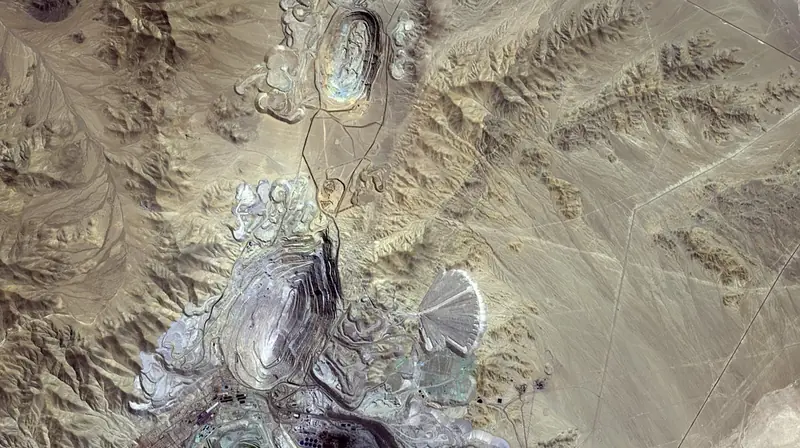
Cover photos from Wikimedia Commons: Chuquicamata from the ISS by Alexander Gerst (ESA), CC BY-SA 2.0.