
The world runs on rock · Story 10 of 12
The Grid copper, the metal of electricity
Every power line, transformer, motor and phone charger carries its current through copper. It is so ordinary that the United States only added it to its list of critical minerals in November 2025, along with silver.
Scroll to open a transformer
Take it apart
Two coils and a core
A transformer steps voltage up for long-distance lines and down again for streets and homes. Inside the steel tank are copper windings wrapped around a core, all soaked in insulating oil that carries the heat out to the cooling fins.
- Tank and radiators steel
- Bushings porcelain, to bring the lines through the lid
- Windings copper: low voltage inside, high voltage outside
- Core thin sheets of grain-oriented silicon steel
The core
Steel with 3% silicon
The core is stacked from sheets of grain-oriented electrical steel, iron with up to about 3.2% silicon, cold-rolled so its crystals line up with the field. Thin sheets and the silicon cut the energy lost as heat.3
The backlog
Two and a half years to wait
In Wood Mackenzie's mid-2025 survey, a large US power transformer took about 128 weeks to deliver, and prices had risen 77% since 2019. It estimated US supply fell about 30% short of demand in 2025.4
Inside the wire
A sea of electrons
Copper atoms pack into a face-centred cubic crystal, and each lets one outer electron go. Those free electrons move through the whole metal, which is why copper conducts so well; among common metals only silver does better.5
Switch on
Apply a voltage and the whole sea drifts one way. In the US, 42% of copper goes into buildings, much of it wiring, and 23% into electrical and electronic products.2
CuAgAlFeSi
Follow the supply
1 · Mining
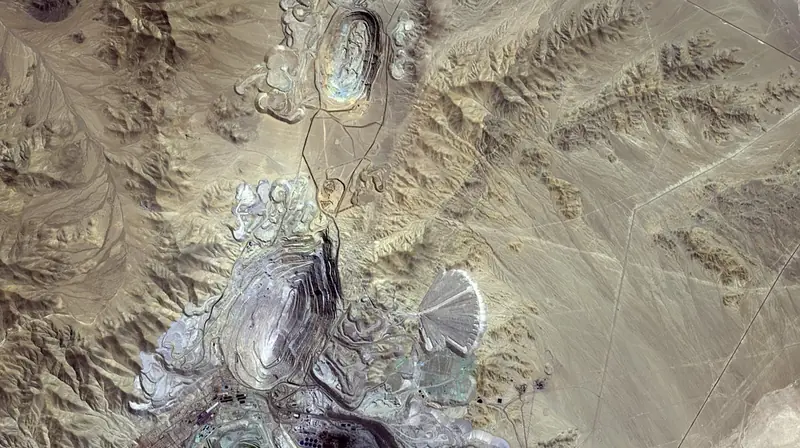
Chile 23%, DR Congo 14% and Peru 12% of world mine output in 2025.2
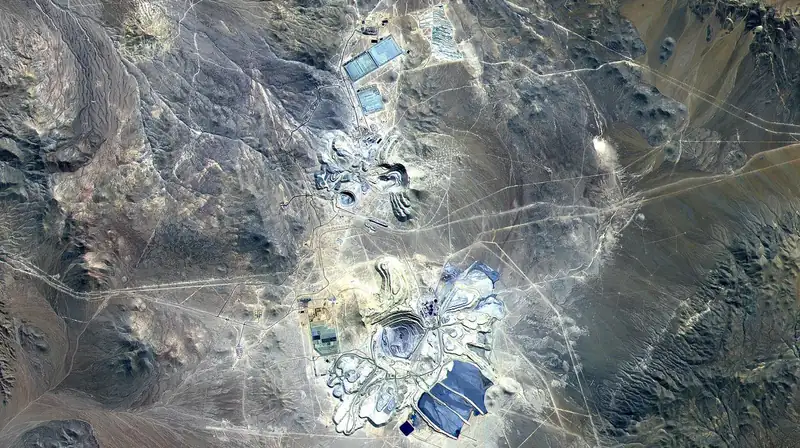
Escondida (left), which also yields gold and silver, and Chuquicamata, from NASA's Terra satellite (public domain).
2 · Refining
Most of that ore is shipped as concentrate. China refined about 14 million of the world's 29 million tonnes of copper in 2025, 48%, while mining under 8%.2
3 · Silver
The best conductor of all is too dear for wires, but every solar cell carries a fine silver paste. Photovoltaics took 15% of US silver use in 2025. Silver averaged $38 an ounce that year and hit $53.60 on 13 November.7 Mexico mined 24% of the world's silver.
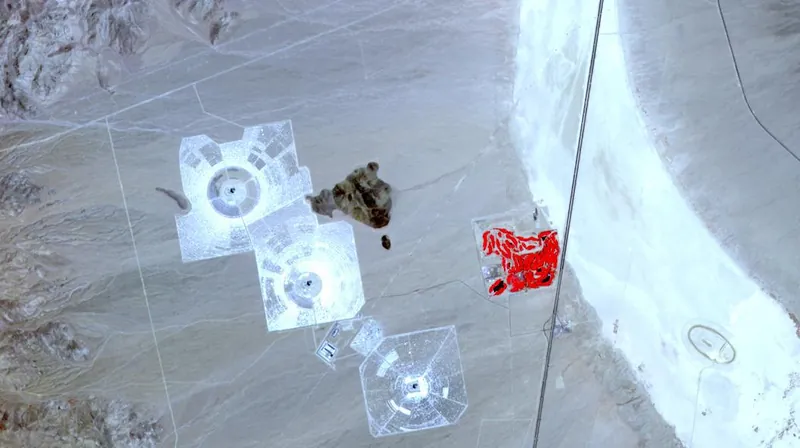
Ivanpah, California, a solar-thermal plant whose mirrors focus sunlight on towers, from NASA's Terra satellite, 2013 (public domain).

Every light
Copper all the way
From Spain to Libya, every light here reaches its lamp through copper. An offshore wind farm needs thirteen times the minerals of a gas plant of the same size, in the IEA's estimate, much of it copper for cables.6
Why "critical"
Ordinary, and suddenly short
Copper is mined in dozens of countries, but refining is concentrated, and the equipment that carries it is backed up for years. The 2025 US critical minerals list added copper, silver, silicon and rhenium.2
Next in the series: The Screen, the rare elements in a phone. Before this: The Engine, The Body, The Shield, The Signal, The Rocket, The Magnet, The Battery, The Mind and The Chip.
Sources
Shares of world output are from USGS Mineral Commodity Summaries 2026 via our minerals data; refined copper figures are from the USGS copper chapter. The 3D models are illustrations, not engineering drawings or any one product. Photos: NASA, public domain.
- NASA/JPL: Chuquicamata Mine, Chile (ASTER)
- USGS Mineral Commodity Summaries 2026: copper (uses, prices, refinery output, 2025 critical minerals list)
- US DOE/NETL: core loss datasheet, 3% grain-oriented silicon steel
- POWER Magazine: transformers in 2026, citing Wood Mackenzie's Q2 2025 survey
- Electrical resistivity and conductivity (Wikipedia), table of metals
- IEA: The Role of Critical Minerals in Clean Energy Transitions (2021), minerals per vehicle and per power plant
- USGS Mineral Commodity Summaries 2026: silver
Keep exploring
Read next


All mining storiesThe world runs on rockAll mineralsMining by country
Cover photos from Wikimedia Commons: Chuquicamata from the ISS by Alexander Gerst (ESA), CC BY-SA 2.0. Pictures: Escondida Mine, Chile, NASA/GSFC/METI/ERSDAC/JAROS, and U.S./Japan ASTER Science Team (Public domain (NASA media, no copyright)); Kopermijn te Kolwezi in de provincie Shaba (Katanka), Mieremet, Rob / Anefo / Europeana (Public Domain Mark 1.0); Falu gruva, Lundberg, Bengt A / Europeana (CC0 1.0).