
The world runs on rock · Story 9 of 12
The Engine the jet engine's hottest metals
A jet engine's turbine blades work at metal temperatures above 1,000°C. They manage it with nickel, cobalt, chromium and a pinch of rhenium, one of the rarest metals mined. The fan in front is titanium.
Scroll to take an engine apart

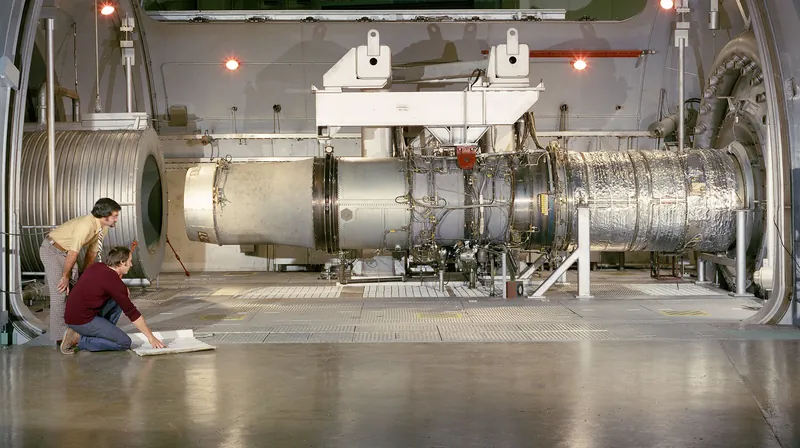

Seventy years of testing
The same problem, hotter every decade
NASA and its predecessor have tested jet engines since the 1940s. Each generation burns hotter to get more thrust from less fuel, and each needs metal that can take it.
Take it apart
Cold at the front, white-hot in the middle
Air enters through the fan, is squeezed by the compressors, burns with fuel in the combustor, then spins the turbines that drive everything in front.
The fan
Hollow titanium
Every large Rolls-Royce turbofan since the RB211-22 has used hollow, wide-chord titanium fan blades, made by inflating bonded titanium sheets at high temperature.1
Where the metal changes
Titanium is used where the engine stays below about 400°C; above that it risks catching fire in rare conditions, so the hotter stages switch to nickel superalloys.2
TiNiCoCrReAlWTa
The hottest part
Single-crystal blades
The first turbine blades are each cast as one single crystal of nickel superalloy, with no grain boundaries, because boundaries are where a hot blade slowly stretches, or creeps.2

Inside the blade
Cubes in a mortar
Under a microscope a blade alloy is mostly tiny cubes of gamma-prime, an ordered compound of nickel and aluminium, Ni₃Al. In blades that run above 1,000°C they fill more than 60% of the volume.2 Between them run thin channels of gamma: nickel with chromium, cobalt, tungsten and molybdenum dissolved in it.
The pinch of rhenium
3% to 6%
Second-generation single-crystal alloys contain about 3% rhenium by weight, third-generation about 6%. Rhenium sits in the gamma channels and is the slowest-moving element in nickel, which slows the creep.24
The ordered cell
Gamma-prime's crystal is a cube with aluminium at its corners and nickel at the centre of each face.2
Follow the supply
1 · Rhenium
Rhenium is a by-product of the molybdenum in copper ores. About 81,000 kg was mined in 2025, Chile 30,000 kg of it. Superalloys take about 80% of US use, and the price of rhenium metal rose from $1,360 to $2,600 a kilogram between 2024 and 2025.5
2 · Nickel
Indonesia mined 67% of the world's nickel in 2025.6
3 · Cobalt
DR Congo mined 74% of the world's cobalt in 2025.7
4 · Titanium sponge
Titanium metal starts as porous "sponge". China made 260,000 of the world's 370,000 tonnes in 2025, Japan 53,000, Russia 25,000 and Kazakhstan 16,000. The last US sponge plant closed in 2024; US imports came mostly from Japan.8
7 March 2022
Boeing stops buying Russian titanium
After Russia invaded Ukraine, Boeing suspended purchases from Russia, home of VSMPO-Avisma, the world's largest titanium supplier, saying its stocks and other sources were enough. Russia had supplied about a third of Boeing's titanium. Airbus kept buying, within sanctions rules.9
Why "critical"
A few kilograms that decide the engine
Rhenium is a few percent of a blade, and the whole world mined about 81 tonnes of it in 2025.5 Titanium sponge comes almost entirely from six countries.8 There is little slack in either.
Next in the series: The Grid, copper, the metal of electricity. Before this: The Body, The Shield, The Signal, The Rocket, The Magnet, The Battery, The Mind and The Chip.
Sources
Shares of world output are from USGS Mineral Commodity Summaries 2026 via our minerals data; rhenium and titanium sponge figures are from the USGS chapters below. The 3D models are illustrations, not engineering drawings or any one engine. Photos: NASA, public domain.
- Wide chord fan blades (Wikipedia)
- University of Cambridge: Superalloys (H. K. D. H. Bhadeshia)
- NASA: stator blade with thermal barrier testing on hot gas rig (1975)
- Imperial College: atomic-scale phenomena and the rhenium effect in nickel superalloys
- USGS Mineral Commodity Summaries 2026: rhenium
- USGS Mineral Commodity Summaries 2026: nickel
- USGS Mineral Commodity Summaries 2026: cobalt
- USGS Mineral Commodity Summaries 2026: titanium
- Reuters via Taipei Times: Boeing suspends Russian titanium as Airbus keeps buying (March 2022)
Keep exploring
Read next

 The world runs on rockThe RocketThe metals that survive launch
 Current eventsThe DeepThe race for metal on the seabed

All mining storiesThe world runs on rockAll mineralsMining by country
Pictures: Escondida Mine, Chile, NASA/GSFC/METI/ERSDAC/JAROS, and U.S./Japan ASTER Science Team (Public domain (NASA media, no copyright)); Salar de Atacama, Chile, NASA/METI/AIST/Japan Space Systems, and U.S./Japan ASTER Science Team (Public domain (NASA media, no copyright)).