
The world runs on rock · Story 2 of 12
The Mind AI runs on metal
Every answer an AI model gives is computed on chips, in racks, in buildings that draw as much power as a city. Behind the software are copper, silicon, gallium and steel, a few factories in Taiwan, and a grid that has to grow to feed it.
Scroll to open the rack
Take it apart
One rack, 72 chips, one machine
This is a model of a rack built the way Nvidia's GB200 NVL72 is: 72 Blackwell GPUs and 36 CPUs in eighteen compute trays, joined through nine switch trays so they work as one giant accelerator, and cooled by liquid rather than air.3
Two miles of copper
Down the back runs a spine of more than 5,000 copper cables, about two miles of it, moving data between the chips at 130 terabytes a second.2 Inside the rack, copper does this job, not optical fibre.
Layer by layer
- Power shelves turn grid power into the low voltages chips use, through copper busbars
- Compute trays the GPUs and CPUs: silicon, with the chip's dozen minerals
- Cold plates copper blocks on every chip, with water running through them
- Switch trays chips that connect every GPU to every other
- Coolant lines carry the heat out to the building's cooling plant
Down to the chip
The chip from Story 1, times 72
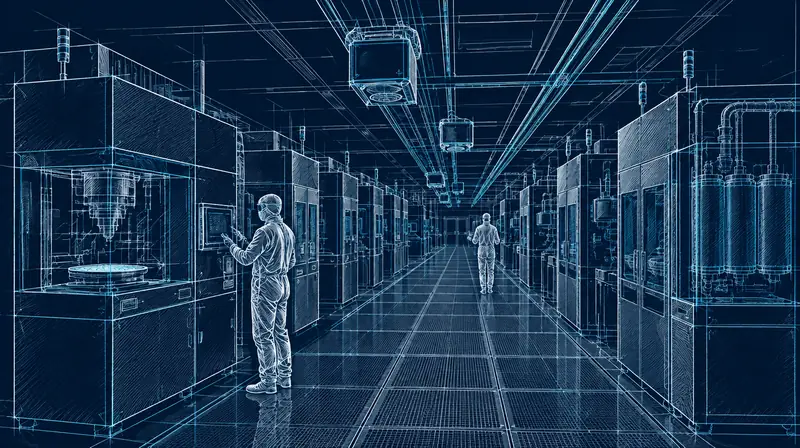
Pull one tray and the accelerator from The Chip comes out: silicon, hafnium, tungsten, cobalt, copper and tantalum, 208 billion transistors at a time. A big AI data centre holds thousands of these racks.
SiCuHfWCoTaGaNiSn

Rows upon rows
Then multiply by thousands
A data centre is aisle after aisle of racks. This is NASA's Pleiades supercomputer in 2008, long before the AI boom. Today's AI racks pack far more chips and power into the same floor space, which is why they need liquid cooling.
The power bill
415 TWhused by the world's data centres in 2024, about 1.5% of all electricity
945 TWhby 2030 in the IEA's base case: slightly more than Japan uses today
International Energy Agency, Energy and AI (2025).1
The transformer wait
Copper and steel, in oil
Every new hall needs transformers: a core of thin silicon-steel sheets, copper windings wrapped round it, the whole thing sitting in oil. Wood Mackenzie says power transformer prices have risen 77% since 2019, and some high-voltage units now take years to arrive, up from about one in 2020 and 2021.5
Metal for the minds
The IEA's first estimate of data centres' mineral needs: by 2030 they could use more than a tenth of today's world gallium supply, for chips and power electronics, and China refines about 99% of it. Copper, aluminium, silicon and rare earths are on the same list.1

Where the minds live
1 · Made in Taiwan
Nvidia's Blackwell chips are made by TSMC in Taiwan.4 Almost every AI lab's computing starts in the same few fabs.
2 · Project Rainier, Indiana
Amazon's campus at New Carlisle runs nearly 500,000 of its Trainium2 chips for Anthropic's Claude, and is planned to draw up to 2.2 gigawatts when finished.7
3 · Hyperion, Louisiana
Meta's campus in Richland Parish is planned at 5 gigawatts, with more than $50 billion of investment.9
4 · Stargate, Texas
OpenAI announced Stargate in January 2025 with SoftBank, Oracle and MGX: up to $500 billion of AI infrastructure in the US, with its first site at Abilene, Texas.10
5 · Anthropic
In October 2025 Anthropic agreed to use up to one million Google TPUs, well over a gigawatt of capacity in 2026.6 A month later it announced $50 billion for its own data centres in Texas and New York, built with Fluidstack.8
6 · Hangzhou
DeepSeek and Alibaba's Qwen team publish open-weight models that anyone can download and run.11,12 They are trained on the same kinds of chips, under export rules that limit which ones they can buy.
7 · Gallium
China refined 99% of the world's primary gallium in 2025.15 Data centres could need more than a tenth of today's supply by 2030.1
8 · Copper
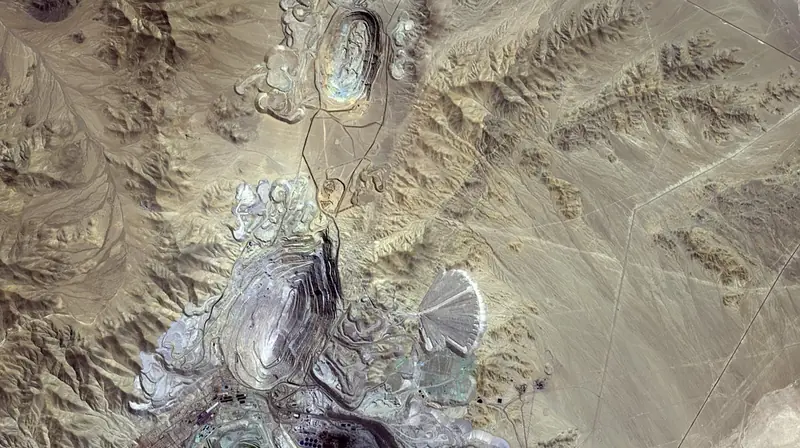
The wiring, cold plates, busbars, cables and transformers are copper. Chile mined 23% of it in 2025, DR Congo 14%.19
9 · A Japan of power
The IEA's base case for data centres in 2030, about 945 TWh, is slightly more than all the electricity Japan uses today.1
The two-way chokepoint
Chips one way, minerals the other
The US and its allies make the most advanced AI chips and the machines that print them. China refines most of the gallium, germanium, graphite and rare earths those industries need. Since 2022 each side has put rules on what the other can buy.
October 2022
The US requires licences to sell China the most advanced AI chips and the tools to make them.13
August 2023
China puts gallium and germanium exports under licence.15
October 2023
The US closes the gap that let Nvidia sell slower versions of its chips, the A800 and H800, to China.14 DeepSeek's V3 had been trained on H800s.
December 2023
China requires licences for exports of battery-grade graphite.16
December 2024 → November 2025
China bans gallium, germanium and antimony exports to the US;17 in November 2025 it suspends that ban until 27 November 2026, with licences still required.18
Most of these rules are licences, not outright bans, so each gate in the model holds back part of the flow, not all of it.
Counting chips
2,048
DeepSeek says it trained its V3 model on 2,048 Nvidia H800s. It put the final training run at about 2.8 million GPU hours, or about $5.6 million at rental prices, a figure that leaves out earlier research and experiments.11 One cube is one chip.
Project Rainier
~500,000
Trainium2 chips running Anthropic's Claude in Indiana, according to Amazon.7 Each dot is 4 chips.
And more coming
1,000,000
Google TPUs in Anthropic's October 2025 agreement: "up to" a million.6 Whether two thousand or a million, every one of them is silicon from the same few refineries, wired, cooled and powered through copper.
Why "critical"
The metals every AI lab shares
The labs compete on models; underneath, they buy from the same fabs and the same mineral supply chains.
Next in the series: The Battery, the minerals inside every lithium-ion cell. Before this: The Chip.
Sources
Shares of world output are from USGS Mineral Commodity Summaries 2026 via our minerals data; other figures are cited where they appear. Company figures are what the companies or reputable outlets have published; they are not rankings. The 3D models are illustrations, not engineering drawings. Photos: NASA, public domain.
- IEA: Energy and AI, executive summary (April 2025)
- Nvidia: Blackwell, born for extreme-scale AI inference (NVLink spine, 5,000+ copper cables)
- Nvidia: GB200 NVL72 designs contributed to the Open Compute Project (October 2024)
- Nvidia: Blackwell platform, 208 billion transistors, TSMC 4NP (March 2024)
- Reuters: US power companies scramble to secure equipment as data centre demand strains supplies (July 2026, Wood Mackenzie figures)
- Anthropic: expanding our use of Google Cloud TPUs and services (October 2025)
- DCD: AWS activates Project Rainier cluster of nearly 500,000 Trainium2 chips (October 2025)
- Anthropic: investing $50 billion in American AI infrastructure (November 2025)
- DCD: Meta expands Richland Parish campus to 5 GW, will invest $50bn (July 2026)
- OpenAI: announcing the Stargate Project (January 2025)
- DeepSeek-AI: DeepSeek-V3 technical report (December 2024)
- Qwen (Alibaba): open-weight model releases
- US Bureau of Industry and Security: export controls on advanced computing and semiconductor manufacturing items (October 2022 and updates)
- A&O Shearman: US clarifies and strengthens restrictions on semiconductor exports to China (October 2023 rules)
- USGS Mineral Commodity Summaries 2026: gallium
- IEA policy database: China's export control measures for graphite items (from 1 December 2023)
- Mining.com: China bans export of gallium, germanium and antimony to the US (December 2024)
- Fastmarkets: China suspends export prohibition to the US (November 2025)
- USGS Mineral Commodity Summaries 2026 (copper, aluminium, rare earths, tantalum)
Keep exploring
Read next
 The world runs on rockThe ChipThe minerals inside every computer chip
 Current eventsSpaceXThe metals behind Starship and Starlink

 The world runs on rockThe GridCopper, the metal of electricity
All mining storiesThe world runs on rockAll mineralsMining by country
Cover photos from Wikimedia Commons: Chuquicamata from the ISS by Alexander Gerst (ESA), CC BY-SA 2.0.