
The world runs on rock · Story 1 of 12
The Chip a grain of sand that thinks
Every phone, car, satellite and AI model runs on chips. Each one is built from more than a dozen minerals, refined in a handful of places and assembled in fewer still. When one link breaks, factories on the other side of the world stop.
Scroll to take one apart
Take it apart
A stack of rocks, refined
This is a model of a modern AI accelerator: two silicon dies side by side, with eight stacks of memory around them, on a silicon bridge, on a package. Nvidia's Blackwell is built this way, and carries 208 billion transistors across its two dies, made by TSMC.1
Layer by layer
- Lid copper, plated with nickel, pulls the heat away
- Dies silicon, cut from a single crystal
- Memory eight dies stacked like a deck of cards, wired through with copper
- Interposer a slab of silicon wiring the dies to their memory
- Substrate copper traces in resin
- Solder balls tin, silver and copper
Now open one die
A city in eleven floors
Inside a die, billions of transistors sit on the silicon. Above them, tungsten and cobalt plugs reach up to layer upon layer of copper wiring. Each copper wire is lined with tantalum, because copper left touching silicon would seep in and ruin the transistors.5,6
Where copper gives up
At the finest layers the wires are only a few dozen atoms wide, and copper's liner takes up too much of the room. Intel moved its two finest wiring layers to cobalt, and GlobalFoundries described a switch from tungsten to cobalt at 7 nanometres.5
SiHfWCoCuTaSnAgNi

Where it starts
Under a mountain in North Carolina
The crucibles that hold molten silicon while chip crystals are grown are made from ultra-pure quartz. Much of it comes from mines around Spruce Pine, North Carolina, run by Sibelco and The Quartz Corp. In September 2024 Hurricane Helene shut both, with no date to reopen.10
Quartz
Silicon, chained to oxygen
Quartz is silicon dioxide: every silicon atom held by four oxygens. Silicon is the second most common element in Earth's crust, but it never occurs on its own.
Break the bond
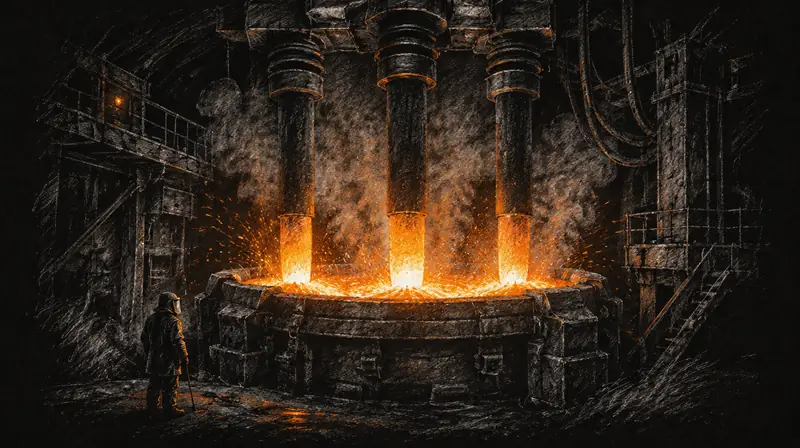
In an arc furnace, quartz is melted with carbon at around 2,000 °C. The carbon takes the oxygen away as gas, leaving liquid silicon metal. China accounted for almost 80% of the world's silicon materials in 2025.9
Eleven nines
99.999999999%
Chip-grade polysilicon must be at least this pure.2 That's one stray atom for every hundred billion silicon atoms: one second out of 3,000 years.
The crystal
The same pattern as a diamond
Freed of oxygen, each silicon atom bonds to four other silicon atoms in a tetrahedron: the diamond-cubic crystal, 0.543 nanometres from corner to corner. Grown from the melt as one giant crystal, it is sliced into the wafers every chip is printed on.
How it works
A switch, billions of times over
A transistor is a switch with no moving parts. Put a voltage on the gate and a channel opens in the silicon fin; electrons flow from source to drain. Take it away and the flow stops. Every photo, search and AI answer is built from these on-and-off decisions.
The hafnium trick
By the mid-2000s the insulating layer under the gate was so thin that current leaked straight through it. In 2007 Intel replaced it with a hafnium-based material and a metal gate, which it said cut gate leakage more than tenfold.3,4 Hafnium is recovered almost entirely as a by-product of refining zirconium.
Wired up
Tungsten or cobalt contacts carry the signal up from each transistor to its first copper wire. On a big AI chip this happens more than a hundred billion times, on a slab of silicon about the size of a postage stamp.
Beyond silicon
Gallium meets nitrogen
Grown layer by layer from gallium and nitrogen gases, gallium nitride forms a hard hexagonal crystal that switches power faster and runs hotter than silicon can. It's in compact fast chargers, 5G base stations and modern radar; its cousin gallium arsenide handles radio signals.7
One country
99%
China's share of the world's primary gallium in 2025.7 Gallium is a by-product of turning bauxite into alumina; refineries elsewhere could recover it, but most of that capacity sits idle.
And germanium
Gallium's neighbour on the periodic table, germanium, goes into fibre optics, infrared lenses and space solar cells. China is the leading producer and exporter of germanium metal.8
Follow the supply
1 · Quartz
High-purity quartz from Spruce Pine is refined and shipped to crucible makers, mostly in Asia.10
2 · Silicon metal
Smelted mostly in China, which accounted for almost 80% of the world's silicon materials in 2025.9
3 · Gallium and germanium
Refined almost entirely in China: 99% of primary gallium.7
4 · Tantalum
Mined mostly in Central Africa: DR Congo 52%, Rwanda 16% and Nigeria 16% of 2025 output.9
5 · Tungsten
China mined 79% of the world's tungsten in 2025.9
6 · Neon
The lasers that print chips need ultra-pure neon. Before 2022, two Ukrainian firms, Ingas in Mariupol and Cryoin in Odesa, supplied an estimated 45 to 54% of the world's chip-grade neon.11
7 · Wafers and machines
Wafers are grown and polished by a few specialist makers, several of them in Japan. The lithography machines that print the finest features come from ASML in the Netherlands.
8 · The fabs
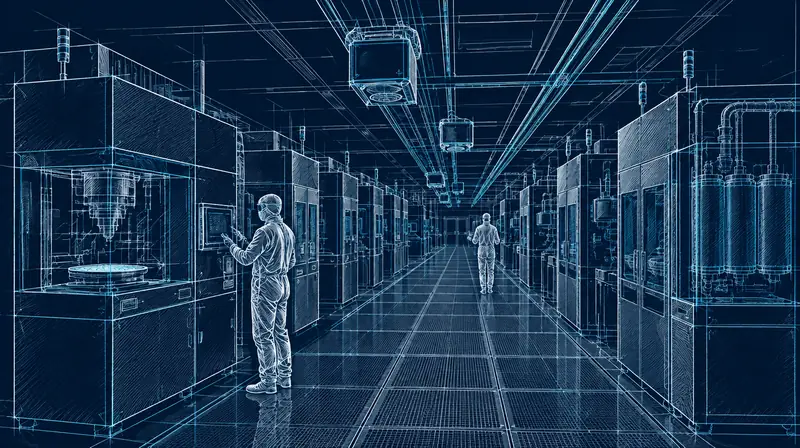
Everything converges on a few fabs. In 2019, about 92% of the world's capacity for the most advanced logic chips, below 10 nanometres, was in Taiwan.12
9 · Out to everything
Finished chips are tested and packaged, mostly in Asia, then fly out to the factories that make phones, cars, servers and fridges.

When it breaks
2021: the year the chips ran out
When the pandemic hit, carmakers cut their chip orders while demand for laptops and consoles soared. When car buyers came back, the fabs were full. Factories built cars and parked them, unfinished, waiting for a few dollars of chips.
The cost
$210bnrevenue the world's carmakers were forecast to lose in 2021
7.7mvehicles not built
AlixPartners forecast, September 2021.13
19 March 2021
A fire in the clean room of Renesas's Naka fab in Japan, a major maker of car microcontrollers, cut supply further. TrendForce estimated three months before it was back to full output.14
Then the minerals
- Feb 2022Russia invades Ukraine; Cryoin and Ingas halt neon production.11
- Aug 2023China puts gallium and germanium exports under licence.7
- Sep 2024Hurricane Helene shuts the Spruce Pine quartz plants.10
- Dec 2024China bans gallium, germanium and antimony exports to the US.15
- Nov 2025China suspends that ban until 27 Nov 2026; licences still apply.16
Why "critical"
Small amounts, no substitutes, few suppliers
Governments call a mineral critical when the economy or defence depends on it and supply could be cut. Nearly every element in a chip is on someone's list.
Next in the series: The Mind, how AI runs on metal and power. See also the critical minerals lists and the periodic table.
Sources
Shares of world output are from USGS Mineral Commodity Summaries 2026 via our minerals data; other figures are cited where they appear. The 3D models are illustrations, not engineering drawings; the pencil illustrations are AI-generated and show no specific site.
- Nvidia: Blackwell platform, 208 billion transistors, TSMC 4NP (March 2024)
- Semiconductor Industry Association: comments on polysilicon, 11 nines purity (2025)
- Intel: first high-volume 45 nm factory, hafnium-based high-k metal gates (October 2007)
- IEEE Spectrum: Intel's 45-nanometer Penryn processors arrive
- IEEE Spectrum: cobalt could untangle chips' wiring problems
- Annual Review of Materials Science: diffusion barriers for copper wiring (2000)
- USGS Mineral Commodity Summaries 2026: gallium
- USGS Mineral Commodity Summaries 2026: germanium
- USGS Mineral Commodity Summaries 2026 (silicon, tantalum, tungsten, cobalt, copper, tin)
- AP: North Carolina town that produces quartz needed for tech products is devastated by Helene (October 2024)
- Reuters via Euronews: Russia's attack on Ukraine halts half of world's neon output for chips (March 2022)
- SIA and BCG: Strengthening the global semiconductor supply chain in an uncertain era (April 2021, 2019 data)
- AlixPartners: shortages to cost the auto industry $210 billion in 2021 (September 2021)
- TrendForce: fire at the Renesas Naka fab (March 2021)
- Mining.com: China bans export of gallium, germanium and antimony to the US (December 2024)
- Fastmarkets: China suspends export prohibition to the US (November 2025)
- United Nations: World Population Prospects 2024
- Space.com: how many stars are in the Milky Way (ESA Gaia estimate)
Keep exploring
Read next
 The world runs on rockThe MindThe metal and power behind AI
 The world runs on rockThe SignalThe glass and metal under the sea
 The world runs on rockThe ShieldThe minor metals defence depends on
 The world runs on rockThe MagnetRare earths that turn power into motion
All mining storiesThe world runs on rockAll mineralsMining by country