
The world runs on rock · Story 4 of 12
The Magnet the invisible muscle in every motor
Electric cars, wind turbines, phones, drones and hard drives all turn electricity into motion with small, ferociously strong magnets. Nearly all of them are made of neodymium, iron and boron, and nearly all of them are made in China.
Scroll to open a motor
Take it apart
A motor is a spinning magnet

Charging bays at NASA's Kennedy Space Center, 2022. NASA/Kim Shiflett (public domain).
Open the aluminium case of an electric car's motor and there are two parts: the stator, which stays still, and the rotor, which spins inside it.
The stator
A stack of thin sheets of silicon steel, each a ring with teeth, wound with copper. Current flowing through the coils makes a magnetic field that sweeps round and round.
- Housing aluminium, to carry heat away
- Stator silicon-steel sheets, thin so less energy is lost as heat
- Windings copper
The rotor
Magnets that chase the field
Set into the rotor are blocks of neodymium-iron-boron, the strongest permanent magnets made. They are pulled along by the stator's turning field, and the rotor spins with them. Without them, the motor would need more copper and more power to make the same field.
NdPrFeBDyTbCuAl
How much
The IEA counts about 0.5 kg of rare earths in a typical electric car, and 239 kg in every megawatt of offshore wind, where large turbines often drive their generators straight from the blades with big rings of magnets. An onshore megawatt needs about 14 kg.1

Where it starts
One mine in Inner Mongolia
Bayan Obo, north of Baotou, is an iron mine that also holds the world's largest known rare-earth deposit. NASA described it in 2012 as the site of almost half the world's rare-earth production.2 China as a whole mined 69% of the world's rare earths in 2025.3
Inside the magnet
Millions of tiny magnets, lined up
A sintered magnet is pressed from powder into a block of tiny crystal grains. Each grain is a little magnet of its own. At the factory a strong pulse of field swings them all to point the same way, and the block becomes one magnet.
The crystal
Nd₂Fe₁₄B
Two atoms of neodymium, fourteen of iron and one of boron. Iron carries most of the magnetism; neodymium locks it along one direction so it can't easily be flipped. General Motors and Sumitomo Special Metals developed the material independently in 1984.4
The heat problem
Dysprosium at the edges
Neodymium magnets weaken as they warm, and a car motor runs hot. Adding the heavy rare earths dysprosium and terbium lets special grades work at up to about 200°C.5 Makers now put them where they do most good: along the grain edges.
Follow the supply
1 · Mining
China 69%, the United States 13%, Australia 7.4% and Myanmar 5.6% of 2025 mine output.3 For the rare earths used in magnets, the IEA puts China's share of mining at 60% in 2024.6
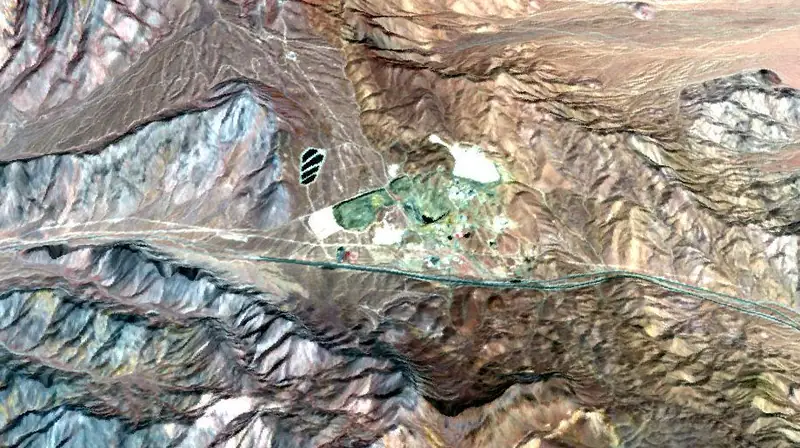
Mountain Pass, California, the United States' rare-earth mine, from NASA's Terra satellite (public domain).
2 · Separating
Rare earths come out of the ground mixed together and are among the hardest elements to separate. China did 91% of the world's refining in 2024.6 Australia's Lynas separates its own ore in Malaysia; most of the rest is separated in China.
3 · Making magnets
In 2005 China made about half the world's sintered permanent magnets. By 2024 its share was 94%.6 From there they ship to motor and car plants everywhere.
4 · The pinch point
One country mines most of the ore, separates almost all of it and makes almost all the magnets. That is why a licence form in Beijing can stop a car plant in Chicago.
September 2010
The first warning
After Japan detained a Chinese trawler captain near disputed islands, Japanese traders reported that rare-earth shipments from China had stopped. Beijing denied any ban, and the captain was released on 24 September.7
2009 to 2011
Prices go vertical
China had been cutting its export quotas. The monthly average price of dysprosium oxide rose from $91 to $2,377 a kilogram between January 2009 and August 2011, about 26 times.8 The line on the left is drawn on a log scale; on an ordinary one it would leave the screen.
Then
Prices fell back as buyers cut their use. The US, the EU and Japan took the quotas to the World Trade Organization, which ruled against them in 2014, and China dropped them.13 But the lesson stuck: whole industries rested on one supplier.
The lines show the size of each reported move, not a full price history.
4 April 2025
Licences for seven rare earths
China began requiring export licences for seven medium and heavy rare earths, among them dysprosium and terbium, and for magnets containing them.9 Shipments slowed while exporters waited for approvals.
May 2025
A car plant stops
Ford idled its Explorer factory in Chicago for a week for lack of rare-earth parts. Its chief executive said supply was "day to day", with licence applications "being approved one at a time".10
October and November 2025
On 9 October China announced wider controls, including on foreign-made products containing Chinese rare earths. After the Trump-Xi meeting it suspended those October measures until 10 November 2026; the April licences still apply.11
- Sep 2010Shipments to Japan reported halted.
- Apr 2025Licences for seven rare earths and magnets.
- Jul 2025The US Defense Department sets a $110/kg price floor for NdPr from Mountain Pass.12
- Nov 2025October's wider rules paused for a year.

Fifty years on
Bigger blades, bigger magnets
NASA and the US government built this 200-kilowatt turbine in the 1970s. Today's offshore turbines are many times larger, and many carry rings of rare-earth magnets in their generators: in the IEA's figures, 239 kg of rare earths per megawatt.1
Why "critical"
Small amounts, no easy substitute
An electric car holds about half a kilogram of rare earths, but nothing else matches their magnets' strength for their size. That puts neodymium, praseodymium, dysprosium and terbium on the critical lists of the US, the EU, Japan and others.
Next in the series: The Rocket, the metals that survive launch. Before this: The Battery, The Mind and The Chip.
Sources
Shares of world output are from USGS Mineral Commodity Summaries 2026 via our minerals data; other figures are cited where they appear. The 3D models are illustrations, not engineering drawings; the price lines show reported moves, not price histories. Photos: NASA, public domain.
- IEA: The Role of Critical Minerals in Clean Energy Transitions (2021), minerals per vehicle and per megawatt
- NASA/JPL: Baiyun Ebo, China (ASTER, 2012)
- USGS Mineral Commodity Summaries 2026: rare earths
- Neodymium magnet: history and composition
- Electronic Design: 4 things you should know about magnets for electric vehicles
- IEA: Rare earth elements, executive summary (mining 60%, refining 91%, magnets 94% in 2024)
- New York Times via CNBC: China is blocking minerals, executives say (September 2010)
- Adamas Intelligence: rare earth export restrictions, price spikes and the risk of demand destruction
- China Briefing: China's rare earth export controls and their impact
- Reuters via Fortune: Ford CEO says rare earth supply is "day to day" after plant halt (June 2025)
- Pillsbury: China suspends export controls on certain critical minerals items (November 2025)
- MP Materials: partnership with the Department of Defense (July 2025)
- WTO: China, measures related to the exportation of rare earths, tungsten and molybdenum (DS431)
Keep exploring
Read next


 The world runs on rockThe MapEvery story on one globe
 Current eventsThe Drone WarMinerals behind the drones
All mining storiesThe world runs on rockAll mineralsMining by country
Pictures: Salar de Atacama, Chile, NASA/METI/AIST/Japan Space Systems, and U.S./Japan ASTER Science Team (Public domain (NASA media, no copyright)); Pangkalpinang. Mijn 3b. Een reeks koelies bezig met het transporteeren van grond, Europeana (Public Domain Mark 1.0).