
In the summer of 1623, two children herding animals near Kongsberg in Norway found silver. State mining began that autumn. Over the next three centuries the mines reached 1,068 m deep and produced about 1,350 t of silver before they closed in 1958.1

In 1883 the Canadian Pacific Railway was being built across northern Ontario. Tom Flanagan, a blacksmith with the construction crew, noticed copper-bearing rock on a hillside near Sudbury. The find led to the Murray Mine and started the Sudbury nickel and copper camp. Vale still runs underground mines there, with reserves expected to last into the 2040s.2,5,6
Twenty years later the railway struck lucky again. In 1903 silver was found at Cobalt, Ontario, during railway building. By 1922 Cobalt had produced 333 million ounces of silver, more than 10,000 t, from 100 mines. Ontario calls it the cradle of Canadian mining.3,4
The money came fast. The first dozen ore deliveries from the La Rose mine at Cobalt earned its owners 480,000 dollars in 1905. By 1911, 34 mines in the camp had produced 30 Moz of silver, and the camp went on to produce about 460 Moz in all.3,7
333 million oz silver
Produced at Cobalt, Ontario, by 1922, after a find made while building a railway4
At Broken Hill in New South Wales, a boundary rider named Charles Rasp found what he thought was tin in 1883. It was silver and lead. His syndicate floated the Broken Hill Mining Company, which grew into BHP.8

Right place, right moment
Goudzoekers in Australië, een Australisch meisje met haar broertje, een zendingspost op Nieuw-Zeeland en een bisschop op een slee, Europeana (Public Domain Mark 1.0)
Some finds were pure chance. The Welcome Stranger, the largest gold nugget ever found, lay just under the soil at the base of a tree in Victoria. It was found in 1869 and weighed about 70 kg.9
Eleven years earlier, twenty-two Cornish miners of the Red Hill Mining Company had found the 68.98 kg Welcome Nugget at Ballarat, about 55 m underground. Geoscience Australia calls it the second largest ever found.9
On 19 October 1872 a mass of reef gold weighing 286 kg came out of Bernhardt Holtermann's Star of Hope mine at Hill End. It is the largest specimen of its kind. Photographers recorded it before it was crushed.10
On 26 January 1905 the manager of the Premier diamond mine in South Africa, Captain Frederick Wells, found a 3,106 carat diamond near the rim of the pit. Named the Cullinan after the company chairman, it is the largest gem diamond ever found. The two largest stones cut from it weigh 530 and 317 carats.11
3,106 carats
The Cullinan diamond, found near the rim of the Premier mine pit in 190511
In Chile, Juan Godoy's silver find at Chañarcillo, dated 16 May 1832, set off a silver rush. The mines worked until 1890.12

Secrets and silences
Kopermijn te Kolwezi in de provincie Shaba (Katanka), Mieremet, Rob / Anefo / Europeana (Public Domain Mark 1.0)
Sometimes the first finder was told to keep quiet. Edward Hargraves is called the pioneer of gold mining in Australia, for the finds of 1851. But the explorer Strzelecki had found gold-bearing quartz in 1839, and the governor asked him to say nothing about it.14,15
In central Africa, the geologist Jules Cornet joined an expedition to Katanga from 1891 to 1893 and found copper at Kambove, Likasi, Kipushi and other sites. King Leopold II made him keep the commercially sensitive findings confidential, and he could only publish his scientific work after a treaty of 1894.13

Following the clues
Folio 171. Medieval mining techniques. Woodcut, 1556., Unknown (Wellcome Collection) (Public Domain Mark 1.0)
Other breaks came to people who were watching closely. George Harrison is credited with finding the main reef of the Witwatersrand on the farm Langlaagte in July 1886. By August the camp had about 3,000 people, and Johannesburg was named on 3 October.16
In 1924 Hans Merensky traced platinum-bearing rock from a stream in the Waterberg district back to its source. There he found the Merensky Reef, a platinum layer about one metre thick across the Bushveld complex.19
In Western Australia, prospectors followed diamonds up Smoke Creek and found the Argyle AK1 pipe in October 1979. Argyle went on to produce more than 865 million carats in 37 years.17,18
In 1952 Lang Hancock was flying over the Hamersley Range when he saw a black outcrop below him. It was iron ore, and it led to the Pilbara iron ore industry once the export ban ended.20
In September 1969 Ken Shirley saw nickel sulphide caps in banded iron formation at Mount Windarra and pegged the ground for Poseidon. The share boom that followed is told in our lesson on booms and busts.21

The find under cover
Escondida Mine, Chile, NASA/GSFC/METI/ERSDAC/JAROS, and U.S./Japan ASTER Science Team (Public domain (NASA media, no copyright))
Modern discoveries rarely start with something seen at the surface. Olympic Dam has no outcrop at all. A magnetic anomaly led explorers to drill there, and in 1975 drill hole RD1 cut 38 m averaging 1.0 per cent copper between 353 and 391 m down.22,24
At Escondida in Chile, the decisive hole was the twenty-third. Drill hole 23 hit rich copper below 300 m of barren cover. Escondida became the largest copper mine in the world. A team that had given up after hole 22 would have walked away from the largest copper mine in the world. Our guide to exploration drilling explains how drill programmes are planned, and our page on drill core shows what comes out of the hole.23
At Kambalda, gossans, the iron-stained caps of weathered rock that can sit over sulphide ore, had been sampled in 1954. Western Mining Corporation was told in 1964 that there was nickel in the rocks. The drill found the first large nickel deposit on 28 January 1966.25,26,27

Near misses and second chances
Earth observation taken by the Expedition 11 crew, NASA JSC (Public domain (NASA media, no copyright))
Luck can be delayed. Jean Jacques Dozy described the Ertsberg copper outcrop in Indonesia on a 1936 expedition. His report lay unnoticed until 1959. Only then did Freeport's Forbes Wilson read it and set out on the trek in 1960.28
Luck can be refused. In 1874 Thomas Walsh turned down half of a Deadwood prospect that later became the Homestake mine.32
A bad break can start a career. In 1978 Robert Friedland inspected a gold mine held in partnership with Steve Jobs and found only pyrite. It sparked his interest in mining. His later companies were behind the Voisey's Bay nickel find in Canada and the Kamoa copper find in the Congo in 2009.33
And a lifetime of effort can still miss. Daniel Barringer, made wealthy by mining, became convinced that the great crater in Arizona was made by a meteorite. His company drilled seven shafts in its floor from 1903 to 1908 and found no buried iron. Scientists did not accept his idea in his lifetime. Proof of the impact came in 1960.30
Luck is not always rewarded fairly. Ignace Tonene, a Temagami Ojibwa chief, began prospecting in his sixties after the Cobalt silver find. He was credited with finding the ore body behind the Kerr-Addison gold mine. One of his claims was jumped, and Indian Affairs could not secure redress.31
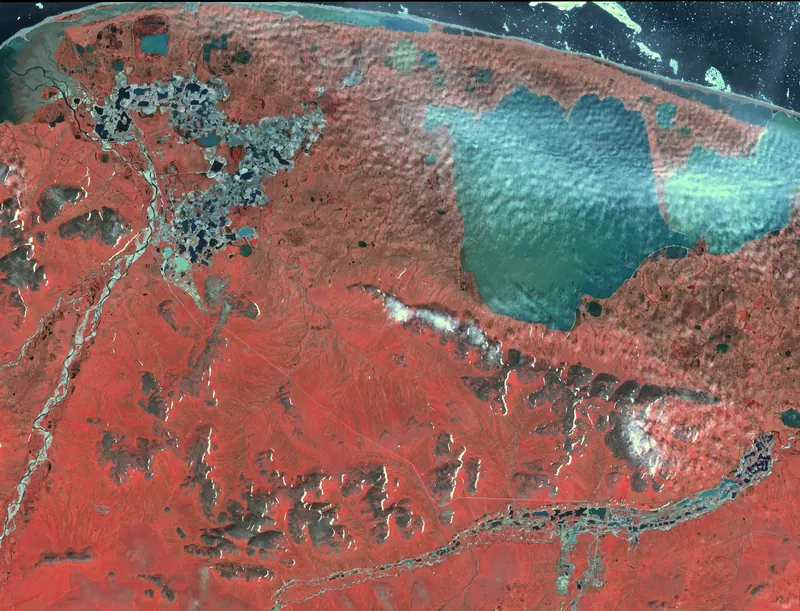
What the lucky breaks have in common
Gold Mining, Siberia, NASA/METI/AIST/Japan Space Systems, and U.S./Japan ASTER Science Team (Public domain (NASA media, no copyright))
Read together, these stories share a few features. Many finds came when people were already on the ground for another reason, building a railway, herding animals or riding a boundary. The modern ones came from persistence, not chance: the twenty-third hole, the report read twenty years late, the gossans sampled twelve years before the drill hit. And luck did not decide who profited, as our lesson on mining fortunes shows.
- Kongsberg silver mines1623
- Copper Cliff Mine (Sudbury)1886
- Cobalt silver camp1903
- Argyle diamond mine
- Olympic Dam1988
- Escondida1990
- Grasberg minerals district1972
- Kambalda nickel1967
- Welcome Stranger nugget found1869
- Holtermann reef gold specimen unearthed1872
- Copper-bearing rock found during Canadian Pacific Railway works at Sudbury1883
- Charles Rasp finds the Broken Hill orebody1883
- Gold found on the Witwatersrand1886
- Cullinan diamond found1905
- Lang Hancock spots iron ore in the Hamersley Range1952
- Chanarcillo silver is discovered
The find about 50 km south of Copiapo drew thousands of adventurers and made fortunes.34,35,36
- Urmeneta finds the Tamaya copper deposit
Tamaya lifted Chilean copper output sharply in the following decades.35
- Comstock Lode strikes
The Comstock set the pattern for the Western mining boom town. By the mid-1870s the lode was seen as played out.37,38,39
- Welcome Stranger nugget found
- Big Hole at Kimberley: inception
Big Hole at Kimberley: inception.41
- Mount Morgan gold mining begins
The site is now a major abandoned mine remediation project.42,43
- Copper-bearing rock found during Canadian Pacific Railway works at Sudbury
- Gold found on the Witwatersrand
It created the largest gold field known and Johannesburg.16,45
- Tin mining starts at Greenbushes
- Peak year for US coal mining deaths
The figure shows the scale of the safety problem before federal regulation.49,50
- Mir kimberlite pipe found in Yakutia
The journal calls Mir one of the largest and best known diamond deposits in Russia and the world.51,52
- De Beers finds the Orapa kimberlite
Orapa was the first mine opened by the company, ahead of Letlhakane (1977) and Jwaneng (1982).53,54
- Kimberlite pipes found at Jwaneng
- Argyle diamond pipe AK1 found
It became the world's largest diamond producer by volume.17,18,56
Next in this series: the gold rush and the lithium rush compared.57


