
Deposit types/Copper, Molybdenum, Gold
Porphyry copper
Copper sulphide in many fine veinlets and scattered grains through a large body of altered porphyry rock and the rock around it.
What it is
Copper sulphide in many fine veinlets and scattered grains through a large body of altered porphyry rock and the rock around it.1,2
How it forms
High-level porphyry intrusions with dykes and breccia pipes form during arc volcanism. Chalcopyrite is carried in stockwork veinlets. Alteration runs in zones from sodic-calcic and potassic at the core through phyllic and argillic to propylitic at the edge. Weathering can leach copper from the top and re-deposit it near the water table as chalcocite.1,2
Host rocks
Tonalite to monzogranite or syenite porphyry cutting granitic, volcanic and carbonate rocks.1,2
Where it forms
Rift zones during volcanism along convergent plate boundaries (Andean or island-arc), later uplifted and eroded.1,2
How old
How geologists look for it
Alteration zoning (potassic core to propylitic edge), copper-molybdenum-gold geochemistry in the centre with lead, zinc and arsenic outside, and leached outcrops stained by iron oxide.1,2
Mines of this type
- Bingham Canyon1903
- Chuquicamata1915
- Escondida1990
- El Teniente1905
- Morenci1939
- Bagdad1945
- Sierrita1959
- Cuajone1976
- Toquepala1960
- Cerro Verde
- Las Bambas2016
- Oyu Tolgoi2011
- Panguna mine1972
- Ok Tedi mine
- Grasberg minerals district1972
- Safford
- Collahuasi
- El Abra1996
- Tyrone1967
- Cadia
Story cards
Where next
Sources
From the Prospector Trails mining history dataset: each fact links to the source it was checked against. Figures are as the source gives them, in the money of their day. Not investment advice.
Keep exploring
Stories with these minerals


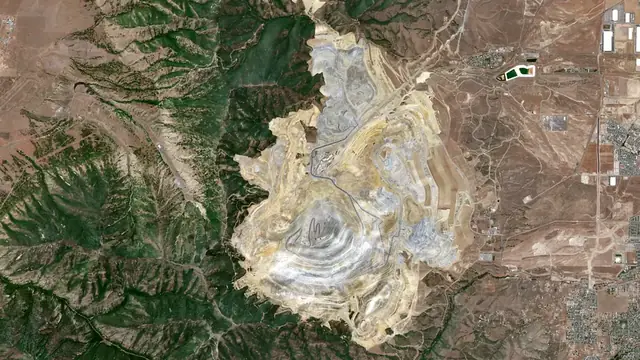 Time machineBingham Canyon from spaceMined since 1903 and still widening.

All mining storiesThe world runs on rockAll mineralsMining by country
Cover photos from Wikimedia Commons: Haul trucks by Lechhabmed, CC BY-SA 4.0. Pictures: Falu gruva, Lundberg, Bengt A / Europeana (CC0 1.0); Escondida Mine, Chile, NASA/GSFC/METI/ERSDAC/JAROS, and U.S./Japan ASTER Science Team (Public domain (NASA media, no copyright)).